REVIEW · WROCLAW
Wrocław: Historical Tour with Tablets and Guide
Book on GetYourGuide →Operated by PDW Sp. z o.o. · Bookable on GetYourGuide
Time travel in Wrocław starts on your sidewalk. I like that you’re given a tablet with a built-in time-travel experience and a live guide who ties the visuals to real places around the center.
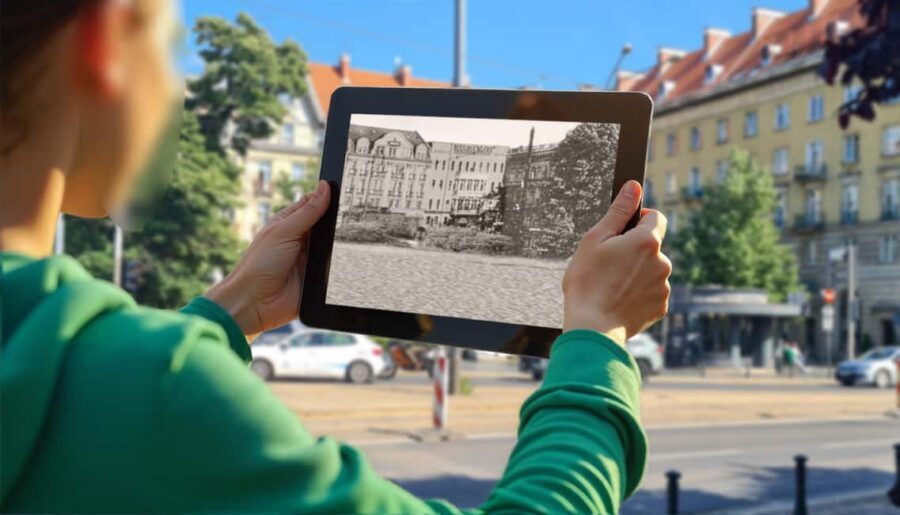
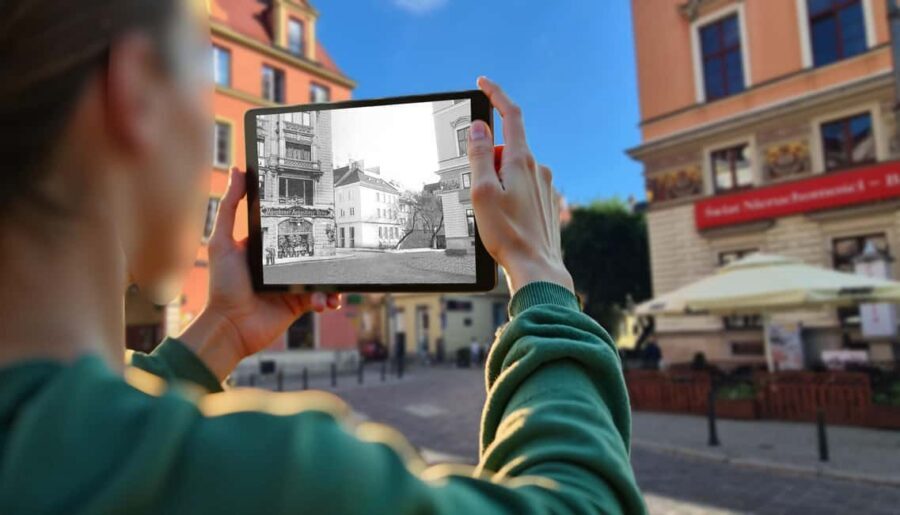
I also love the simple before-and-after effect. At each stop, you activate the feature on the tablet and get historic photos, videos, or even spherical views that help you picture how the streets looked about a century ago.
One thing to plan for: it’s a walking tour. If your feet get sore easily, or if weather turns extreme, you’ll need to stay flexible since the operator may cancel or reschedule.
In This Review
- Quick highlights you’ll feel right away
- Why this Wrocław time-travel format actually works
- The 2-hour walk: pacing, comfort, and what to expect
- Starting at Pręgierz and setting the “then vs now” mindset
- Iron Gate Passage and the northern Market Square: stories you can see
- Plac Solny (Salt Square): where the tablet comparison becomes personal
- Plac Wolności and Muzealny Square: understanding change without getting lost
- Tadeusza Kościuszki Square and Świdnicka Street: the city starts to feel like a timeline
- Wrocław Opera: where the guide’s context helps the visuals click
- Ending at Hotel Monopol: your final viewpoint and next steps
- Price and value: what $26 buys you
- Who should book this tour (and who might skip)
- Weather, timing, and simple prep tips
- Should you book the Wrocław Historical Tour with Tablets and Guide?
- FAQ
- How long is the Wrocław historical tour with tablets?
- How much does the tour cost?
- Where does the tour start and where does it end?
- How many stops are included?
- Do I need to download an app or create an account?
- How does the time-travel feature work on the tablet?
- What languages are the guides available in?
- Is the tour wheelchair accessible?
- What happens in bad weather?
- Is free cancellation available?
Quick highlights you’ll feel right away
- Tablet time travel at 10 key sites with historic visuals on demand
- No app download or login needed; everything is preinstalled
- Guide-led route that connects each location to what you’re seeing
- Multiple language options including Polish, English, German (Spanish also listed)
- Wheelchair accessible and available as private or small groups
- End point at Hotel Monopol so you finish in a great central spot for onward exploring
Why this Wrocław time-travel format actually works
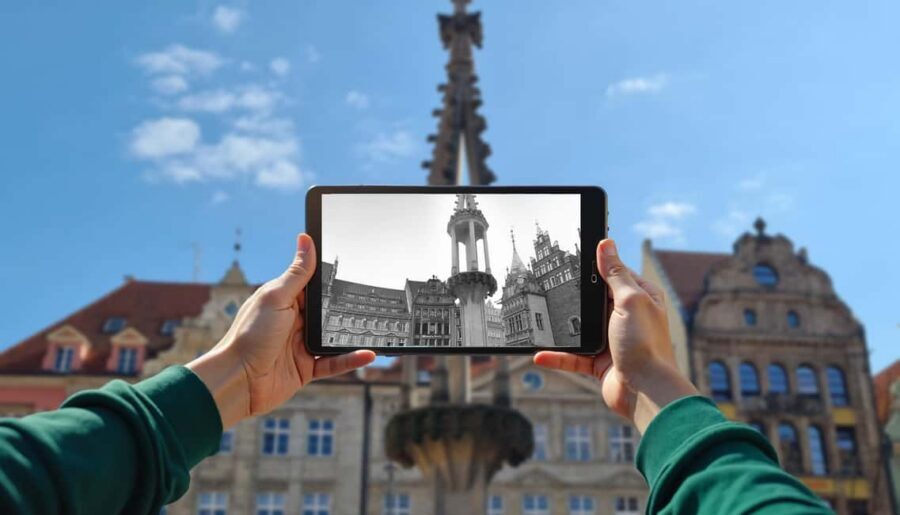
This tour is built around one smart idea: you don’t just hear about old Wrocław, you compare it on the spot. The tablet shows early-20th-century scenes, and the guide’s stories help you understand what you’re looking at.
The “how” is part of the fun. You activate a time travel feature at each location, and the experience is designed so you can trigger the historic view simply by turning around. That makes it easier to follow, even if you’re not a big tech person.
I also like the practicality: you don’t need to download an app or log in. It’s grab-and-go, which matters on a short, 2-hour walking tour.
And in a city like Wrocław, where the skyline and street rhythm have changed, the value is that the tablet doesn’t ask you to guess. It gives you something visual, then your guide explains the why.
You can also read our reviews of more guided tours in Wroclaw



The 2-hour walk: pacing, comfort, and what to expect
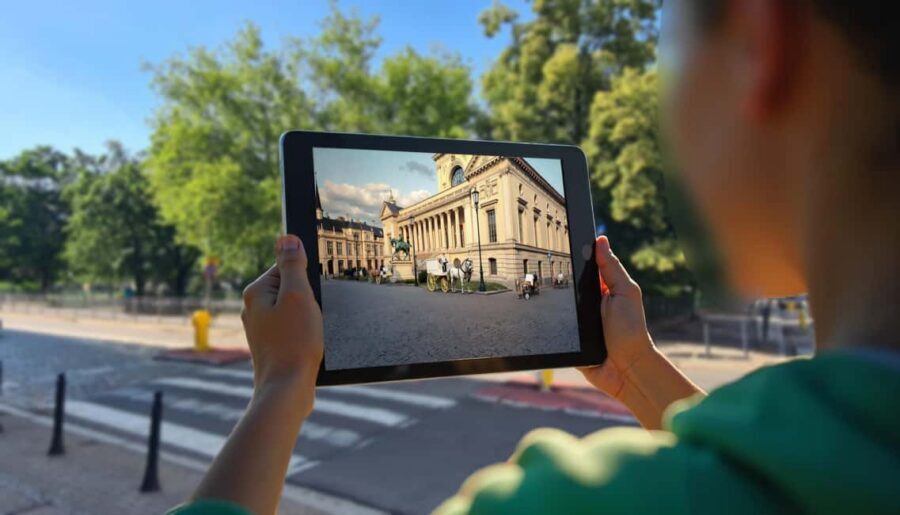
You’ll cover 10 locations in about 2 hours, so expect a steady rhythm of short stops and walking between them. That’s a good pace for first-time visitors, but it can feel brisk if you’re carrying bags or have limited mobility.
Comfort tip: wear comfortable shoes. The tour is walking-focused, and the best part of the experience happens when you’re positioned correctly to view the scene on the tablet.
On the tablet side, you might need a small manual tweak to match what you see on screen with what’s around you. One practical example from a guide-led group: people found the tablet’s alignment sometimes needed minor adjustment, but it was quick and easy to do.
Finally, if you’re booking this as a pair or a small group, you’ll usually get more time with the guide between stops. That helps if you want clarification before you move on.
Starting at Pręgierz and setting the “then vs now” mindset
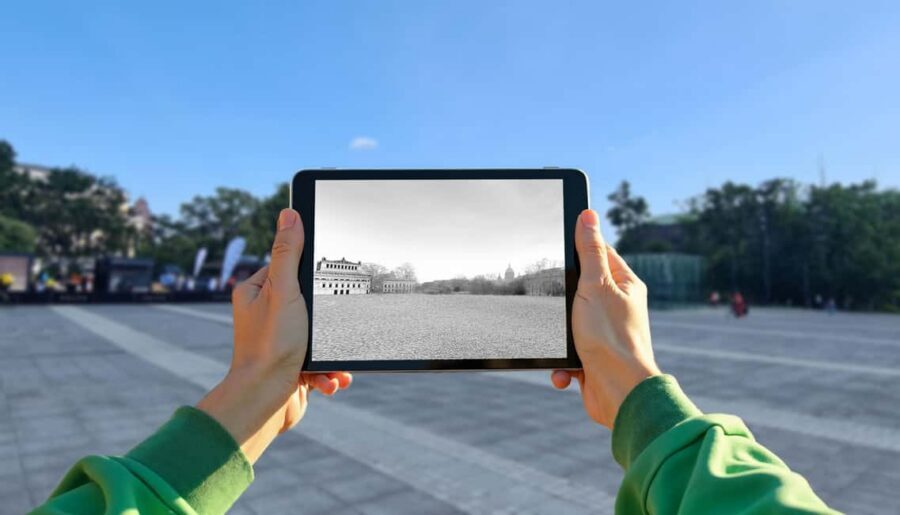
The tour begins at Pręgierz, the Pillory. It’s a strong opening choice because it anchors you in the Market Square area, where you can constantly “read” the city around you.
What makes the start work is the psychological switch. Once you activate the tablet at your first historic point, you stop thinking of old Wrocław as distant. It becomes a street-level comparison you can keep making with each next stop.
You’ll also learn how the guide frames the changes. Instead of treating the past as separate from today, the stories help you connect the dots between what the tablet shows and what the street looks like now.
Iron Gate Passage and the northern Market Square: stories you can see
Next you move through the Iron Gate Passage and onto the northern side of the Market Square. This section is where the guide’s storytelling really earns its place.
The tablet does the heavy lifting for the visuals, but the guide does the heavy lifting for meaning. As you walk, the historic scenes give you a sense of how the surrounding space was used and experienced, while the narration helps you understand why those changes matter.
If you like street-level history, this middle stretch is satisfying because it’s dense with recognizable landmarks. You’re not trudging through random blocks; you’re staying in the parts of town where memory and architecture collide.
Plac Solny (Salt Square): where the tablet comparison becomes personal
At Plac Solny, the tour shifts into a more intimate “spot and compare” mode. The tablet’s historic view encourages you to look up, around, and back down at the street, instead of only listening.
Here’s the practical benefit: you start noticing how small changes in building edges, street orientation, or general surroundings can alter the vibe of a place. The guide’s commentary helps you connect those shifts to Wrocław’s story over time.
A small drawback to keep in mind: because the tablet experience depends on your position, you’ll want to stand where the guide indicates. If you wander too far during activation, the overlay may not line up as well.
You can also read our reviews of more historical tours in Wroclaw




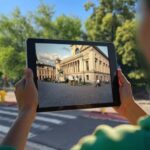
Plac Wolności and Muzealny Square: understanding change without getting lost
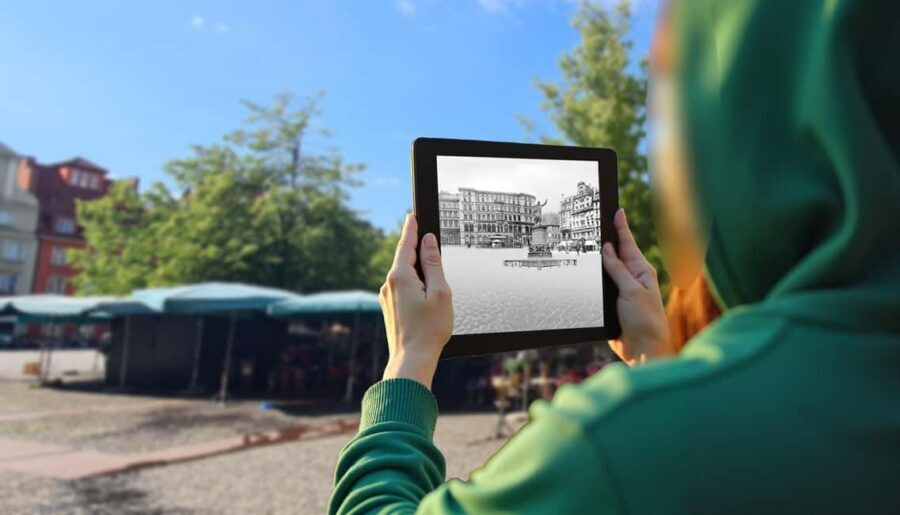
Moving on to Plac Wolności and then plac Muzealny, you’ll feel the tour broaden from one “famous square” to a wider view of the city core. This is where the 10-stop structure helps most.
Each activation is a chance to re-center. You’re not just collecting facts; you’re repeatedly testing what you think you see with what the tablet shows you.
The guide’s pacing matters here. The best guided segments keep momentum while still giving you time to look at the tablet’s images and then listen to how the area has evolved.
If you’re the type who likes to ask questions, this is a good stretch to do it. The tour is short, so interactive moments usually get handled between stops.
Tadeusza Kościuszki Square and Świdnicka Street: the city starts to feel like a timeline
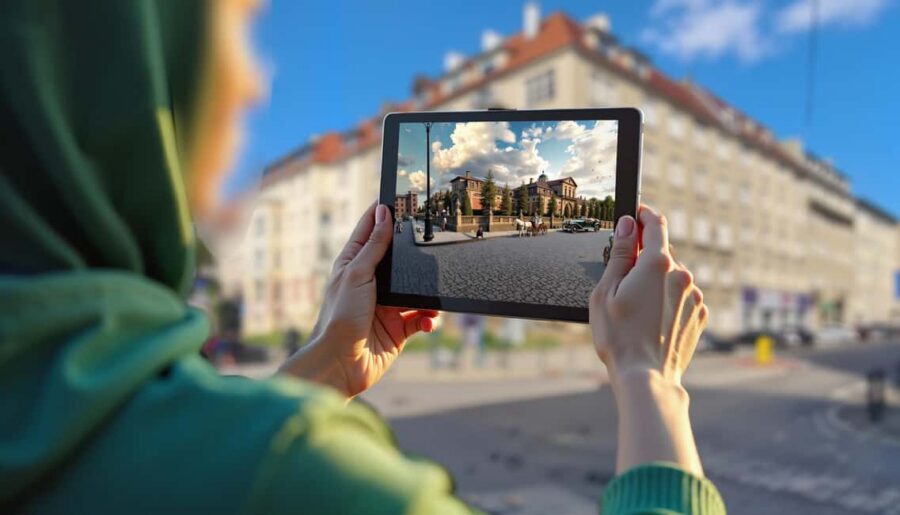
At Tadeusza Kościuszki Square, the tour keeps its “then vs now” rhythm. You’re still getting historic visuals, but the area also helps you understand how Wrocław’s center functions as a connected whole, not just a chain of separate sights.
Then comes Świdnicka Street, which is a big deal because it lets you see continuity and change along a longer stretch. Even if the tablet shows you a single historic moment, the act of walking the street makes it easier to imagine how people would have moved through it.
This is also a good point to slow down mentally. When the tablet shows early scenes, you’ll get more out of it if you take one extra second to look around beyond the screen, then turn back to the view you’re comparing.
Wrocław Opera: where the guide’s context helps the visuals click
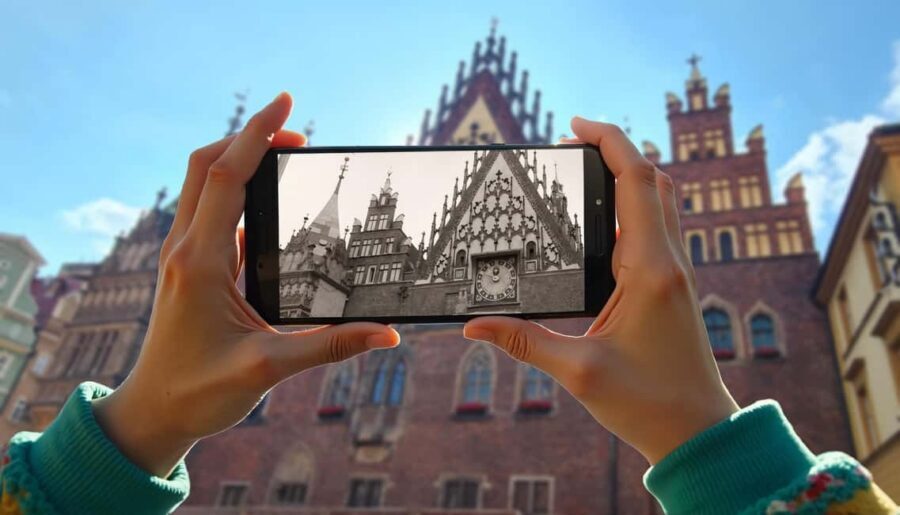
At the Wrocław Opera stop, the tablet experience becomes more meaningful if you can connect the architecture to what you’re seeing on screen. The guide’s job is to provide that connection, and this is one of the highlights of the whole tour format.
A nice detail from real tour operations: the team often helps with the tablet technique. One group described a guide named Dagmara, with her husband assisting with tablet setup and tech help. That kind of support matters because it keeps the magic from turning into fiddling.
If you prefer a guided pace, you’ll appreciate that the tour doesn’t force you to figure everything out alone. The guide stays focused on the story, while the tablet experience stays straightforward.
Ending at Hotel Monopol: your final viewpoint and next steps
The tour finishes at Hotel Monopol. Ending here is practical because it puts you in a central, easy-to-navigate spot for the rest of your day.
One useful tip if you’re planning your schedule afterward: this final area can give you good views once the walk ends. For some groups, the experience continued independently for a little extra panoramic looking time.
If you still have energy, pair this tour with a longer sit-down meal nearby. The tour is only 2 hours, but the tablet comparisons tend to stick. After you’ve seen the city in both time layers, it’s easier to appreciate what’s happening around you without feeling rushed.
Price and value: what $26 buys you
At about $26 per person for a 2-hour walking experience, you’re paying for three things at once: a professional guide, a rental tablet, and the preinstalled time-travel content.
If you’d try to recreate this with a self-guided map, you’d likely spend time figuring out routes and then hunting for historic references separately. Here, the tablet content is built in and activated at each stop, so you get a structured comparison without extra searching.
This is also good value for what you actually do during the tour. It’s not just watching a slideshow while standing in one place. You’re walking, looking, and comparing ten different locations with guidance that keeps everything connected.
Where the price is most worth it: if you like details, enjoy city-center landmarks, and want to see how Wrocław’s look has shifted over time.
Who should book this tour (and who might skip)
I’d recommend this tour if you like guided walking plus visual comparisons. If you’ve visited a new city before and found “history tours” too lecture-heavy, the tablet format gives you an on-the-ground way to understand the story.
It’s also a strong fit if you want your visit to feel efficient. In just 2 hours, you cover 10 points in a tight center area, and each one is supported by a historic view trigger.
Who might skip it? If you strongly dislike walking, or if you only want one long stop rather than multiple short ones, this style may feel too “move and activate” for your taste. And remember the weather note: the tour runs in all weather, but extreme conditions can lead to cancellation or rescheduling.
Weather, timing, and simple prep tips
This tour is designed to run in all weather, but you should dress for the conditions. If the day turns extreme, the organizer reserves the right to cancel or reschedule, and you’ll be told in advance.
Your best prep is plain: comfortable shoes, weather-appropriate layers, and a bit of patience while you get used to how the tablet view lines up with your surroundings.
Also, go in with the right mindset: you’ll get the most if you treat each stop like a comparison moment. Look, activate, glance around, then listen.
Should you book the Wrocław Historical Tour with Tablets and Guide?
If you want Wrocław’s past with less guessing and more on-the-street visuals, I think you’ll be happy booking this. The combination of a live guide and preinstalled tablet time travel makes the experience feel practical, not gimmicky.
Book it when you have 2 hours to spare and you’re curious about how the city changed from the early 1900s to today. It’s an especially good match for city-center explorers who like landmarks, prefer clarity over long lectures, and enjoy seeing history right where it happened.
FAQ
How long is the Wrocław historical tour with tablets?
It lasts 2 hours.
How much does the tour cost?
The price is listed as $26 per person.
Where does the tour start and where does it end?
It starts at Pręgierz and finishes at Hotel Monopol.
How many stops are included?
You’ll visit 10 carefully selected locations during the tour.
Do I need to download an app or create an account?
No. The tablets come with a dedicated, preinstalled time-travel application, and there is no app download or login required.
How does the time-travel feature work on the tablet?
At each location, you activate the time travel feature on the tablet. By turning around, you’re transported 100 years back in time, with historic photos, videos, or spherical visualizations.
What languages are the guides available in?
The professional guide is listed in Polish, English, German, and Spanish. Live tour guide availability is listed for German, English, and Polish.
Is the tour wheelchair accessible?
Yes, the tour is wheelchair accessible.
What happens in bad weather?
The tours generally take place in all weather conditions. In extreme weather, the operator may cancel or reschedule and will inform you in advance with an alternative solution.
Is free cancellation available?
Yes. You can cancel up to 24 hours in advance for a full refund.