REVIEW · GDANSK
SUP Private Tour in Motlawa River
Book on Viator →Operated by Adamus on tour · Bookable on Viator
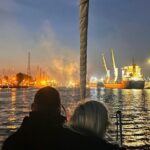
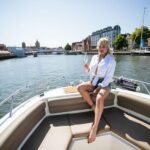
There’s something about floating past old stone in Gdańsk. This private SUP tour on the Motława River turns the waterfront into your moving viewpoint, with quick stops at major sights and a guide who explains what you’re seeing. I like that the gear is included (board, paddle, leash, life jacket) and I like that you get a fresh angle on landmarks like the Crane and the Green Gate—close enough to actually notice details. One consideration: you do need good balance and you’ll want decent weather, since the activity depends on it.
The route also feels smart for a day in the city. You choose a departure time, you stay out on the water for about 1 hour 40 minutes to 2 hours 30 minutes, and then you’re back where you started at Kamienna Grobla. If you’re into water + history + easy activity vibes, this is a strong fit—especially with a private group setup.
In This Review
- Key highlights to know before you go
- Why SUP on the Motława feels different than land tours
- Price and value: what $50.85 buys you (and what it doesn’t)
- Where you meet: finding Kamienna Grobla and settling in fast
- The Motława route: what you see at each stretch
- Motława River embankment (Długie Pobrzeże): start with the Hanseatic mood
- The Crane: a trading symbol you can actually study
- Wyspa Spichrzów (Granary Island): where grain and wealth met the sea
- Wartka Bridge: the modern connector between town and the islands
- Wyspa Ołowianka: lead, warehouses, and granary buildings near the Philharmonic
- SS Soldek: a living museum on the waterfront
- Brama Mariacka: a gothic gate and the street behind it
- Green Gate (Brama Zielona): waterfront palace… with a famous modern office
- Brama Krowia (Cow Gate): an old road name turned into a clue
- Motława channel fortifications: the city’s flood-control defense
- How easy is SUP here? Balance, comfort, and pacing
- Gear and what to bring for a smooth outing
- The guide experience: what you learn besides the photos
- Best fit: who should book this private SUP tour
- Should you book this private SUP in Gdańsk?
- FAQ
- How long is the SUP private tour on the Motława River?
- What’s included with the SUP tour?
- Where does the tour start and end?
- Is this a private tour?
- What language is the tour offered in?
- Do I need to bring water?
Key highlights to know before you go
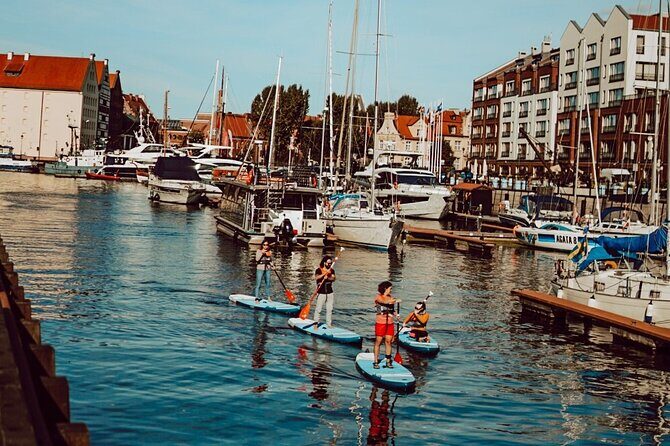
- Private SUP on the Motława: Only your group paddles together, with your guide for English-language support.
- Sights stay right beside you: You pass classic waterfront landmarks without the busy “bus window” feeling.
- Hanseatic-era clues, on the water: Embankments and islands that connect to Gdańsk’s trading past.
- Warm-weather gear included: Board, paddle, leash, and life jacket are part of the price.
- A route with built-in variety: Bridges, islands, gates, and even a steamship museum stop by the river.
- Local guide energy: Many visitors single out the guide experience—friendly, knowledgeable, and very Gdańsk-focused.
Why SUP on the Motława feels different than land tours
If you only experience Gdańsk from the street, you miss how the city “works” as a port. The Motława River is the spine that connects the old trade areas, the islands, and the waterfront gates. On a SUP, you’re not just looking at postcard buildings—you’re moving through the exact corridors where ships once came and went.
This tour is also built for people who want variety without overplanning. In roughly two hours you’ll see a chain of landmarks that connect visually and historically—Crane, granary islands, bridges, and signature gates—so your day feels like a single story instead of scattered stops.
And yes, it’s fun in a low-pressure way. Multiple visitors describe SUP here as an enjoyable activity that doesn’t demand special athletic training—balance helps, but it’s not the kind of challenge that ruins the experience if you’re a first-timer.
You can also read our reviews of more private tours in Gdansk

Price and value: what $50.85 buys you (and what it doesn’t)
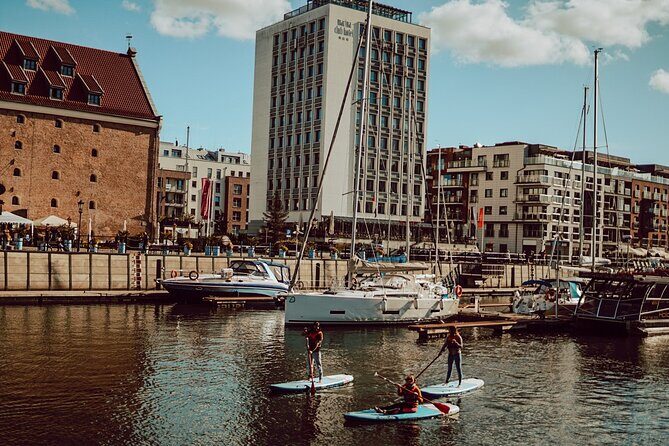
At $50.85 per person, the value is mostly about what’s included versus what you’d otherwise have to solve yourself.
What you get:
- SUP board
- Paddle
- Leash
- Life jacket
That matters because it removes the big hassle: renting gear, figuring out sizes, and trying to look like you know what you’re doing. You also get the private-group element, so you’re not stuck waiting while strangers wrangle boards and life jackets.
What you don’t get:
- Bottled water. Bring your own. Even on the river, hydration is smart.
- Extra admissions. The stops are described as free, so you’re not adding entry tickets to your day.
Given that you’re effectively sightseeing and paddling at the same time, it’s a pretty efficient use of time. You’re paying for guided movement, waterfront access, and included safety gear—not just a “look at the river” moment.
Where you meet: finding Kamienna Grobla and settling in fast
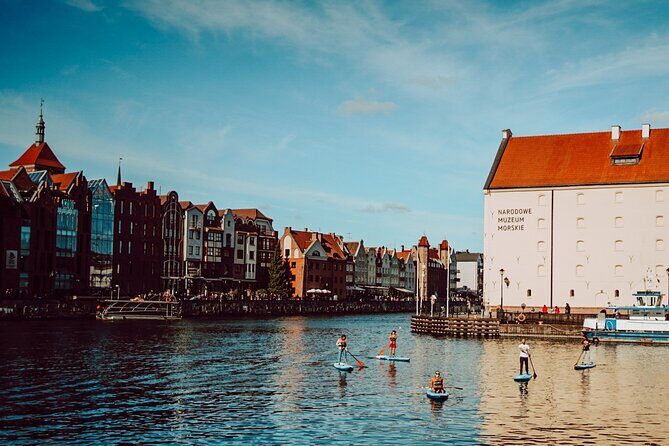
The tour starts at Kamienna Grobla, 80-700 Gdańsk, Poland, and it ends back at the meeting point. That round-trip setup is convenient because it keeps logistics simple. You don’t need a complicated transfer plan or worry about being dropped somewhere far from public transit.
It’s also listed as being near public transportation, which is helpful if you’re mixing this with other sightseeing. If your plan includes walking the historic center afterward, starting and ending at a central-ish waterfront location makes the rest of the day easier to manage.
Timing-wise, you’ll get a slot you choose ahead of time. The tour runs about 1 hour 40 minutes to 2 hours 30 minutes, so you can usually place it between other Gdańsk activities without stress.
The Motława route: what you see at each stretch
Think of this as a guided loop through the riverfront “port city highlights.” The stops are short, so the power here is in how close and continuous the scenery feels. You’re not just getting one landmark—you’re getting a sequence.
Motława River embankment (Długie Pobrzeże): start with the Hanseatic mood
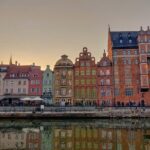
You begin at the Motława River embankment at Długie Pobrzeże. This is where you can feel the old Hanseatic League spirit. It’s the kind of waterfront where the city’s identity as a trading hub becomes obvious quickly—even before you reach the most famous monuments.
This first stretch is useful because it gets you oriented. Before you’re busy photographing gates and boats, you’ll already have the river’s rhythm and direction in your head.


The Crane: a trading symbol you can actually study
Next comes the Crane, one of Gdańsk’s defining symbols. It’s tied to what’s left of the city’s great trading age. From the water, it reads differently than from the street. You’ll see it in relation to the river, which helps it feel less like a standalone statue and more like a tool of the port world.
This stop is short, but the payoff is good because you’re already in SUP mode. No long downtime. Just a quick, high-impact look.
Wyspa Spichrzów (Granary Island): where grain and wealth met the sea
Then you paddle toward Wyspa Spichrzów, also known as Granary Island. This is one of the most important places in the city’s trading story. The island once served as a storage center where granaries handled huge amounts of grain and supported shipping for centuries.
What’s especially interesting is that the island is described as being brought back into public use through major construction projects. So you’re not just seeing “old stuff”—you’re seeing a place still changing.
If you like when sightseeing connects past and present, this part will click.
Wartka Bridge: the modern connector between town and the islands
At Wartka Bridge, opened in June 2017, you get a quick look at how the riverfront is now being stitched together for walkers. The footbridge connects the main town area near the Hilton hotel with Ołowianka.
It’s a short stop, but it’s a nice reminder that the Motława is still an active part of the city, not only a museum backdrop.
Wyspa Ołowianka: lead, warehouses, and granary buildings near the Philharmonic
Next is Wyspa Ołowianka, named from ołów, meaning lead. In the Teutonic era, lead metals sailed upriver from Silesia and were stored on the island. Later, those warehouses became granaries, including the kinds of granary buildings you can spot beside the Philharmonic Hall and the Royal Granary.
This is one of the most “specific” stops on the route because the name itself carries the history. From the water, you can connect the story to the shapes of buildings and warehouse facades instead of only relying on plaques.
SS Soldek: a living museum on the waterfront
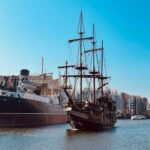
You’ll also pass SS Soldek, described as the first steamship built in Polish Gdańsk after 1945. It’s been turned into a living museum.
Even if you don’t go aboard for extra time, seeing it from the river is a strong moment. It adds a different flavor than the stone gates—more of an industrial, maritime feel.
Brama Mariacka: a gothic gate and the street behind it
Then there’s Brama Mariacka—a shadowy gothic gate. The description also points to the most beautiful street in Gdańsk behind it, which makes this stop feel like a visual threshold between the river view and the historic center.
Again, short stop, but it’s one of those landmarks that reads instantly as “this is the real Gdańsk.”
Green Gate (Brama Zielona): waterfront palace… with a famous modern office
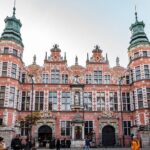
Next up is the Green Gate (Brama Zielona), a four-arched gatehouse on the waterfront. It was built as a palace for Polish monarchs, though no Polish king was ever said to have stayed there.
One of the more intriguing modern details is that Lech Wałęsa had his office here before moving to the European Solidarity Centre. That gives the stop extra meaning if you connect Polish political history with the city’s maritime trade story.
From the water, the gate’s shape and position make it feel like part of the river’s architecture, not only the background to it.
Brama Krowia (Cow Gate): an old road name turned into a clue
Brama Krowia, the Cow Gate, sits on the Motława end of ul. Ogarna. The name is linked to the road along which cattle were driven. It’s a small stop, but it’s a reminder that “port city” wasn’t just ships—it was also goods and animals moving through systems of roads and gates.
Motława channel fortifications: the city’s flood-control defense
Finally, you’ll see parts of the Motława channel fortifications. Gdańsk was surrounded by a bastion fort, and there was a stone lock built in Motława that could flood areas around the city.
This is one of the quieter moments, but it’s valuable because it explains why the river mattered for defense, not only commerce. You’re seeing a city planning idea that still feels practical even today.
How easy is SUP here? Balance, comfort, and pacing
SUP is easy to underestimate until you’re standing on the board. The good news is that the tour’s overall experience is described as relaxing and approachable.
The key physical requirement is balance. You don’t need special sports training, but you do need to be willing to find your stance. The included leash also helps you feel more secure, because it reduces the panic factor if you wobble.
Pacing is also built for beginners and casual tourists. The stops are frequent and short, and you’re not expected to power through for long stretches without a break. That keeps the mental load low.
If you haven’t tried SUP before, go in expecting a learning curve for the first few minutes—then your body usually figures it out. And the best part? Even if you’re not “great” on the board, the views are still excellent.
Gear and what to bring for a smooth outing
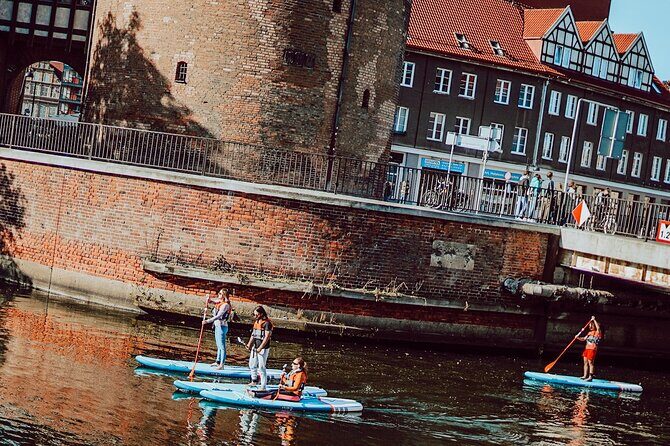
The tour includes:
- SUP board
- Paddle
- Leash
- Life jacket
So you’re mostly done with the heavy lifting.
What you should bring:
- Water (bottled water isn’t included)
- Weather-appropriate clothing for warm-weather SUP, since the gear you wear and the way you dress can matter more than you’d think once you’re in motion
Also, remember this is an outdoor activity that depends on good weather. If conditions aren’t right, the tour can be moved or refunded, so you’ll want a plan that has some flexibility.
The guide experience: what you learn besides the photos
A big reason this tour keeps getting praised is how much it adds between the landmarks. One guide name that comes up clearly is Hania, described as friendly, knowledgeable, and very in-love with Gdańsk.
That kind of local guiding changes the feel of the trip. Instead of looking at gates and thinking, “Cool, that’s old,” you start connecting:
- why granaries mattered,
- what the gates functioned as,
- and how the river was used for trade and defense.
Even the shorter stops feel meaningful because the guide keeps the explanation tied to what you can see right now.
Best fit: who should book this private SUP tour
This is a great choice if:
- you want Gdańsk sights from the water without a long walking day,
- you like learning quickly, without museum-room fatigue,
- you’d rather be active at a calm pace than stuck indoors,
- you want a private experience with just your group.
It also works well for people who are comfortable standing and balancing for about the duration of the tour. The activity is listed as suitable for most travelers, which is a helpful signal if you’re worried it’ll be too technical.
If you’re traveling with friends, it’s especially nice because everyone gets the same shared viewpoint and you’re not negotiating turns with a large mixed group.
Should you book this private SUP in Gdańsk?
I’d book it if you want your Gdańsk day to feel different. The private SUP format gives you included gear, close-up waterfront sightseeing, and a route that connects major landmarks in a way walking alone often can’t.
Skip it (or think twice) if:
- you’re sensitive to wobbling and don’t feel steady on your feet,
- you’re traveling with no flexibility for weather,
- or you hate being outdoors for even a couple of hours.
But if you’re open to learning a new skill in a relaxed way, this tour is one of those rare combos: active fun + strong sightseeing + practical guidance.
FAQ
How long is the SUP private tour on the Motława River?
The duration is about 1 hour 40 minutes to 2 hours 30 minutes, depending on your departure time and how the outing runs.
What’s included with the SUP tour?
The included items are the SUP board, paddle, leash, and life jacket.
Where does the tour start and end?
It starts at Kamienna Grobla, 80-700 Gdańsk, Poland and ends back at the same meeting point.
Is this a private tour?
Yes. It’s a private tour/activity, so only your group participates.
What language is the tour offered in?
The tour is offered in English, and you’ll receive a confirmation at the time of booking.
Do I need to bring water?
Yes. Bottled water is not included, so it’s a good idea to bring your own water.