REVIEW · WARSAW
Private Warsaw Old Town & Royal Route Walking Tour – Bestseller
Book on Viator →Operated by Warsaw Tourist Guide Łukasz Benedykciński · Bookable on Viator
Old Town hits different when someone explains the why. This private walk pairs famous stops with the kind of detail that turns Warsaw from a set of sights into a story you can follow, especially around Chopin’s heart at Holy Cross Church and the WWII rebuilding that shaped Old Town. I like how the tour focuses on meaning, not just names, so you know what you’re looking at and why it matters.
One thing to consider: it’s a 2 hours 30 minutes walking route with lots of short stops (many around 5–10 minutes). That makes it great for seeing many places, but if you prefer slow pacing or long photo breaks, you may feel the schedule moves briskly.
In This Review
- Key highlights you’ll actually notice on the walk
- Price and group value: what $258.88 buys you
- How the 2.5-hour route works: from Copernicus to the Mermaid
- Holy Cross Church: Chopin’s heart and the story you’ll remember
- Krakowskie Przedmieście: the capital story plus coffee history
- Plac Marszalka Józefa Pilsudskiego: the skyline moment
- Presidential Palace and the Royal Castle: surviving war, rebuilt meaning
- The church built twice, plus a solemn 5-minute stop
- Kanonia: the small Amsterdam label and the cemetery that came first
- Rynek Starego Miasta: seeing Old Town through before-and-after photos
- Barbakān and Gnojna Góra: city walls, odd purpose, and love locks
- Old Town finish: Piwna Street, the Pigeon Lady, mermaid lore, and WWII
- Who this tour suits best (and who might want a different style)
- Should you book it?
- FAQ
- How long is the Private Warsaw Old Town & Royal Route Walking Tour?
- What’s included for the price of $258.88 per group?
- Where does the tour start and end?
- Is hotel pickup available?
- Is the tour offered in English?
- Are there admission tickets required at the stops?
- Is this tour private or shared?
- What’s the best time to go?
- When will I receive confirmation after booking?
- Can I cancel for a full refund?
- Are service animals allowed?
Key highlights you’ll actually notice on the walk
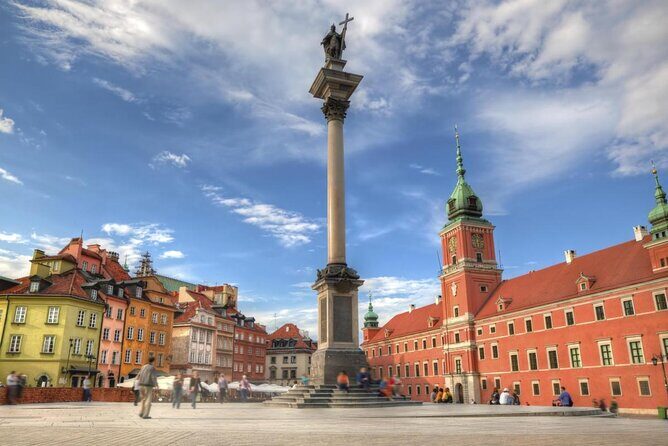
- Hotel pickup option plus a clear start and finish at landmarks near the center of town
- Chopin’s heart story tied to Holy Cross Church and how it returned to Warsaw
- Krakowskie Przedmieście in depth with capital origins, coffee history, and the Kraków name connection
- WWII impact explained where you stand: why key buildings survived when much of Warsaw didn’t
- Old Town details you can point to: Piwna Street, the Pigeon Lady, and the Mermaid of Warsaw
- Dark-to-romantic contrast handled thoughtfully at places like Barbakān and Gnojna Góra
Price and group value: what $258.88 buys you

This tour costs $258.88 per group for up to 15 people. That pricing structure is the big value play: if you’re traveling with friends or family, the cost can spread out fast compared with paying per person for a standard walking tour. Even if you’re just a couple, you’re still paying for a private guide who can tailor the pace to your group.
Also, this one gets booked ahead. On average it’s reserved about 128 days in advance, which is a good clue that people like the format and timing. It’s offered in English and runs from early morning until evening (7:00 AM–9:00 PM), so you can usually find a slot that fits your Warsaw day.
You can also read our reviews of more walking tours in Warsaw



How the 2.5-hour route works: from Copernicus to the Mermaid
The tour is a private activity, meaning only your group participates. You also get a mobile ticket, and the guide meets you either at the landmark start point or at your hotel (hotel reception is the pickup detail).
You’ll start at the Nicolaus Copernicus Monument on Krakowskie Przedmieście and finish at the Warsaw Mermaid Statue in Rynek Starego Miasta. That end point is useful: once the tour finishes, you’re right where most people want to continue—Old Town streets, cafes, and the photos you actually came for.
Duration is listed at around 2 hours 30 minutes. Because the stops are spread out across the Royal Route and the Old Town, you’ll get both the “grand axis” feel of central Warsaw and the tighter, story-heavy sections around Rynek Starego Miasta.
Holy Cross Church: Chopin’s heart and the story you’ll remember
Stop one is Holy Cross Church (Kosciol Swietego Krzyza). The tour ties in a strong hook: Fryderyk Chopin died abroad, and before his death he asked his sister to bring his heart back to Warsaw. You’ll hear how she managed it (including the smuggling part) and you’ll see where Chopin’s heart is located.
Why this works as a first stop: it sets the emotional tone early. Even if you’re not a classical-music deep dive, you’ll understand why Chopin is treated as a national figure, and why this church becomes a place you don’t just pass through.
Practical note: the stop is about 10 minutes. That’s enough time to understand the narrative and take in the point of the visit, but it’s not an open-ended museum-style experience. If you want extra time inside, you can always plan a return later.
Krakowskie Przedmieście: the capital story plus coffee history
Next you walk Krakowskie Przedmieście Street, one of Warsaw’s most representative streets, for about 40 minutes. This is where the tour leans into “how Warsaw became Warsaw,” with several connected topics woven into the walk:
- why Warsaw became the capital of Poland
- where the oldest coffee place in Warsaw is, plus how Polish people link to European coffee history
- why the street is named Krakowskie Przedmieście, meaning the suburbs of Kraków
That coffee thread is a clever way to make history feel normal. Instead of treating the past like a distant textbook, you’re learning how everyday culture (coffee, meeting places, habits) ties into Europe-wide stories.
A consideration: 40 minutes on a long street is great for momentum, but you’ll be on your feet the whole time. If you’d rather do Old Town first or want lots of photo stops, this is the one segment where you may want to plan your camera breaks carefully so you don’t feel behind schedule.
Plac Marszalka Józefa Pilsudskiego: the skyline moment
At Plac Marszalka Jozefa Pilsudskiego, you get a short 10-minute stop with a view over the Warsaw skyline. This is a classic “big-city orientation” move. After the street-walk focus of Krakowskie Przedmieście, the square helps you re-map where everything sits.
This is also a nice pause point. Even though the stop is brief, it gives you a chance to look outward before the tour shifts back into the more intense wartime and Old Town stories.
You can also read our reviews of more private tours in Warsaw


Presidential Palace and the Royal Castle: surviving war, rebuilt meaning
The tour then moves into the wartime “why” you can’t fully understand from brochures. After WWII, the information given is blunt: about 70% of Warsaw was destroyed. Yet the Presidential Palace of Poland was spared, and your guide explains why.
That “spared” detail matters because it gives you a lens for everything else you’ll see later. You stop looking at buildings as fixed scenery and start seeing them as choices, circumstances, and consequences.
Next up is the Royal Castle (Zamek Królewski) story, which is intense and very specific. Adolf Hitler ordered soldiers to blow up the Royal Castle in Warsaw. The tour explains how holes for dynamite were drilled in 1939, but those holes were filled with explosives in 1944—and it goes into why it took so long. It also covers why the rebuild took an additional 40 years after the destruction.
This is the part of the tour that rewards attention. You’re not just hearing that things were damaged. You’re getting timelines and cause-and-effect, which helps you interpret the city’s patchwork look without guessing.
The church built twice, plus a solemn 5-minute stop
At one point, the itinerary includes “the most important church of Warsaw,” described as being built twice. You’ll hear why it had to be rebuilt and what the second construction means in the larger Warsaw story. Even without taking a long break, this stop adds weight to the theme: Warsaw repeatedly lost key places, then worked to restore identity in stone and brick.
Then you move to the Tomb of the Unknown Soldier. You’ll see the monument and listen to its history in about 5 minutes, and that brevity actually helps. It keeps the route moving while still giving you a respectful moment that changes the emotional tempo.
If you’re the type who likes to linger, this is one stop where you might want to return later on your own for extra quiet time.
Kanonia: the small Amsterdam label and the cemetery that came first
Stop five is Kanonia—today a beautiful place locals call the small Amsterdam. There’s even a wishing bell located at Kanonia Square, and your guide connects that present-day charm to what used to be there: for hundreds of years, there was a cemetery.
The contrast here is the point. The tour doesn’t ask you to treat the past as dead. It shows how layers overlap: a place can become romantic in the present because the past still has a say in what’s remembered and where people gather.
The stop is about 10 minutes, which is enough to understand the transformation without turning it into a long pause. If you’re trying to see the whole route without fatigue, this timing helps.
Rynek Starego Miasta: seeing Old Town through before-and-after photos
At Rynek Starego Miasta (Old Town Market Square), you’ll spend about 10 minutes at one of Warsaw’s most lovely public spaces. The tour highlights how photos of the square look before and after WWII, and how the city went about rebuilding.
This stop is valuable because the square is so central to the Warsaw postcard image. Without context, it can feel like a set. With context, you understand it as a project of recovery.
Also, because the stop is short, you don’t get stuck in a single viewpoint. You’ll take the meaning with you and still have time to explore the surrounding Old Town area afterward.
Barbakān and Gnojna Góra: city walls, odd purpose, and love locks
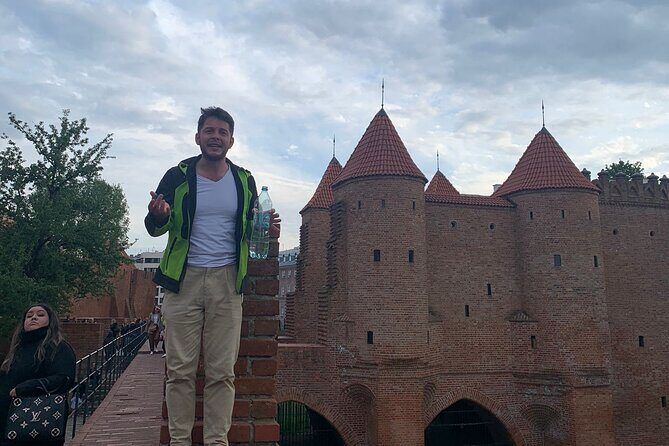
The route includes Barbakān, described as part of Warsaw’s City Walls. What’s interesting is that when it was built, it had no military importance. You’ll hear who built it, why it was made, and who used it.
That detail flips how you may expect to read city walls. Instead of seeing them only as defense, you start noticing how they also served civic, symbolic, or social functions.
Then comes Gnojna Góra, a hill that’s now romantic. People come, lock padlocks for love, and enjoy a beautiful setting. Your guide tells you not to do it, because of the history of the place.
This is a smart way to keep the tour honest. It acknowledges what tourists tend to do, then redirects you toward the meaning underneath the ritual. It’s also a reminder that “cute tradition” and “historical context” aren’t always aligned.
Old Town finish: Piwna Street, the Pigeon Lady, mermaid lore, and WWII
The final big stretch is Old Town itself, about 40 minutes. This is where you get the smaller stories that make the area feel lived-in:
- Piwna Street (the beer street)
- the Pigeon Lady
- the mermaid of Warsaw
- WWII in Warsaw, tied directly to what you’re seeing
You end at the Warsaw Mermaid Statue near Rynek Starego Miasta 18i. That ending is satisfying because the mermaid isn’t just decorative in the tour framing—it’s part of the local identity story, so you’re finishing with a symbol that actually means something.
If you want a practical plan after the tour: give yourself time to walk the Old Town streets slowly for your own photos. The tour hands you names and narratives; then you can choose your favorite corners to revisit.
Who this tour suits best (and who might want a different style)
This is a strong match if you want a guided walk that connects major landmarks to the reasons behind them—especially the WWII timeline and how Warsaw rebuilt identity. It’s also ideal if you like narrative pacing, since each stop is short enough to cover a lot without feeling like you’re stuck in one place all day.
It’s less ideal if you want deep time inside buildings, or if you dislike walking between many points. The route is designed to be efficient and to move, not to slow down into one single neighborhood.
For families, the private format helps, because your guide can keep the group together and the pace controllable. For couples and friends, it’s a good way to get oriented fast before deciding where to linger.
Should you book it?
I’d book it if you want your Warsaw Old Town day to have a spine: Chopin’s heart to explain identity, Krakowskie Przedmieście to explain power and everyday culture like coffee, and WWII survival and rebuilding to explain why Warsaw looks the way it does. The fact that it’s private, runs in English, includes hotel pickup, and is priced per group (up to 15) makes it a practical choice for many group sizes.
I’d think twice if you know you’ll want long pauses at every stop. This tour gives you the story highlights in a tight window, so it works best when you’re happy to see a lot and then explore on your own afterward.
FAQ
How long is the Private Warsaw Old Town & Royal Route Walking Tour?
It’s approximately 2 hours 30 minutes.
What’s included for the price of $258.88 per group?
The tour is private for your group (up to 15 people) and includes an English-speaking guide. A mobile ticket is offered.
Where does the tour start and end?
It starts at the Nicolaus Copernicus Monument on Krakowskie Przedmieście and ends at the Warsaw Mermaid Statue on Rynek Starego Miasta 18i.
Is hotel pickup available?
Yes. The guide can meet you at your hotel reception. You can also begin the tour at your hotel with a few extra stops before reaching the final destination.
Is the tour offered in English?
Yes, it’s offered in English.
Are there admission tickets required at the stops?
The stops listed are marked as admission ticket free.
Is this tour private or shared?
It’s private. Only your group participates.
What’s the best time to go?
The tour’s listed availability runs daily from 7:00 AM to 9:00 PM.
When will I receive confirmation after booking?
Confirmation is received within 48 hours of booking, subject to availability.
Can I cancel for a full refund?
Yes, free cancellation is available. You must cancel at least 24 hours before the experience’s start time for a full refund.
Are service animals allowed?
Yes, service animals are allowed.