REVIEW · WARSAW
Medieval Warsaw Walking Tour with Smartphone App
Book on GetYourGuide →Operated by LEPLACE GLOBAL · Bookable on GetYourGuide
Your phone turns Warsaw into a game. This Leplace World smartphone tour sends you trotting through historic streets with location-based clues, all framed as a Lithuanian nobleman heading to Parliament in 1652. I like how the story gives you a reason to look closely, and I like that you can move at your own pace while solving tasks. The main drawback is simple: if the app’s GPS or QR codes act up, the experience can slow down fast.
You’ll be walking for about 2 hours with an English host/greeter, in a small group capped at 10. At around $15 per person, it’s a low-cost way to try something different from a standard guided walk—more game than lecture, more problem-solving than sightseeing bullet points.
In This Review
- Key things to know before you go
- Medieval Warsaw in 1652: The story you follow on foot
- Leplace World on your phone: how the puzzle flow really works
- The 2-hour format: pacing, attention, and how not to get stuck
- QR codes, a Schloss clue, and a padlock logo task: what to expect
- Price and value: is $15 worth it compared with a classic guide?
- Who this tour suits best (and who should skip it)
- Tips to avoid phone problems and keep the hunt fun
- Should you book this Medieval Warsaw Walking Tour?
- FAQ
- How long is the Medieval Warsaw Walking Tour?
- How much does it cost?
- Where do I meet the host?
- Do I need to download an app before the tour?
- What should I bring?
- What language is the host/greeter?
- How big is the group?
- What’s the cancellation policy?
Key things to know before you go

- A phone-guided scavenger hunt instead of a traditional step-by-step guide
- Location-based gameplay that nudges you from spot to spot at your own speed
- 1652 Warsaw storytelling through the eyes of a Lithuanian nobleman heading to Parliament
- QR-code and puzzle moments, including challenges that can involve finding specific items
- Small group size (up to 10), which usually keeps the pace more flexible
- High dependence on your smartphone, especially GPS strength and QR scanning
Medieval Warsaw in 1652: The story you follow on foot

This tour is built like a role you can carry while you walk. You start with the premise that it’s 1652, and you’re exploring Warsaw like a Lithuanian nobleman attending Parliament. That framing matters because it changes how you pay attention. Instead of just checking off famous buildings, you’re scanning the city for whatever the next instruction is asking for—often in a way that feels closer to real exploration than formal sightseeing.
I also like that the tour is designed around “do this next” steps rather than long explanations. You’re not stuck listening the whole time. Even when you’re standing still, you’re doing something with the information on your phone, like checking a location prompt or working out what the game wants you to find.
One more thing: the tour’s format naturally supports small-group energy. With a limit of 10 participants, you’re less likely to feel herded, and it’s easier to take breaks when you need them. Just remember: the walk is outdoors, and weather affects comfort.
You can also read our reviews of more walking tours in Warsaw



Leplace World on your phone: how the puzzle flow really works

The tour is supported by the Leplace World mobile app. After checkout, you’ll get instructions for downloading and using it. When you arrive, you’re expected to follow the app’s directions closely—this is not the kind of activity where you can wing it confidently without checking your phone.
The core idea is location-based exploration. That means the app expects you to be in the right place for the next step. It may also use QR codes as part of the trail. In practice, that turns Warsaw into a series of “arrive, scan or confirm, solve, move on” moments.
Here’s what you should understand before you spend time and energy: this isn’t just a photo tour with an audio track. It’s closer to a scavenger hunt. So if you prefer walking while reading facts at your own pace, you may enjoy it. If you hate games, or you really want a guide explaining context sentence-by-sentence, the experience can feel overly task-driven.
Also, you’ll likely be moving more than you expect. The tour is only 2 hours, and the app tries to keep you progressing through multiple steps during that window. If you stop to browse shops or linger at every corner, you might feel rushed—or you might end up spending most of your time on just one segment.
The 2-hour format: pacing, attention, and how not to get stuck
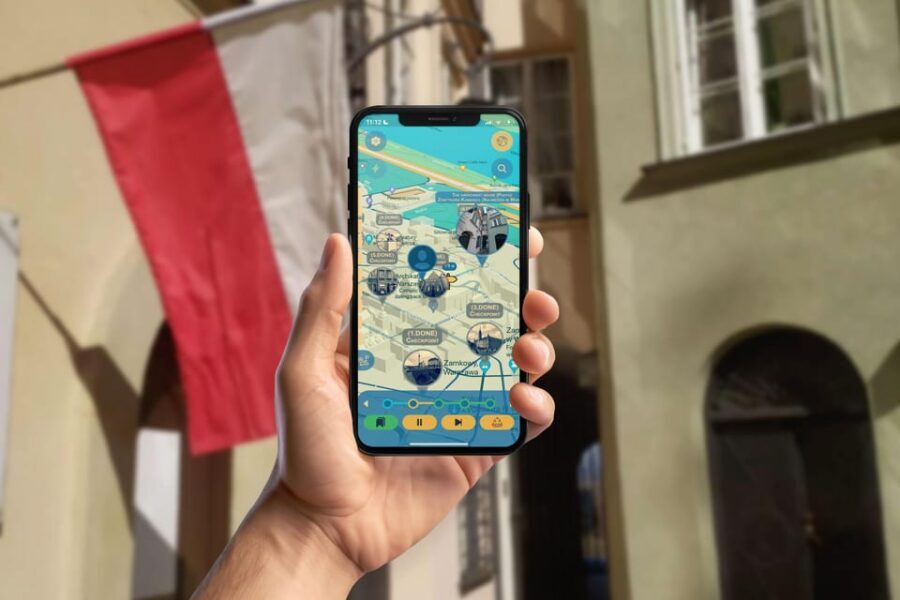
Two hours sounds short, but scavenger-style tours can be deceptively active. You’re not only walking; you’re also pausing to solve puzzles and locate items. That’s great when the clues are clear, because it turns sightseeing into momentum. It’s less great when a step becomes confusing.
One pattern you’ll want to avoid: looping back. Since the app guides you by locations and tasks, it can lead you to re-check a spot if the game thinks you haven’t completed it. If you’re trying to see a lot of the city in a short time, this can feel inefficient.
In a perfect run, you’ll feel like you’re “progressing through the map” while learning the city through movement. You’ll also get a practical benefit: you’ll notice streets, corners, and small architectural details you might otherwise miss because the game effectively gives you a reason to look.
But treat this as a guided experience with a twist. You’re the one walking and solving, not the app. So build in your own sanity check. When a task feels impossible, it’s usually better to pause, read the instructions again, and confirm you’re at the correct location before spending 20 minutes searching randomly.
QR codes, a Schloss clue, and a padlock logo task: what to expect
Based on the kinds of challenges built into the app experience, it’s smart to expect at least a couple of “find-and-scan” moments. One common style of step involves locating something with a QR code. If you’re the type who assumes QR codes will be obvious and easy, keep your expectations grounded. On some runs, QR-based steps can be hard to spot depending on lighting, angle, or how the instruction is phrased.
There’s also evidence that the game may include a task related to locating a Schloss using a QR prompt. Another task can involve searching for a padlock with a specific logo. That second type of step is worth special caution. If you can’t clearly identify what the logo looks like (or you don’t have enough detail on your screen), it can turn into a time sink.
This is where smartphone setup matters. If your GPS signal is weak or your screen navigation is clunky, you can feel stuck even when you’re near the right spot. And if your phone doesn’t scan QR codes reliably, you’ll lose time that you can’t really get back in a 2-hour tour.
So, go into it with a mindset like this: you’re here to solve the trail, not just to photograph the city. When you accept that, the quirks feel less frustrating and more like part of the adventure.
Price and value: is $15 worth it compared with a classic guide?
At $15 per person for 2 hours, you’re paying for a walking experience plus the app-based guidance. In value terms, that price works best if the phone experience runs smoothly. When GPS and QR steps behave, the tour gives you an active form of sightseeing at a budget-friendly rate.
A classic guided walking tour typically costs more because you’re paying for real-time explanation, context, and an expert who can redirect when something goes wrong. This tour doesn’t promise that kind of continual guidance. Instead, it offers structure through the app: story, steps, puzzles, and pacing.
So here’s how I’d frame the math for your decision:
- If you like self-paced challenges and your phone works well outdoors, $15 is a bargain for the novelty.
- If you depend on reliable GPS/QR and your smartphone can be temperamental, the same $15 can feel less satisfying—because you’re paying for the app to do the heavy lifting.
My advice: think of the tour as “guided by software,” not “guided by a person.” If you’re comfortable with that, you’ll probably have a good time. If you’re not, you may find yourself wishing for a traditional human guide to bail you out.
A few more Warsaw tours and experiences worth a look





Who this tour suits best (and who should skip it)
This experience fits you best if you enjoy:
- walking while following short tasks rather than long talks
- exploring at your own pace
- puzzles, scavenger-hunt logic, and location prompts
- a story wrapper (1652 Parliament vibes through a Lithuanian nobleman lens)
It’s a smaller group, up to 10 participants, so you’re not stuck in a mass of people. That tends to make it easier to pause, regroup, and keep moving without feeling like you’re holding up a large group.
It’s also not for everyone. It’s not suitable for people with mobility impairments, not suitable for visually impaired people, and it’s not recommended for people over 80. Since the tour relies on smartphone interaction and outdoor walking, those limits make sense.
If you go in expecting a calm, purely educational history walk, you might feel like the tasks are getting in the way. If you go in expecting a light game with sightseeing baked in, you’re more likely to enjoy the ride.
Tips to avoid phone problems and keep the hunt fun
Because the experience depends on the app, you’ll get more enjoyment by planning like a realist:
- Bring a charged smartphone. This sounds obvious, but 2 hours of GPS + screen use can drain faster than you expect.
- Use Google Maps (or a map service) to reach the meeting area, then follow the app instructions once you’re there.
- Check the weather first. Rain and strong wind don’t just affect comfort; they can also make it harder to read the screen or scan QR codes.
- If you get stuck, don’t keep searching randomly for 10 minutes. Re-read the step, verify you’re at the right location, and then try again.
One more practical note: the app can be the whole experience. I’ve seen real-world complaints about GPS weakness and iPhone vs. browser behavior not matching expectations. You can’t control that, but you can reduce your risk by arriving with your phone ready and your patience intact.
If you’re the kind of traveler who carries a backup plan (like a power bank or extra battery time), you’ll feel calmer during the hunt.
Should you book this Medieval Warsaw Walking Tour?
Book it if you want a 2-hour Medieval Warsaw walking experience that feels like a game: story-first, puzzle-based, and paced by your phone. The value is strong at $15, especially if you’re comfortable figuring things out as you go.
Skip it (or choose something more traditional) if you want a guide to steer the experience in real time, or if you know you’ll be frustrated by QR or GPS issues. Since the tour leans heavily on smartphone performance, it’s not the best pick for travelers who need everything to work perfectly with zero downtime.
If you do book, treat it like an adventure with some tech dependency, and you’ll likely enjoy the blend of walking, problem-solving, and 1652 storytelling. If the tech cooperates, you’ll have a memorable way to see Warsaw. If it doesn’t, you’ll still be walking through the city—but the “game” part may feel like more work than fun.
FAQ
How long is the Medieval Warsaw Walking Tour?
The tour lasts 2 hours.
How much does it cost?
It costs $15 per person.
Where do I meet the host?
Use Google Maps or another map service to arrive at the location. Once you’re there, follow the instructions inside the Leplace World app closely.
Do I need to download an app before the tour?
Yes. The activity is supported by the Leplace World mobile app, and you’ll receive instructions for downloading the app after checkout.
What should I bring?
Bring a charged smartphone.
What language is the host/greeter?
The host/greeter communicates in English.
How big is the group?
It’s a small group limited to 10 participants.
What’s the cancellation policy?
You can cancel up to 24 hours in advance for a full refund.