REVIEW · WARSAW
Private 4h Tour in Warsaw Old Town
Book on Viator →Operated by PT Team · Bookable on Viator
Warsaw tells its story in stone. This private 4-hour loop through Old Town and the Royal Route turns a pile of landmarks into a clear timeline, from trade city to WWII devastation to careful reconstruction. I love the way the guide anchors the big events in specific details you can actually point at, like how Sigismund’s Column was knocked down and rebuilt.
I also like that it stays practical: English-speaking private group time with a professional local guide, and stop-by-stop sights that don’t require paid entry. One possible drawback: the emotional weight ramps up quickly around the Warsaw Uprising, so bring patience for the somber parts and plan comfortable shoes.
In This Review
- Key Things You’ll Notice on This Private Old Town Tour
- Price and Private-Group Value on a 4-Hour Warsaw Walk
- Sigismund’s Column and Old Town: Getting Your Bearings Fast
- Royal Castle Gardens, St. John’s Cathedral, and the City’s Rebuild
- Rynek Starego Miasta and Barbakan Warszawski: Market Life Meets Defense
- Warsaw Uprising Monument and Krasiński Palace Park: Where the Tone Shifts
- Ulica Miodowa and Plac Teatralny: Palaces, Schools, and Opera Square
- Tomb of the Unknown Soldier and the Royal Route Finish
- Should You Book This Private 4-Hour Old Town Tour?
- FAQ
- How long is the Private 4h Tour in Warsaw Old Town?
- What is the price per person?
- Where do we meet, and where does the tour end?
- What language is the tour offered in?
- Is this tour private or shared with other groups?
- Do the tour stops require paid admission tickets?
- Is there a mobile ticket?
- Can I cancel for a full refund?
- Is the tour suitable for most people in terms of participation and transport?
Key Things You’ll Notice on This Private Old Town Tour
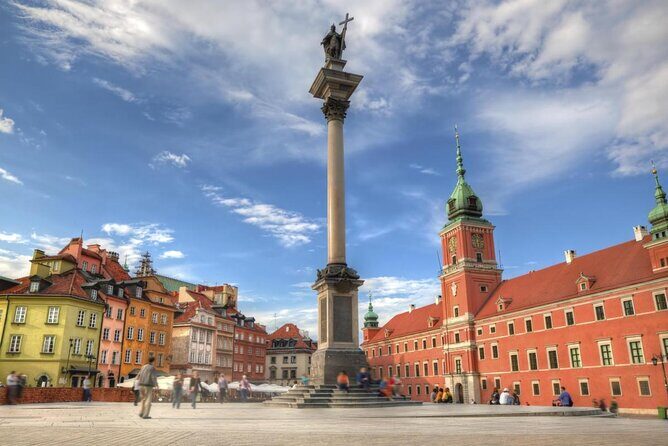
- A moved monument with a story: Sigismund’s Column has been relocated and rebuilt after destruction.
- Old Town after the fire and the rubble: you’ll see why the area was rebuilt and earned UNESCO status.
- Royal Castle Gardens as a reconstruction lesson: faithful rebuilding is the point here, not just pretty grounds.
- Organ music details in St. John’s Cathedral: Sundays at 4 PM (July to September) during the International Organ Music Festival.
- Barbakan Warszawski’s “pre-war imagination” exhibition: May to October photo and model displays help you compare then vs now.
- A memorial built for continuity: the Tomb of the Unknown Soldier keeps an eternal flame and a daily noon guard change.
Price and Private-Group Value on a 4-Hour Warsaw Walk
At $111.75 per person for about 4 hours, this isn’t a bargain bus tour. But it can be good value if you care about meaning, not just photos—because you get a professional local guide who can connect sites in a way a self-guided walk often won’t.
This is a private tour, meaning only your group participates. That matters more than people expect. You can ask questions, slow down when a stop hits harder (Warsaw Uprising), and speed up when you’re cruising. You also get a mobile ticket, which makes logistics simpler on the day.
One small reality check: the route is packed with major stops, so it’s not a sit-down, slow-and-linger tour. Expect to get a lot of highlights, then keep walking on your own at the end.
You can also read our reviews of more private tours in Warsaw
Sigismund’s Column and Old Town: Getting Your Bearings Fast
Most tours start with a landmark; this one starts with a symbol that has moved around the city—King Sigismund’s Column (Kolumna Zygmunta). It’s described as Warsaw’s oldest public memorial, but not in its original place. The column shifted when the axis of Krakowskie Przedmieście Street changed in the 19th century, and again during post-WWII development around the WZ route. Then came the brutal break: on September 2, 1944, German troops brought it down, and reconstruction finished in 1949.
That background does two useful things for you. First, it explains why Warsaw feels like it has layers. Second, it primes you for the rest of the tour: rebuilding isn’t a footnote here—it’s part of the city’s identity.
From there you move into Old Town, the historic core shaped by geography and trade. Warsaw grew fast because it sat on a route between the Baltic Sea and the Black Sea. Over time, wood structures replaced with masonry tenements, and earthen ramparts became stone walls. And then history punches the clock again: 90 percent of the Old Town area was razed in 1944, with reconstruction taking years and ultimately earning UNESCO World Heritage status.
Tip: Old Town looks “finished,” but the guide’s timeline helps you see it as a careful restoration project. If you want that angle, this tour is doing exactly what you hope it will.
Royal Castle Gardens, St. John’s Cathedral, and the City’s Rebuild
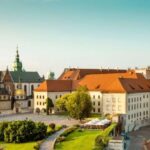
Next comes Warsaw Royal Castle Gardens, a stop that feels calm—but it’s carrying heavy history. The castle became a royal residence in the 16th century, repeatedly destroyed over the centuries, and then hit hard in WWII: bombed in the first days and nearly wiped out by fire. Some priceless artworks were carried out in time and hidden, but remaining works were plundered. In 1944, the castle was blown up in retaliation connected to the Warsaw Uprising.
Then you get the “why they bothered” part: reconstruction wasn’t decided immediately. The call to rebuild came later, in 1971, with financing heavily supported by community generosity. Visitors could enter again starting in 1984. The result is UNESCO recognition for a faithful reconstruction of an historic structure.
After that, you head to Archcathedral Basilica of St. John the Baptist, one of Warsaw’s oldest churches. This is where the tour adds texture to the timeline. St. John’s isn’t only about architecture; it ties into major national milestones, including the oath connected to the Constitution of May 3—called the first of its kind in Europe in the tour description.
If your dates line up, St. John’s can also deliver live music. Every Sunday at 4 PM from July to September, concerts run here as part of the International Organ Music Festival. If you aren’t there during that season, you still get the key visual and historical stop plus a chance to understand why the building matters.
Rynek Starego Miasta and Barbakan Warszawski: Market Life Meets Defense
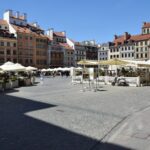
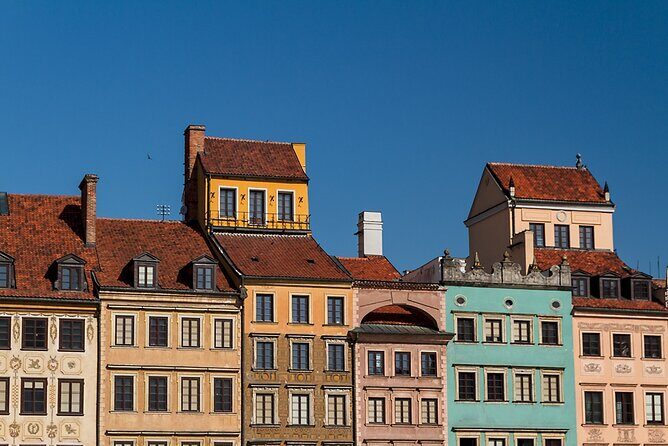
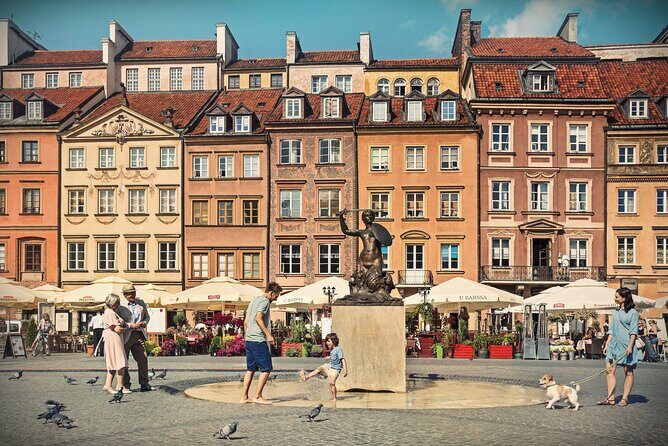
You’ll then land at Rynek Starego Miasta, the Old Town Marketplace. This is the place to reset your brain. It’s surrounded by tenement buildings now used for restaurants, cafes, clubs, galleries, and museums, so it’s lively even when the history overhead is intense.
The square also has a modern symbol layer: the Warsaw Mermaid statue. And the marketplace’s design is tied to local enlightenment-era activists, split into four sections named Kołłątaj, Dekert, Barss, and Zakrzewski.
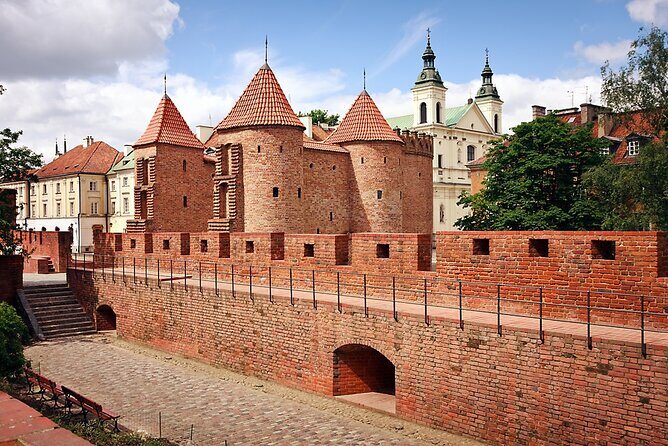
From the open square, you move to Warsaw Barbican (Barbakan Warszawski), built in 1548 as part of about 4,000 feet of defensive ramparts. Today it’s a walkable fortress-like structure where you may catch painters showing work or musicians playing. From a travel standpoint, this is a rare chance to feel “defense” without needing a battlefield museum.
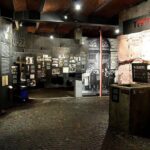
The guide also points out what’s inside and when it’s worth it. From May to October, there’s an exhibition inside the Barbican’s walls with historical photos and models of defensive lines and towers that no longer exist. The best way to use this stop is simple: compare old images to what you see now, and let your imagination fill in the missing walls. It’s the fastest way to understand the scale of what was lost.
One consideration: the Barbican area is great for photos, but it can be a little bit of a “picture trap.” If your goal is learning, ask your guide to talk first, then take photos after you’ve got the context.
Warsaw Uprising Monument and Krasiński Palace Park: Where the Tone Shifts
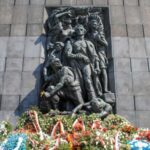
After the defensive walls, the tour turns to one of Warsaw’s most painful modern stories: the Warsaw Uprising Monument. It depicts groups of insurgents during battle, and the uprising ended in defeat with the death of 200,000 Poles. That number isn’t just background. It changes how you stand in front of the monument.
This is one of the tour’s strengths, and you should plan for it. If you’re the type who rushes through heavy history, slow down here. Let the guide frame what you’re seeing—this stop is designed to make the city’s resilience feel real, not abstract.
A short walk leads to Krasiński Palace (Palace of the Republic). The palace’s roots go back to Jan Krasiński, Prefect of Warsaw, and today it hosts special collections for the National Library. The tour description calls it Warsaw’s most enchanting Baroque structure, with many reliefs inspired by antique works. Behind it, the park is highlighted as an early public space available to residents regardless of social status, which is a nice counterpoint to the uprising theme.
You’ll also notice the recently built Supreme Court seat in a green building across the street. In a few minutes, the area shows you the same idea the rest of the tour pushes: Warsaw keeps rewriting itself.




Ulica Miodowa and Plac Teatralny: Palaces, Schools, and Opera Square
Now you move onto Ulica Miodowa, a narrow street full of life and lined with older, more luxurious residences. This part feels like a stroll that still has homework attached.
A few standout stops along Miodowa:
- Number 24 used to host the Collegium Nobilium, described as the first school for the young of the ruling elite. Today it houses the Academy of Theatre.
- Number 17 is the residence of the Primate of Poland, the Palace of Warsaw’s Archbishops, erected in the 18th century.
- Number 16 is Warsaw’s only Eastern Catholic Church.
- The Pac Palace houses the Ministry of Health.
You also get a look at the Church of the Capuchins, where the right side of the altar features the heart of Jan III Sobieski, identified here as the founder.
As you walk, the tour also points toward the Monument of Warsaw’s Heroes, commonly called the Monument of Nike. Even if you don’t stop long, it’s one of those “anchor views” that helps you orient yourself to the city’s commemorative geography.
Next comes Plac Teatralny (Theatre Square), a classic Warsaw drama scene—late Baroque buildings up close and big performance architecture nearby. The square is bordered on one side by the Late Baroque Blank Palace, and behind it sits Jabłonowski Palace. Before WWII it functioned as city hall. After war destruction, the description says it was rebuilt in the 1990s but only the façade and clock tower remain from the original design. A useful tip here: walk through the gate under the tower to see the foundations laid in the 19th century.
Then you face the Grand Theatre, described as huge and Classicist, housing the National Opera and the National Theatre. If you attend a performance, the tour notes that you can see impressive interiors—cut glass chandeliers, a spacious foyer with columns, and notable floor tiling. Even without a show, it’s a powerful change of pace after monuments and churches.
The theatre square ends at the Petrykus Tenement House (erected in 1821), which now holds restaurants and clubs valued by Warsaw citizens. It’s a good place to grab a snack if you still have energy.
Tomb of the Unknown Soldier and the Royal Route Finish
One of the most moving stops on the route is the Tomb of the Unknown Soldier. This symbolic tomb commemorates the millions of soldiers who sacrificed their lives fighting for Poland’s freedom. Buried here are ashes of a defender of Lvov and an urn with soil from World War I battlefields, and the tomb contains urns from every battlefield where Polish troops fell in the last century.
There’s an eternal flame next to the tomb, and it’s watched over by a military honour guard. The tour description includes a very practical detail: the guard changes daily at noon. If you happen to be there around that time, it’s one of the few moments in the city where the ritual is built into your timeline.
From the tomb area, you shift into the Royal Route, which runs from Zamkowy Square to Trzech Krzyży Square. This is where the tour gives you a “keep walking after the tour” map in your head. Must-see elements on the route include:
- St. Anne’s Church (including a view from the church tower)
- Polonia House, described as the place where Maria Skłodowska-Curie worked
- Radziwiłł Palace, noted as the current residence of the President of Poland
- Warsaw University campus with Kazimierzowski Palace
- Czapski Palace, home to the Academy of Fine Arts
- Nowy Świat Street’s stores and restaurants, described as an extension of Krakowskie Przedmieście
This end section is handy because the guide finishes by leaving you at a point where you can branch out on your own rather than cutting you loose in the middle of nowhere.
Should You Book This Private 4-Hour Old Town Tour?
If you like Warsaw’s history with a strong storyline, this tour makes a lot of sense. It packs the big themes—trade and growth, war destruction, careful rebuilding, and national memory—into 4 hours without skipping the “how” details. I’d especially recommend it for first-timers who want their bearings fast, and for people who don’t just want to see monuments but want to understand why they’re where they are.
I’d also book it if you want high guide quality. Private tours here have been praised for guides like Maria, Cesar, Carolina, and Mariola, with comments highlighting clear explanations, before-and-after context (including war photo comparisons), and even language skill for Francophone visitors with perfect French handling.
Skip it only if you want a long, slow wander with lots of free time to shop and eat. This route is structured. You’ll learn a lot, then you’ll go enjoy the city after.
FAQ
How long is the Private 4h Tour in Warsaw Old Town?
It’s approximately 4 hours.
What is the price per person?
The price is $111.75 per person.
Where do we meet, and where does the tour end?
You meet at Sigismund’s Column at plac Zamkowy (00-001 Warszawa). The guide leaves you at the Nicolas Copernicus Monument area, and the tour ends on the Royal Route near Krakowskie Przedmieście (00-079 Warszawa).
What language is the tour offered in?
The tour is offered in English.
Is this tour private or shared with other groups?
This is a private tour/activity, so only your group participates.
Do the tour stops require paid admission tickets?
The listed stops on the route are marked as free admission.
Is there a mobile ticket?
Yes, the tour includes a mobile ticket.
Can I cancel for a full refund?
Yes. Cancellation is free up to 24 hours in advance for a full refund.
Is the tour suitable for most people in terms of participation and transport?
Most travelers can participate, and the route is described as near public transportation.