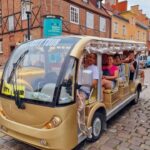
Gdańsk rolls by on a quiet golf cart. In about 1 to 1.5 hours, you glide between major landmarks and get a tight story arc—from medieval brick churches to 20th-century memory stops—without wearing yourself out on cobblestones. You’re moving through the Old Town core with an easy, sightseeing-friendly pace.
I especially like two things: the named landmarks you hit in a short loop, and the way the tour mixes styles and eras in one ride. You’ll see St. Mary’s Church (completed in 1502, Brick Gothic) early, then later shift to WWII and resistance history. That pairing is great if you want context fast, not just postcard views.
One drawback to plan around: the Gdańsk market building (built in 1896 in neo-Gothic style) is currently under reconstruction until 2026. So if you’re hoping for perfect photo angles and a fully “finished” facade, you may find scaffolding or partial views.
In This Review
- Key highlights you’ll feel right away
- The golf cart pace: fast orientation without the marathon
- Meeting at Galeria Na Wieży (Wielkie Młyny 1) and returning there
- St. Mary’s Church: the Brick Gothic Crown of Gdańsk
- The Crane Gate and the Motława River: a 15th-century photo moment
- Neo-Gothic reality check: the Gdańsk market building (reconstruction until 2026)
- St. John’s Church and the amber altarpiece: art in Brick Gothic form
- St. Catherine’s Church: the oldest layer of Gdańsk’s religious past
- WWII memory, up close: the Museum of the Second World War
- The Polish Post Office: 1920 to the start of WWII
- Solidarity and resistance: the European Solidarity Centre
- Sołdek and the Teutonic mill: industrial Gdańsk in one sweep
- Stacked eras in 90 minutes: why this order works
- Price and value: $27.64 for a guided golf cart loop
- Shared vs. private: when to choose each
- Who should book this tour (and who may want something else)
- Should you book the Gdańsk golf cart city tour?
- FAQ
- How long is the Gdańsk City Tour by golf cart?
- Is the tour shared or private?
- What language is available?
- Where do I meet, and does the tour end there too?
- What happens if the weather is bad?
- Can I get a full refund if I cancel?
Key highlights you’ll feel right away
- Golf-cart pacing keeps the route fun for a short time window
- Brick Gothic landmarks with big-name backstories, like St. Mary’s and St. John’s
- Amber altarpiece stop tied to one of the world’s largest amber artworks
- WWII and Post Office context at the Museum of the Second World War and Polish Post Office
- Solidarity history at the European Solidarity Centre (opened 31 August 2014)
- Industrial-era sights including Sołdek and a Teutonic Knights mill with 18 waterwheels
The golf cart pace: fast orientation without the marathon
This is a shared or private city tour by golf cart, priced at $27.64 per person, and it runs roughly 1 to 1.5 hours. That timing matters in Gdańsk, because you can hit the “big ideas” of the city without turning your day into a long slog.
The ride also keeps your attention on what you’re there for. You’re not stuck guessing where to go next. Your stops are stacked in a practical order, so you get a logical flow from landmark to landmark.
If you’re sensitive to weather, keep one thing in mind: the tour requires good weather. When conditions are poor, it may be rescheduled or refunded—so it’s smart to check forecasts and be flexible with your plans.
You can also read our reviews of more city tours in Gdansk
Meeting at Galeria Na Wieży (Wielkie Młyny 1) and returning there
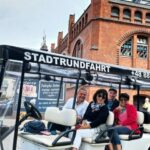
You start at Galeria Na Wieży, Wielkie Młyny 1, 80-849 Gdańsk, and the tour ends back at the same meeting point. That is a quiet win for your schedule. You don’t have to think about transit back across town afterward.
It also helps that the activity is near public transportation, so you can treat it like a simple hub. If you’re building the rest of your day around this tour, you can plan meals and museum time nearby without stress.
St. Mary’s Church: the Brick Gothic Crown of Gdańsk
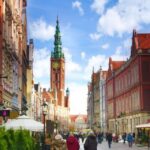
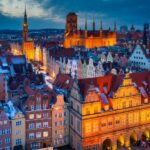
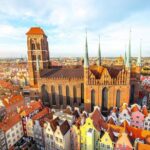
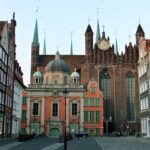
St. Mary’s Church is the kind of stop that makes you slow down, even if you’re on a tight itinerary. It’s a Roman Catholic church and co-cathedral in central Gdańsk, completed in 1502 in the Brick Gothic style, and it’s known as the Crown of Gdańsk.
This stop is valuable because it anchors the rest of what you’ll see. After this, the cranes, churches, and old-town buildings start to feel like parts of one long visual conversation: medieval power, wealth, and craftsmanship.
Practical tip: bring your phone camera and be ready to take a few shots from different angles. Brick Gothic architecture has details that look better once you walk a few steps, even if the tour’s overall pacing is quick.
The Crane Gate and the Motława River: a 15th-century photo moment
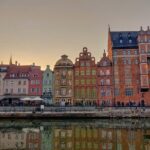
Next up is the Gdańsk Crane, also called the Crane Gate. It’s a 15th-century crane located in central Gdańsk on the Motława river—one of those structures that instantly signals this city’s waterfront identity.
This is a strong stop for two reasons. First, cranes are visually “busy” in a good way. Second, the river setting gives you that sense of Gdańsk as a working port, not just a museum town.
If you like architecture with a job to do, this one will click. You’re looking at industrial-era engineering that still feels present today.
Neo-Gothic reality check: the Gdańsk market building (reconstruction until 2026)
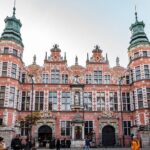
The Gdańsk market building was built in 1896 in a neo-Gothic style and sits in the historical center. The catch is that it’s currently under reconstruction until 2026.
So what should you expect? Think of this as an “outside view” stop where you learn what it is and see what you can from the street. If you come expecting a perfect, finished facade, you might feel a little let down.
Still, it’s useful. You’re seeing how the city keeps moving while preserving what matters. And your guide can help you spot the structure and style elements even with restoration happening.
You can also read our reviews of more private tours in Gdansk

St. John’s Church and the amber altarpiece: art in Brick Gothic form
One of the stops you’ll remember is the St. John’s Church, a Brick Gothic church in Gdańsk’s Old Town. In this area, you’ll also see the world’s largest amber altarpieces housed in a reconstructed medieval church.
Amber is one of those materials that looks different depending on the light. If the day is bright, it can feel almost unreal in photos, even if you’ve seen amber before. This is a great stop if you want one “wow” moment that feels tied to local identity.
If you’re the type who likes to connect art to place, this helps. The tour doesn’t just say amber exists—it puts it in a church setting with medieval roots and reconstruction context.
St. Catherine’s Church: the oldest layer of Gdańsk’s religious past
You’ll also stop at St. Catherine’s Church, described as the oldest church in Gdańsk. Construction began in the 1220s, but it has seen many renovations and additions over time to reach its full size.
This stop works well because it adds depth to what you’ve already seen. Earlier you get the grandeur and Brick Gothic style of other churches. Here you’re reminded that the city’s built story keeps evolving.
Even if you’re not a church-insider, the age alone makes it worth the quick pause. You’re looking at the kind of continuity that makes Old Town architecture feel like a living timeline.
WWII memory, up close: the Museum of the Second World War
The Museum of the Second World War is a state cultural institution established in 2008 in Gdańsk. It’s devoted to the Second World War, and it’s one of the tour’s heavier, more reflective stops.
Why it’s a good fit for a short golf cart tour: it gives you a framework. After seeing medieval cranes and churches, this museum stop helps you understand how quickly Gdańsk’s story shifted in the 20th century.
Practical tone tip: keep your pace calm here. Don’t rush your own reaction. Even without long museum time, a city tour context can help everything you already saw land better.
The Polish Post Office: 1920 to the start of WWII
Another meaningful stop is the Polish Post Office (Poczta Polska) in the Free City of Danzig, now modern-day Gdańsk. It was created in 1920 and operated until the German invasion of Poland, which marked the beginning of WWII.
This isn’t just a building. It’s a timeline you can feel: a civic service tied directly to a turning point in history. If you like learning from places that were involved in events, this stop will hit harder than a purely architectural stop.
If you’re the type to read plaques slowly, this is where you’ll want that habit. The tour’s time is short, but the significance here is not.
Solidarity and resistance: the European Solidarity Centre
The European Solidarity Centre is a museum and library in Gdańsk devoted to the history of Solidarity, the Polish trade union, and civil resistance movements. It also covers other opposition movements in Communist Eastern Europe and opened on 31 August 2014.
For many visitors, this is the “bridge” stop. You’ve just come from WWII remembrance and wartime-era context. Then this place shifts the story toward political organizing and resistance, which helps modern history make more sense.
It’s also a good stop for people who prefer story-based museums. The center’s role as both a museum and library suggests you can go beyond displays and keep learning.
Sołdek and the Teutonic mill: industrial Gdańsk in one sweep
Two industrial-history stops make this tour feel more complete than a pure church-and-crane loop.
First is Sołdek, described as a retired Polish coal and ore cargo steamship. Even if you don’t go deep into maritime history, it’s a tangible reminder that Gdańsk’s wealth and identity were built around movement and cargo.
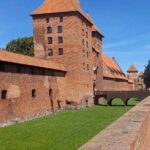
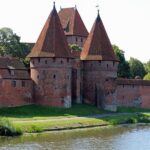
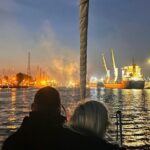
Then you’ll encounter the mill built by the Teutonic Knights in 1350. It’s described as the grandest civil construction in Gdańsk, with a rising tiled roof and a history tied to power and labor: until 1356, when the Radunia Canal was built, the mill was powered by slaves turning 18 huge wheels. It was also described as the largest industrial plant in Europe during the Middle Ages, and it functioned until the end of WWII.
That’s a lot of time compressed into one place. This stop is valuable because it explains industrial power as a system, not a vague idea. You get the human labor component, then the engineering shift with the canal, then the long lifespan up to WWII.
If history makes you curious, you’ll likely spend a few extra minutes looking at the structure details and thinking about how industrial buildings shape city centers.
Stacked eras in 90 minutes: why this order works
One reason I like this itinerary is the sequence. You start with iconic religious architecture, then move into waterfront structure and old-town buildings, then shift into the 20th century. After that, you land on civic resistance and industrial memory.
That arc helps you avoid the common problem in short tours: collecting sights without collecting meaning. Here, the stops connect, even if you only stay briefly at each location.
Price and value: $27.64 for a guided golf cart loop
At $27.64 per person, you’re not paying for long museum entry time. You’re paying for a guided, structured overview—delivered by golf cart—with an English offering and a mobile ticket.
In practical terms, the value comes from what you avoid. Without this format, you’d have to figure out routing, time gaps, and which landmarks to prioritize. Instead, you get a ready-made shortlist that hits big city identifiers: Brick Gothic churches, the Crane Gate, WWII and postwar-era institutions, plus industrial history.
Shared vs. private: when to choose each
- Shared makes sense if you want the essentials and don’t need a custom pace.
- Private is best if you want more room for photo pauses and back-and-forth questions.
One private-tour detail worth mentioning: a driver named Jacob has been described as very friendly and happy to explain history around the areas, while also taking plenty of photos at the spots that matter to you. That kind of interactive energy is exactly what you’re paying for with a private cart.
Who should book this tour (and who may want something else)
This tour fits you if you want a guided overview with major stops across several time periods. It’s also a good choice when you’re short on time but want more than one “quick photo” per stop.
It also works well if you like your sightseeing organized. With a maximum of 99 travelers on the activity, it’s designed to keep logistics manageable even in a shared setup.
You might want a different format if you’re looking for deep, slow time inside the major museums. This tour is built for movement and context, not long stays.
Should you book the Gdańsk golf cart city tour?
If your goal is to get oriented quickly and understand how Gdańsk’s story shifts from medieval landmarks to WWII and Solidarity, I’d book it. For the price, the tour’s big strength is that it compresses multiple “Gdańsk chapters” into one easy ride.
Just plan around two things: good weather and the fact that the Gdańsk market building is under reconstruction through 2026. If you can accept outside views where needed, you’ll get a satisfying snapshot of the city without burning half your day walking.
FAQ
How long is the Gdańsk City Tour by golf cart?
It lasts about 1 hour to 1 hour 30 minutes.
Is the tour shared or private?
You can book it as shared or private.
What language is available?
The tour is offered in English.
Where do I meet, and does the tour end there too?
You meet at Galeria Na Wieży, Wielkie Młyny 1, 80-849 Gdańsk, and the activity ends back at the same meeting point.
What happens if the weather is bad?
The tour requires good weather. If it’s canceled due to poor weather, you’ll be offered a different date or a full refund.
Can I get a full refund if I cancel?
Yes—free cancellation is available. You can cancel up to 24 hours in advance for a full refund.