REVIEW · WARSAW
Walk through the Warsaw Old and New Town: like Phoenix from the ashes
Book on Viator →Operated by PolinTours · Bookable on Viator
Warsaw rebuilds itself, street by street. This 2-hour walk lets you connect Old Town and New Town through the people who shaped them, from Frederick Chopin’s life and legacy to the Warsaw Uprising sites. I especially like how the guide points out the practical reasons the city was rebuilt the way it was, and how you keep getting story-sized moments at each stop. One possible drawback: it is mostly a walking route with short holds at each landmark, so if you want long, sit-down time in museums and churches, you may wish you had more hours.
You’ll start at Krakowskie Przedmieście near the Nicolaus Copernicus Monument, then work across Castle Square, churches, and viewpoints before ending at the Warsaw Uprising Monument. You’ll finish with Marie Curie’s birthplace in the New Town area, though the museum entry itself is not included. At $72.87 per person, the price feels fair for a guided route that saves you from guessing what to look at, and you can even end up with a private one-on-one feel if your group is small.
This is offered in English, runs with a licensed guide, and has a strong track record (a 5/5 rating based on 11 reviews). If you’re in Warsaw for a first visit and want a clear spine through the stories, this is a solid way to spend your time.
In This Review
- Key things to know before you go
- Starting at Krakowskie Przedmieście: where your walk gets its direction
- Holy Cross Church and Chopin’s heart: music history you can actually stand near
- University of Warsaw: the oldest campus edges of the city
- Tomb of the Unknown Soldier and the Saxon kings: power behind the scenes
- Palac Prezydencki and Castle Square: modern authority meets UNESCO Old Town
- St John the Baptist: the only church the frontline ran through
- Gnojna Góra and Rynek Starego Miasta: Vistula views and Old Town legends
- Through the city gate into New Town: Marie Curie’s birthplace stop
- Ending at the Field Cathedral and the Warsaw Uprising Monument
- Price and value: what $72.87 buys in two hours
- Who should book this Warsaw Old and New Town walk
- Should you book it?
- FAQ
- Where does the tour start and end?
- How long is the tour?
- What language is the tour offered in?
- Is this tour private?
- What’s included in the price?
- Which admissions are free and which are not?
- What payment extras should I plan for?
- Is there a meeting sign or guide identification?
- Is service allowed for people with mobility needs or service animals?
- Is cancellation free?
Key things to know before you go
- A tight 2-hour route that links Old Town, New Town, and the Warsaw Uprising story
- Stop-by-stop explanations at major landmarks like Holy Cross Church and Castle Square
- Chopin’s heart and Marie Curie’s birthplace both featured, with one museum entry not included
- UNESCO Old Town focus, including how the reconstruction was funded and who helped shape it
- Perfect meeting point at the Nicolaus Copernicus Monument with a PolinTours sign
- Built for small groups, and it can feel like a private tour if your group is tiny
Starting at Krakowskie Przedmieście: where your walk gets its direction
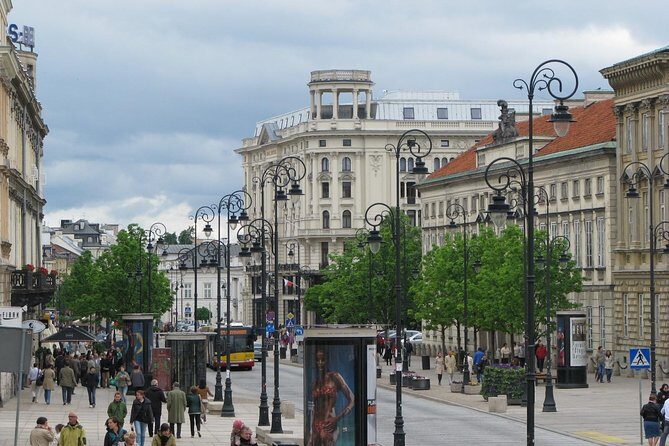
Your tour begins at the Nicolaus Copernicus Monument on Krakowskie Przedmieście, where the guide meets you holding a PolinTours sign. This is a helpful start because it puts you right on a main artery of the city, with an easy-to-navigate public transport area.
From the start, you’ll be walking with a guide who uses German, while the experience is offered in English. You’ll want to use the language you’re comfortable with, but the important part is you’ll get narration and guidance as you go, not just a list of sights.
This first stretch is also a good warm-up. You get your bearings fast and learn which streets and buildings matter, so later the Old Town doesn’t feel like a picture postcard you can’t connect to the human stories underneath.
You can also read our reviews of more walking tours in Warsaw


Holy Cross Church and Chopin’s heart: music history you can actually stand near
One of the first emotional stops is Holy Cross Church (Kosciol Swietego Krzyza). The guide brings the story of Frédéric Chopin into focus, including the fact that the church is where his heart rests.
That detail changes how you experience the space. Instead of treating the church as just another war-damaged or historic building, you understand it as a physical place tied to Chopin’s life and legacy. Even if you’re not a music superfan, you’ll likely leave with a more specific kind of appreciation because you’ve seen the marker directly tied to him.
A practical note: your time at each stop is short, so go in with a quick plan. Look up, then look around. If you try to read every plaque, you’ll lose the flow of the walk.
University of Warsaw: the oldest campus edges of the city
Next you’ll see the oldest part of the University of Warsaw (Uniwersytet Warszawski). This stop is brief, but it does something valuable: it gives you a Warsaw that isn’t only about battles and rebuilding.
Universities shape cities over generations. Seeing that older institutional presence helps you understand why Warsaw had cultural and intellectual momentum, even when politics and war threatened everything. If you care about why some cities recover faster, this kind of stop matters.
Since the time is limited, focus on the overall feel: scale, age, and how this civic institution sits within the broader city fabric. It’s a quick anchor before you pivot toward the political heart of modern Warsaw.
Tomb of the Unknown Soldier and the Saxon kings: power behind the scenes
You then pause at the Grob Nieznanego Zolnierza, the Tomb of the Unknown Soldier. The guide adds context that connects this memorial to the estate of the Saxon kings in Poland.
This is one of those moments where a monument can look straightforward until you hear what it’s pointing to. A tomb dedicated to an unknown person still tells you something very specific: how societies choose to remember, and how memory becomes part of public space. And tying it to the Saxon kings helps you place Warsaw’s later centuries into a longer chain of power and influence.
Keep your eyes open at this stop. It’s not about rushing photos; it’s about noticing how monuments set the tone for what comes next—especially when the tour turns toward seats of authority and national symbolism.
Palac Prezydencki and Castle Square: modern authority meets UNESCO Old Town
At Palac Prezydencki (the Presidential Palace), you’ll admire the seat of the Polish President and hear about its history in ways that go beyond the postcard exterior. The key value here is interpretation: you learn to see a government building as something that carries layers of change.
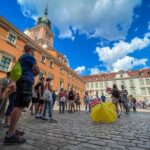
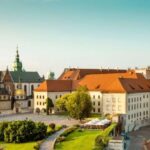
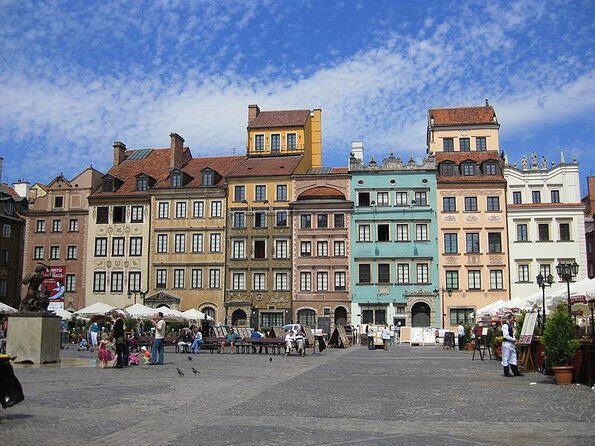
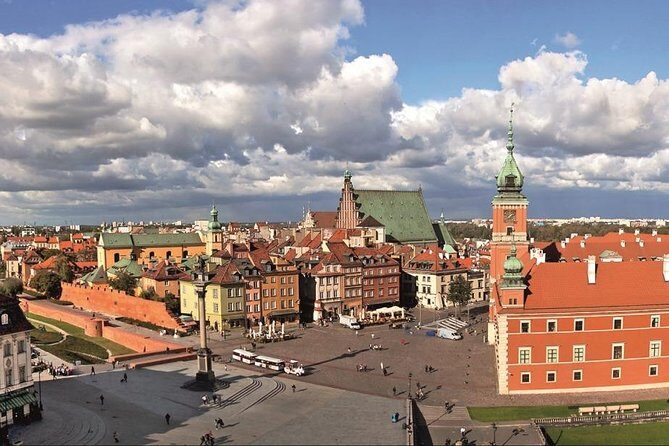
Then comes Castle Square (Plac Zamkowy), where the tour really starts to feel like the theme from the name. The guide highlights Warsaw’s Old Town, a UNESCO World Heritage Site, and emphasizes the fact that it’s known for being the youngest Old Town in the world, thanks to an extraordinary reconstruction process.
You’ll also hear the practical side of rebuilding: how it was financed and the role of a Venetian painter. That detail is worth paying attention to because it explains why the Old Town looks the way it does. It’s not random styling. It’s a chosen look, made with deliberate people and deliberate money.
In the square, you’ll also get context tied to the Royal Castle and the history of the first democratic constitution in Europe. That matters because it reframes the Old Town as civic identity, not only architecture. You’re not just walking streets; you’re walking symbols of self-rule and self-definition.
One consideration: this section can feel busy around the square. If you’re sensitive to crowds or waiting for others to move, give yourself a little patience. The stop time is short, so the guide will keep things moving.




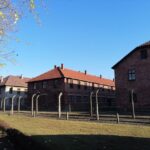
St John the Baptist: the only church the frontline ran through
Next up is the Archcathedral Basilica Of St John The Baptist. Here, the tour shifts from rebuilding and politics into survival and resistance.
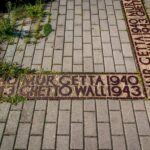
The big detail: you visit the church in Europe through which the war front ran during World War II. You’ll learn about the heroic struggle of the Poles in the Warsaw Uprising and also the role of the Russian army, as part of the broader wartime context.
This is a powerful stop, and it’s also a good one for history accuracy. When a guide explains how a church intersected with the war line, it turns abstract dates into something you can picture. Instead of hearing about the Uprising from a distance, you stand in the kind of place where the fighting actually touched daily life.
If you visit with a mindset of calm attention—look, listen, then move—you’ll get more out of it than if you rush for photos. Short stop times mean you have to choose what to absorb.
Gnojna Góra and Rynek Starego Miasta: Vistula views and Old Town legends
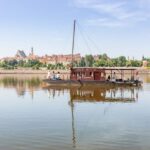
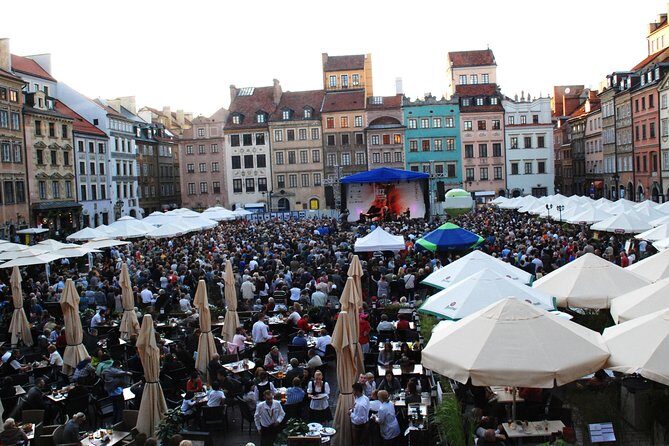
After the church, you get a breather at Gnojna Gora, where you look toward the Vistula. This is a quick pause, but it’s the kind of stop that helps your brain reset. You need those “you can see the city” moments so the stories don’t all blur together.
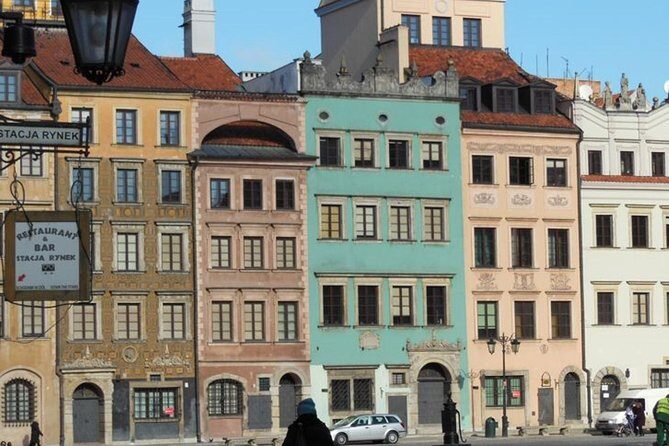
Then you reach Rynek Starego Miasta, the Old Town Market Square. This is where you’ll wander the picturesque streets around the most famous corners and landmarks of Warsaw. At the market place, the guide shares legends and authentic stories that help you connect the architecture to everyday life.
This stop can be great for first-timers because it’s where Warsaw’s identity feels most visible. The square and nearby streets are easier to recognize, so your guide’s comments land better.
The only watch-out: if you’re shopping or snacking, plan your timing. The tour moves on, and your time here is limited. If you want a snack, do it before you arrive so you don’t cut into the story time.
Through the city gate into New Town: Marie Curie’s birthplace stop
After entering the new town area through the city gate, you head to Muzeum Marii Sklodowskiej-Curie. Here, you explore the birthplace of Marie Curie—one of Poland’s most famous scientific figures.
One important detail: admission to the museum is not included. That means you’ll likely need to pay the museum entry separately if you want the full on-site experience. If you’re trying to keep your trip budget tight, check this decision early, because it can affect whether you feel the value matches your expectations.
Still, even with that added cost, this stop gives you something different from the wartime and political landmarks. It’s a reminder that Polish history isn’t only about conflict and rebuilding. It includes science, ideas, and the kind of achievements that travel far beyond national borders.
If you don’t want to pay for extra entry, you might still appreciate the general stop and surrounding context—but the tour is clearly set up to connect you to Curie’s story at the museum.
Ending at the Field Cathedral and the Warsaw Uprising Monument
Your walk concludes at the Field Cathedral of the Polish Army, and the tour ends at the Warsaw Uprising Monument (plac Krasińskich). This is a fitting final stop because it’s the emotional endpoint of the tour’s wartime through-line.
At this stage, the earlier stops make more sense. You’ve seen symbols of memory, places touched by conflict, the setting for civic identity, and then you end at a monument that consolidates the entire story of uprising and resistance.
Ending at a major memorial also helps you plan your next move. You’ll know where you’re headed and you won’t feel like the tour drops you into random streets. It’s a clean finish line for your history walk.
Price and value: what $72.87 buys in two hours
At $72.87 per person for about 2 hours, you’re paying for two things: interpretation and time-savings. In a city like Warsaw, the difference between wandering and guided walking is huge. Without a guide, you might admire the buildings and still miss why they were rebuilt, how monuments connect, and what specific sites mean.
The good value angle is also the structure. The tour covers major anchors from Old Town to New Town with short, purposeful stops. You don’t have to decide what order to hit first. You just follow the logic and get context as you go.
Also keep in mind: it’s priced per person, but it can feel more private if only a small group books. One-on-one or near one-on-one time is where tours like this feel especially worth it, because you can ask questions and get specific answers.
Who should book this Warsaw Old and New Town walk
I think this tour fits best if you:
- want a first-time Warsaw orientation that connects sites to stories
- care about Chopin and Marie Curie but still want the political and wartime context
- like guided walking tours that move at a pace you can handle without committing to a full day
It may feel less perfect if you:
- need long museum time or want deep, inside-only visits at every stop
- dislike brief stops and prefer slow, independent wandering
If you’re the type who likes to leave a city with clear mental maps and names you can place, you’ll likely enjoy this.
Should you book it?
Yes, if you want a focused history walk that ties together reconstruction, resistance, and major cultural figures without requiring you to plan a route. The Old Town emphasis at Castle Square and the ending at the Warsaw Uprising Monument are strong bookends. Add Chopin’s heart at Holy Cross Church and Marie Curie’s birthplace, and you get variety that still fits the same story line.
One extra smart move: decide in advance whether you’re willing to pay museum admission at Marie Curie’s site. If yes, you’ll likely feel like the experience covers a lot for the time. If no, you may want to adjust your expectations about what the New Town portion can provide.
If you’re in Warsaw for a shorter trip, this kind of guided spine can turn a confusing city into one you understand fast.
FAQ
Where does the tour start and end?
It starts at the Nicolaus Copernicus Monument on Krakowskie Przedmieście, and it ends at the Warsaw Uprising Monument at plac Krasińskich.
How long is the tour?
The tour lasts about 2 hours.
What language is the tour offered in?
The tour is offered in English.
Is this tour private?
It’s a private tour/activity, meaning only your group participates.
What’s included in the price?
Included items are a licensed city tour and tax. A mobile ticket is also provided.
Which admissions are free and which are not?
Admissions for most stops are free. Admission to the Muzeum Marii Sklodowskiej-Curie is not included.
What payment extras should I plan for?
The tour does not include snacks or transport, and it does not include admissions (other than the free stops). You may also need to budget for the Marie Curie museum entry.
Is there a meeting sign or guide identification?
Yes. The guide will pick you up with a PolinTours sign at the start point.
Is service allowed for people with mobility needs or service animals?
Service animals are allowed. The tour is near public transportation and most travelers can participate.
Is cancellation free?
Yes, you can cancel for a full refund up to 24 hours in advance. If you cancel less than 24 hours before the experience start time, the amount paid is not refunded.