REVIEW · KRAKOW
Krakow: Old Town, Jewish Kazimierz and Ghetto Sightseeing by Electric Golf Cart
Book on Viator →Operated by excursions.city · Bookable on Viator
Some cities are too big for a short visit. Krakow’s hits come fast on an electric cart tour.
You get Old Town landmarks and the Jewish Kazimierz and ghetto areas in one smooth loop, with an audio system that keeps moving even when sights are crowded.
What I like most is the small group (max 8) and the way the guide names key details clearly while you’re rolling between places. I also really appreciated the tour’s human touch—my favorite moments were tied to guides like Radic, Filip W, Michael, Tom, and Peter, who consistently explained what you’re looking at and answered questions when they could.
The main drawback is simple: the total time is short, so you might want longer photo stops at the busiest spots in Stare Miasto. If you come later in the day, you can also feel the push from other carts and tours, which makes it harder to pause when you want.
In This Review
- Key Things I’d Put on Your Radar
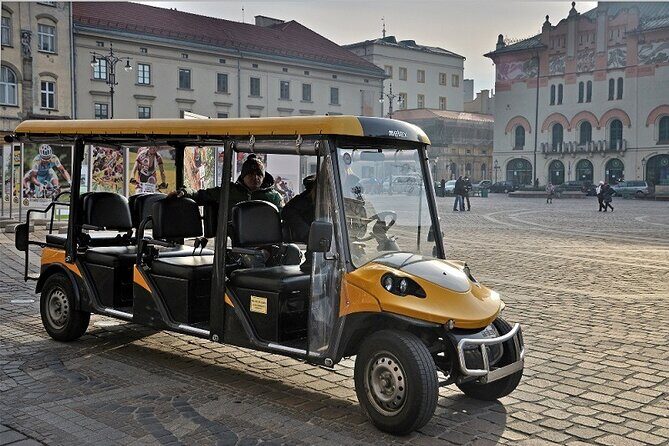
- Electric Golf Carts in Krakow: Fast, Quiet, and Actually Comfortable
- Starting Point to Finish Line: How the Route Feels in 2.5 Hours
- Old Town Power Stops: Market Square, Cloth Hall, and Town Hall Tower
- St. Mary’s Basilica and Its World-Class Art in the Center of Town
- Juliusz Słowacki Theatre and the Barbican: Fortification Meets Drama
- Kazimierz on Wheels: Szeroka Street and the Synagogue Stops You’ll Remember
- Podgórze and the Krakow Ghetto: What You See at the Wall and Umschlagplatz
- Price and Value: What $56.47 Buys You in Real Terms
- Getting the Most Out of the Tour: My Practical Tips
- Who This Tour Is For (and Who It Isn’t)
- Should You Book This Electric Cart Tour?
- FAQ
- How long is the Krakow Old Town, Jewish Kazimierz and Ghetto sightseeing tour by electric golf cart?
- Is the tour offered in English?
- What group size is this tour limited to?
- Is there a mobile ticket?
- Are large bags allowed on the electric golf cart?
- What is the cancellation policy?
Key Things I’d Put on Your Radar
- Electric golf cart = efficient sightseeing when your feet are tired or your schedule is tight
- Max 8 travelers means you’re not just a number in a huge group
- A guide plus an audio system helps you understand what you’re seeing right away
- Kazimierz focus: Szeroka Street and multiple synagogue stops, not just a drive-by
- Ghetto remembrance stops around Podgórze, including Umschlagplatz and a preserved wall fragment
- Time-tested Old Town lineup: Market Square, Cloth Hall, Town Hall Tower, and major churches
Electric Golf Carts in Krakow: Fast, Quiet, and Actually Comfortable
Krakow can feel like two trips at once: the fairy-tale Old Town you want to photograph, and the real neighborhoods you need time to understand. This tour’s big value is that it solves the main problem—getting to the right places without burning your whole day walking.
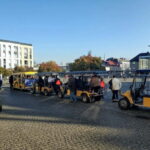
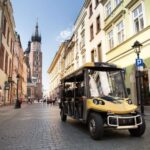
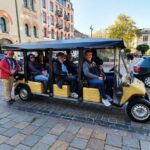
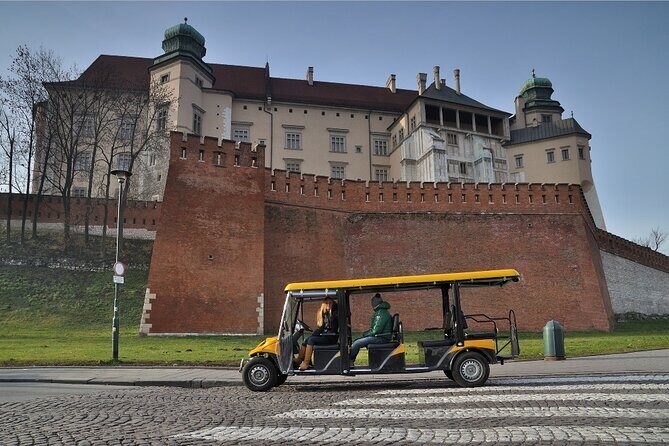
You ride in an eco-friendly electric golf buggy with an audio system. That matters because the route is packed with landmarks, and the audio keeps context flowing while you’re moving. Even if you only catch part of a monument’s story, you’re still getting the “what, where, and why” in real time.
Comfort-wise, the vehicles are designed for sitting, so you’ll want to travel light. The tour note is clear: don’t bring large baggage, since there’s only room for passengers. If your day includes shopping or a big backpack, plan to stash it before you meet.
And yes, it’s a group tour—other people will join you. The max of 8 helps keep the vibe friendly, but you should still be ready for quick transitions between stops.
You can also read our reviews of more tours and experiences in Krakow.
Starting Point to Finish Line: How the Route Feels in 2.5 Hours
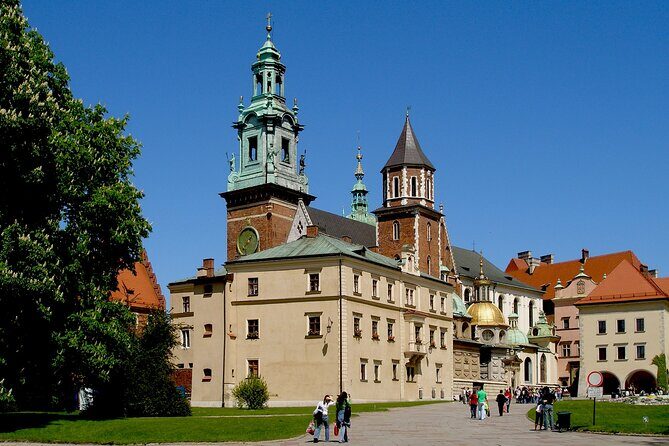
The tour runs about 2 hours 30 minutes and goes from Mikołaja Zyblikiewicza 2 to Mikołaja Kopernika 3. That end point is handy because it keeps you close to more central areas after the cart drops you off.
Timing matters. You start at a set time, so be at the meeting point on schedule. This is one of those tours where being late can throw off the whole flow, because you’re sharing a tight route with other groups.
Because the cart is moving most of the time, the schedule feels like a series of “quick snapshots.” That’s not a flaw—it’s the point. You’re buying coverage and orientation more than deep, hour-long museum-style visits.
In practice, I’d treat it as a high-impact introduction. You’ll likely want to return later for the one or two places that grab you most.
Old Town Power Stops: Market Square, Cloth Hall, and Town Hall Tower
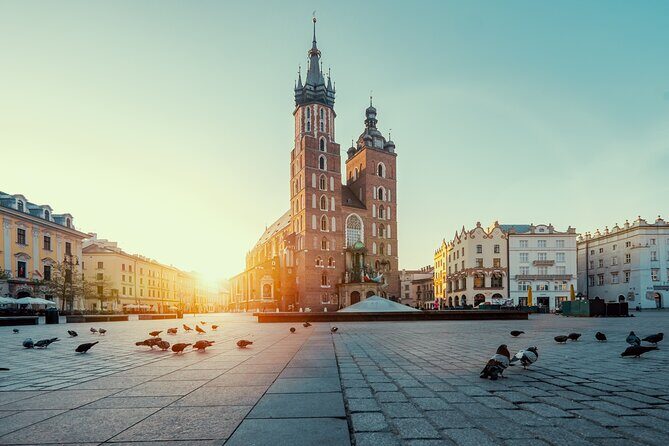
Krakow’s Old Town is the kind of place where it’s easy to get lost in the beauty and forget what matters. This tour starts you in the middle of the action: the main Market Square. It’s described as the most important public space in Kraków, and the idea is that everything you need to understand about the city’s medieval life is concentrated here.
From there, you move to the Sukiennice (Cloth Hall), Kraków’s oldest commercial center. This stop is useful even if you don’t go inside, because you see how commerce and civic life were linked. The Renaissance architecture is also a visual anchor—you can point at it and say, this is one of the city’s big anchors.
Next comes the Town Hall Tower, with its steep count of stone steps and its long history. The key for me wasn’t the numbers (though they’re impressive); it was the feeling of a city that has kept going for centuries. When your guide explains that the tower is the only remnant of the city authorities’ original seat, the place turns from “pretty tower” into “real governance history.”
These stops also give you something practical: after seeing them from the cart route, you’ll know where you are when you walk back later on your own.
St. Mary’s Basilica and Its World-Class Art in the Center of Town
If you’ve ever wondered how Kraków fits huge artistic masterpieces into a normal street-level day, St. Mary’s Basilica is your answer.
You’re shown a church that’s packed with “this is why people come” details. The highlight is the high altar by Veit Stoss (Wit Stwosz). You also hear about the strong visual storytelling inside—painted and star-strewn vaulting murals attributed to Jan Matejko, plus the mention of a bugle call as part of the church’s cultural life.
Here’s the practical part: this is one of those places where the cart route helps you locate the church quickly, but the real payoff comes when you step inside (if time allows) or at least view it from close by. Because you’re in Kraków’s center, the stop feels integrated rather than tacked on.
The only thing to plan for is time. With a 2.5-hour tour, moments like this may be shorter than you want. If St. Mary’s is a top priority, you’ll probably circle back later.
Juliusz Słowacki Theatre and the Barbican: Fortification Meets Drama
Kraków has a talent for mixing serious stonework with everyday life. The Juliusz Słowacki Theatre is one example. It’s described as one of the country’s best-known Polish stages, operating continuously since 1893. Even if you’re not a theater person, seeing a building that has kept its cultural role for so long changes how you read the city.
Then you move toward the Barbican, one of the city’s fortification pearls. The story here is that it was never captured during a siege, and the legend credits defenders repulsing attackers with a single shot. Whether you take the legend literally or as part of local memory, the point is clear: this is medieval defense architecture with real presence.
On a cart, the Barbican works well because you get the context of how it sits within the larger city view. On foot, it’s easy to miss that defensive role. On wheels, you see how the city’s old layers wrap around each other.
Kazimierz on Wheels: Szeroka Street and the Synagogue Stops You’ll Remember
If Old Town gives you the postcard Kraków, Kazimierz gives you the living history. This is where the tour feels most focused, because it doesn’t just point at one spot—it walks you through a neighborhood identity.
One of the key streets is Szeroka Street, described as the heart of Jewish Kazimierz and a place where four synagogues once stood—something that’s said to be unheard of elsewhere in Europe. Even if you only spend a short time in the area, this framing helps you understand why the neighborhood’s layout matters.
You also visit the Tempel Synagogue, with special attention on stained glass windows (among the best preserved in Poland). The other reason it’s highlighted is its less conventional character. This matters because it shows that Jewish community life wasn’t monolithic—it had different expressions and traditions over time.
Another stop is the Remuh Synagogue (the smallest of the seven synagogues referenced here). It’s known for modest decor compared with the others, and after renovations completed in April 2016, it became a main site of prayer for Kraków’s Jewish community. For me, this is one of the more powerful moments on the tour because it ties architecture to present-day continuity, not only to what was lost.
The tour is careful to keep these stops connected to the story of the neighborhood. That’s the difference between a “see a synagogue” moment and a “understand what this place meant” moment.
Podgórze and the Krakow Ghetto: What You See at the Wall and Umschlagplatz
The tour’s second act shifts tone for the Krakow Ghetto and Podgórze area. It’s not handled as trivia; it’s treated as remembrance, with specific sites tied to occupation-era tragedy.
You see a preserved fragment of the original ghetto wall with a plaque commemorating what happened to the inhabitants. That’s the kind of stop where you usually notice fewer people photographing and more people trying to take it in quietly. Even if your day is still moving, this point can slow you down in a good way.
Another major stop is Plac Zgody, also called Concord Square, now linked to its occupation name Umschlagplatz. This is explained as the gathering place where Jews were forced to assemble for deportation. Standing in a public square and hearing that story gives you a painful contrast: everyday urban space used for machinery of persecution.
This tour also brings in the story of Tadeusz Pankiewicz, connected to a pharmacy that his father owned. The framing here is that taking over the pharmacy became the start of a historical story. Even without deep details at every stop, the guided attention helps you connect the dots between individuals, local places, and the broader war context.
One practical note: this part of Kraków can be emotionally heavy, so give yourself permission to pause. The cart transitions help keep the schedule manageable, but you’ll still want a moment to sit with what you’re seeing.
Price and Value: What $56.47 Buys You in Real Terms
At $56.47 per person for about 2.5 hours, you’re paying for three things:
- transport (electric cart),
- interpretation (audio plus guide presence), and
- tight routing (coverage across Old Town + Kazimierz + ghetto sites).
If you tried to do the same range purely on foot, you’d likely lose time—and you’d probably skip at least one of the bigger chunks, like the ghetto-area stops. The cart is what makes “one-day orientation with meaningful stops” possible.
The small group size (max 8) also improves value. In a bigger group, the stops can feel rushed and the guide can’t answer questions. Here, the feedback you get is more personal. Many guides on similar tours win people over; in this case, I saw repeated praise for guides by name (Radic, Filip W, Michael, Tom, Peter), and that matches the experience goal: understanding quickly, not just seeing quickly.
The trade-off is also about value: because time is limited, you might want longer at a few high-demand sites. One review summed up a common wish—more time for photos at each stop. Plan your expectations around this being a fast, guided sampler.
Getting the Most Out of the Tour: My Practical Tips
This is where you can make the difference between a good tour and a great one.
First, pick an early time slot when possible. The experience can get busier later, and the busiest parts of Stare Miasto are exactly where congestion can make it hard to line up for photos or get a clear view.
Second, if a stop matters to you—like a church interior, a synagogue visit, or a specific memorial—decide in advance what you want from it. Since your overall time is tight, you’ll get better results by aiming for one or two “deeper” moments rather than trying to do everything at maximum speed.
Third, communicate what you want during the stops. Guides on this tour are described as attentive and informative, and some made time for short walks and quick photo moments. If you need to step out for a brief visit, you’ll want to request it clearly and promptly.
Finally, pack light. The vehicles are designed for passengers sitting, so you’ll feel more relaxed if you’re not juggling big bags.
Who This Tour Is For (and Who It Isn’t)
This tour fits best for you if:
- you have limited time in Kraków and want the main landmarks in one day,
- you prefer organized guidance over figuring out transit and timing on your own,
- you want both sides of Kraków: Old Town charm and Kazimierz plus ghetto remembrance.
It may not fit perfectly if:
- you want long, unhurried time at each monument,
- you’re looking for a museum-level deep dive at one specific site,
- you travel with bulky luggage that’s hard to keep compact.
Also, if walking is difficult for you, the cart helps. Several guide-focused comments specifically mention that the setup works well for people who can’t walk for long periods.
Should You Book This Electric Cart Tour?
I’d book this tour if your goal is fast orientation plus meaningful stops—Old Town, Kazimierz, and the ghetto area—without losing half your day to transit or searching. The value is strongest when you treat it like a guided introduction and then return later to the places that pull you in.
If you’re the type who needs lots of time at every stop for photos and interiors, consider using the tour to learn the layout and stories, then plan a follow-up on your own day. The cart gives you the map. Your second visit gives you the depth.
Overall, this is a smart way to see a lot of Kraków in a way that still feels guided, not rushed.
FAQ
How long is the Krakow Old Town, Jewish Kazimierz and Ghetto sightseeing tour by electric golf cart?
It lasts about 2 hours 30 minutes.
Is the tour offered in English?
Yes, the tour is offered in English.
What group size is this tour limited to?
The tour has a maximum of 8 travelers.
Is there a mobile ticket?
Yes, the tour includes a mobile ticket.
Are large bags allowed on the electric golf cart?
No. The vehicles only have enough room for passengers to sit, so you should not bring large baggage.
What is the cancellation policy?
Free cancellation is available. You can cancel up to 24 hours in advance for a full refund, and cancellations within 24 hours are not refunded.