REVIEW · GDANSK
Gdansk: 1945 History Local Guide Tour by Electric Golf Cart
Book on GetYourGuide →Operated by Electricity Tour · Bookable on GetYourGuide
A 1945 Gdańsk drive can feel like time travel. This electric golf cart tour takes you around the Old and Main Towns while your guide connects today’s streets to the immediate aftermath of WWII. You also get archival photographs that help you “see the before” instead of guessing.
I love how the route is built for first-time orientation. In about an hour, you get a sense of where key sights sit in the city, and your guide keeps steering the conversation back to reconstruction—so it’s not just a checklist.
My other favorite part is the delivery. Guides like Ewelina (English, plus German and Polish options) make the stories clear and answer questions without rushing you, and the heated cart with blankets makes winter stops much easier.
One thing to consider: this is a short ride with brief stops. If you’re the type who wants to linger for long museum reading or deep architectural details, plan to follow up on your favorite spots after.
In This Review
- Quick reasons this 1945 cart tour is worth your hour
- Why a 1945 electric-cart tour works so well in Gdańsk
- Pańska 1 to a time-jump: what the 1-hour format really means
- The first stops: seeing the post-war story start to form
- Old Town checkpoints: churches, mill, and squares with a 1945 lens
- Museum stop and main square energy: how context is added without slowing you down
- Waterfront and gates: where the 1945 contrast feels real
- Great Armoury stop: a satisfying finale to the reconstruction loop
- Guide delivery: Ewelina’s storytelling is the engine
- Price and value: why $4.89 can be surprisingly fair
- What this tour is best for (and what it isn’t)
- Should you book this 1945 Gdańsk electric-cart tour?
- FAQ
- How long is the Gdańsk 1945 History tour by electric golf cart?
- What is the meeting point for the tour?
- Which languages are available for the live guide and audio guide?
- Is the tour wheelchair accessible?
- Does the price include anything besides the cart ride?
- Is there a cancellation option?
- Is it possible to reserve without paying immediately?
- Is the tour heated and comfortable in cold weather?
Quick reasons this 1945 cart tour is worth your hour
- Heated electric cart and blankets help when it’s cold and you want comfort while viewing outdoor sights
- Archival photos + live guide stories turn “post-war Gdańsk” into a story you can actually follow
- Small-vehicle feel (in at least one recent run, a compact seating setup) makes it easy to hear your guide
- Old and Main Town coverage gives you fast orientation without leg fatigue
- English, German, Polish live guiding + audio in those languages lets you match your comfort level
- Stops across major landmarks (churches, gates, waterfront, and more) show how many parts of the city were rebuilt and reimagined
Why a 1945 electric-cart tour works so well in Gdańsk
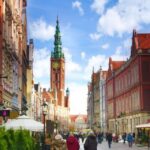
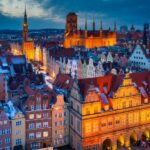
Gdańsk can look like a movie set—beautiful facades, clean streets, and postcard views. The catch is that without context, it’s easy to miss what you’re actually looking at. This tour keeps you grounded in a single question: what did the city look like right after the war, and how did it get from ruin to what you see now?
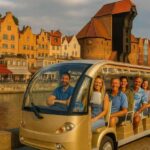
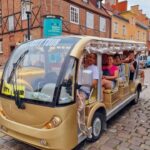
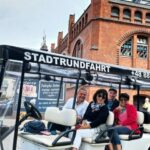
The electric golf cart matters more than you might think. It lets the group move at a pace that fits a “see, then understand” format. Instead of hopping between places on foot until you’re tired, you can stay present for the guide’s comparisons between then and now.
And the tone is what I’d call practical and human. It’s not a lecture you have to decode. It’s a moving history lesson that focuses on the shock of damage and the stubborn work of rebuilding.
You can also read our reviews of more guided tours in Gdansk

Pańska 1 to a time-jump: what the 1-hour format really means
You start at Pańska 1. From there, the tour runs on short sightseeing windows—typically only a few minutes per stop—so you’ll never get bored, but you also won’t get “museum-length” time. Think of it as a curated loop that gives you momentum and a clear mental map.
The schedule is tight in a good way. You’ll stop often enough to orient yourself, and the guide uses the drive between points to stitch the story together. This helps a lot in Gdańsk, where landmarks are close but the city’s layout can still feel like a puzzle on day one.
Comfort is built into the experience, especially in colder months. The cart can be heated, and there are blankets available according to recent visitor notes. If you plan your day around outdoor sightseeing, that kind of comfort changes the whole vibe.
The first stops: seeing the post-war story start to form
The first viewpoints are aimed at easing you into the big theme. You’ll make a short stop at the Polish Post Office Museum. Even without getting stuck in details, it sets an early tone: how public institutions and everyday life fit into wartime disruption and later rebuilding.
Next up is Parafia pw. Świętej Brygidy and then St. Catherine’s Church, Gdańsk. Churches can be dramatic anchors in a city, but on this tour the point isn’t to memorize features. The point is to notice what survives, what changes, and how different parts of the city’s identity return after destruction.
Then you reach Wielki Młyn and Plac Solidarnosci. These stops help broaden the story beyond monuments. Your guide’s job is to connect the visible city to what it meant to reconstruct a living place—streets, neighborhoods, and community space—rather than only big-ticket landmarks.
You’ll also pause at the Museum of Second World War. Even though your time there on the cart tour is brief, the stop works like an orientation marker. It cues you to see what comes later with fresh context, especially if you plan to visit that museum on a separate day with more time.
Old Town checkpoints: churches, mill, and squares with a 1945 lens
What I like about the Old Town and Main Town mix is that it prevents the story from becoming one-note. If you only looked at gates and grand buildings, you’d miss the everyday texture of the rebuild. If you only looked at neighborhood streets, you might miss the major landmarks that frame the city’s identity.
At St. Mary’s Church, Gdańsk, you get another religious landmark with a short stop window. I treat these stops as “story anchors.” Your guide is the one doing the heavy lifting by connecting the site to the visible differences between past devastation and present-day form.
The tour also includes the Statue of John III Sobieski. It’s a reminder that cities rebuild more than physical structures. Public memory—what gets honored and how it’s represented—changes too, and your guide helps connect those dots to the broader post-war moment.
From Plac Solidarnosci to the later fortress-adjacent stops, the route is designed so the story doesn’t feel random. Every few minutes you see something new, and every time you stop, the guide ties it back to the same theme: 1945 transformation and resilience.
A practical note: with frequent brief stops, your photo strategy matters. If you want photos, stand where you can shoot quickly because you won’t have long. If your priority is the story, give yourself permission to pause without always raising your camera. The real value here is how the guide compares what you’re seeing to what the city looked like in reconstruction.
Museum stop and main square energy: how context is added without slowing you down
When the tour reaches the Museum of Second World War, it does something subtle. It places a major context point inside an otherwise outdoor loop. You don’t have to choose between walking the city and learning the setting. You get a quick “you are here in the larger story” moment, then you keep moving.
Plac Solidarnosci also helps with pacing. A square is an easy place to understand scale—how wide the spaces are, how the city moves through them. On a 1945-focused tour, a public square is especially useful because reconstruction isn’t just about buildings. It’s also about restoring space for people to gather, work, and live.
The tour’s strength is that the comparisons are guided. Instead of you trying to interpret ruins or missing pieces on your own, the guide points out what the archival images help you see. That’s the difference between “I saw a nice square” and “I understand what changed.”
You can also read our reviews of more historical tours in Gdansk

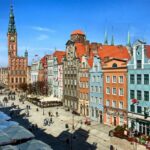
Waterfront and gates: where the 1945 contrast feels real
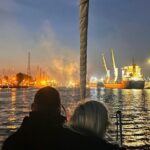
A major highlight for many people is the mix of harbor and fortification-style landmarks. You’ll stop at Stary Zuraw Portowy—the port crane. Even on a quick stop, it’s a memorable shift from streets and church towers to maritime identity. Your guide uses stops like this to underline how the city’s role in trade and daily work kept shaping what rebuilding needed to restore.
Then you move toward the city’s thresholds with Brama Wyzynna. A gate is a natural place for a “then and now” contrast because it’s both functional and symbolic. Gates control passage and define the boundaries of the old city structure, so your guide can connect the symbolic weight to the rebuilding period.
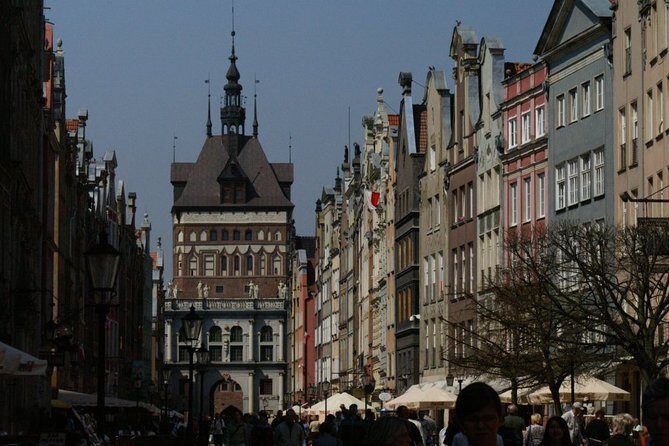
Short stops also include Katownia and Golden Gate, Gdańsk. Even if you only have a couple minutes at each, the cart tour format works because your guide ties them back to the reconstruction story. Rather than you trying to read every detail, you’re getting a curated emotional and historical framework.
The Golden Gate stop tends to anchor the route. It’s the kind of landmark that makes you look up, and that’s exactly what you want when you’re trying to understand how a city reasserts itself after destruction. Your guide’s photos help explain why the visual impact matters.
Great Armoury stop: a satisfying finale to the reconstruction loop
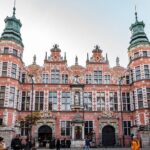
The final major sightseeing point is the Great Armoury. By the time you arrive here, the story has usually clicked. You’ve moved through churches, a mill, squares, the war museum area, gates, and the port. That means your last stop doesn’t feel like a random final stop—it feels like a wrap-up of how the city’s identity comes back in tangible form.
A good cart tour doesn’t just show you places. It gives you a way to connect them mentally when you’re back in your hotel. When you reach the end of the loop and return to Pańska 1, you’re not starting from scratch. You’ve built a timeline in your head: the shock of what happened, and then the deliberate rebuilding.
Guide delivery: Ewelina’s storytelling is the engine
A history tour lives or dies on the guide. In recent tours, Ewelina has been singled out for making the information clear, with strong English and a friendly, question-friendly style. That matters because you’re hearing a complex period explained without turning it into a textbook.
There’s also an audio guide included, in English, Polish, and German. That’s useful if you want a second channel for the story or if you like to follow along in your own pace when the cart moves between stops. The combination of live guidance plus audio support gives you a better chance to catch every key point.
If you’re the type who likes to ask questions, this format helps. You’ll have a guide who can pause, respond, and keep the narrative coherent. One of the best ways to use a short tour like this is to treat it as a conversation starter. Ask what to look for afterward on your self-guided walk.
Price and value: why $4.89 can be surprisingly fair
At $4.89 per person for a 1-hour experience, you’re paying for more than rides. You get a live guide, archival photographs, and an audio guide. You also get the convenience of an electric cart that reduces walking time, which is a real cost saver when weather is cold or you’re conserving energy for museums later.
This is also a good value structure: brief stops across major areas mean you get a lot of orientation. If you’re visiting Gdańsk for a limited time, that orientation has a direct pay-off. You’ll know where to return for longer time at the places that grab you.
There’s also a comfort value that people notice. Recent visitors have mentioned the cart being heated and having blankets. That turns the “winter problem” from a deal-breaker into a minor inconvenience. Even if the weather is less than perfect, you’re still moving and learning instead of standing outside freezing.
One practical consideration: because the stops are short, you may not feel satisfied if you want deep detail at every single location. For that, you’ll likely want to pick one or two spots to revisit independently.
What this tour is best for (and what it isn’t)
This is an ideal fit if you want:
- A fast way to get your bearings in the Old and Main Town areas
- A history-centered route where you learn through comparisons of then and now
- A comfortable sightseeing format, especially in colder weather
- A guide-led experience that answers questions and keeps things moving
It might not be the best match if:
- You want long museum time at every stop
- You need deep, stop-by-stop architectural analysis (this tour is designed for quick, story-driven viewpoints)
- You prefer fully self-guided experiences with lots of unscheduled wandering
If you fall into the middle—curious, want context, but don’t want to spend a whole day doing research—this is a sweet spot.
Should you book this 1945 Gdańsk electric-cart tour?
I’d book it if you like learning while you move and you want a clear 1945 framing for what you’ll see in Gdańsk. The combination of archival photos, a guide who can explain the contrasts in plain language, and a comfortable heated cart makes the short duration feel efficient rather than rushed.
Skip it only if you already have a strong background and you’d rather spend the hour reading and exploring one place deeply. For most people making the first or second visit to Gdańsk, this tour is a smart way to understand the city’s transformation without burning a whole day.
FAQ
How long is the Gdańsk 1945 History tour by electric golf cart?
It lasts 1 hour.
What is the meeting point for the tour?
The starting location is Pańska 1.
Which languages are available for the live guide and audio guide?
The live tour guide is available in English, German, and Polish. The audio guide is also included in English, Polish, and German.
Is the tour wheelchair accessible?
Yes, the tour is wheelchair accessible.
Does the price include anything besides the cart ride?
Yes. The tour includes the Gdańsk tour by electric car, archival photographs, and the guide’s stories, plus an audio guide.
Is there a cancellation option?
Yes. You can cancel up to 24 hours in advance for a full refund.
Is it possible to reserve without paying immediately?
Yes. The option is reserve now & pay later.
Is the tour heated and comfortable in cold weather?
Recent visitors mention that the golf cart is heated and that blankets are available if you need them.