REVIEW · KRAKOW
City Tour Cracow golf car plus Cruise on the Vistula River.
Book on GetYourGuide →Operated by Melexy Kraków · Bookable on GetYourGuide
Krakow moves fast with the right ride. This tour pairs a comfortable golf car city loop with a relaxing Vistula River cruise, so you get big sights without spending half your day in traffic or walking circles. I especially like how it focuses on practical orientation stops like Kraków Barbican and St. Florian’s Gate, and how it threads in the Jewish quarter plus Oscar Schindler’s factory area. The one possible drawback: there are several self-guided stretches, so you’ll want to move with purpose and be okay with quick stops rather than slow, in-depth museum time.
The best part is the pacing. You’ll start with hotel pickup, then do guided driving plus audio narration during the cruise, ending back on the boulevard near Wawel Castle.
In This Review
- Key highlights at a glance
- Why this golf car + river combo makes Krakow easier
- Florian Gate, Barbican, and Planty Park: getting your bearings fast
- Florian Gate and the medieval gateway feeling
- Kraków Barbican as the Old Town threshold
- Planty Park as the reset zone
- Main Market Square, Town Hall, and Collegium Maius
- Main Market Square: the big medieval plaza moment
- Town Hall area and the Old Town skyline
- Collegium Maius: university space with stone details
- Church of St. Francis, Bishop’s Palace, and Wawel Hill views
- St. Francis of Assisi area and the human-scale details
- Bishop’s Palace and a royal-city feel
- Wawel Hill: the castle-on-a-bluff perspective
- Kazimierz and the Jewish quarter: synagogues plus walking history
- Old Synagogue and the synagogue cluster
- Plac Nowy and the daily-life vibe
- Corpus Christi Basilica: dates that ground the architecture
- Wolnica Square and the old salt trading corridor
- Podgórze, the ghetto memorial spots, and Oscar Schindler’s factory area
- Father Bernatek’s Bridge: sculptures and a strong photo angle
- Plac Bohaterów Getta and the ghetto connection
- Apteka pod Orłem and the Schindler’s Factory complex
- Fragment of ghetto wall and Église Saint-Joseph ending point
- The one-hour Vistula River catamaran cruise with 27-language audio
- Audio narration in many languages
- Where you end: back near Wawel Castle
- What I think the best value is for you
- Who should book this (and who might want another option)
- Before you go: simple tips that help
- Should you book this Krakow golf car and Vistula cruise?
- FAQ
- How long is the tour, and how much of it is the river cruise?
- Is hotel pickup included?
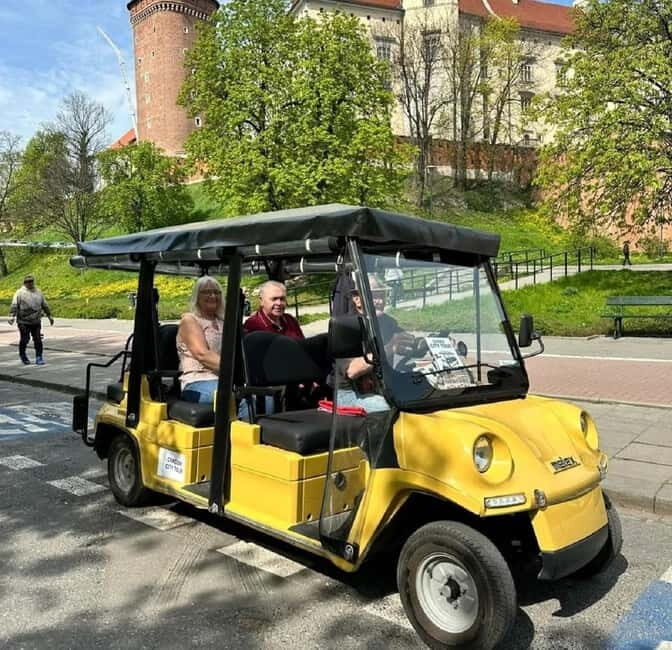
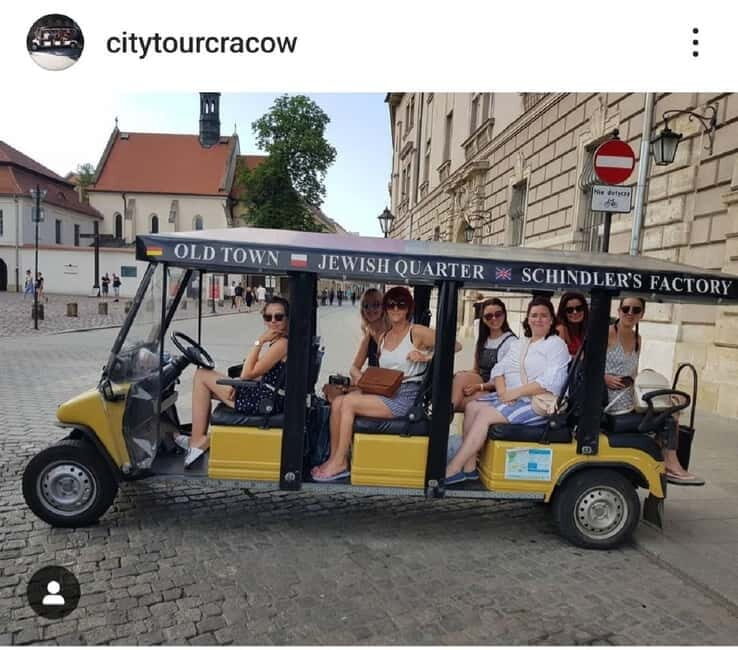
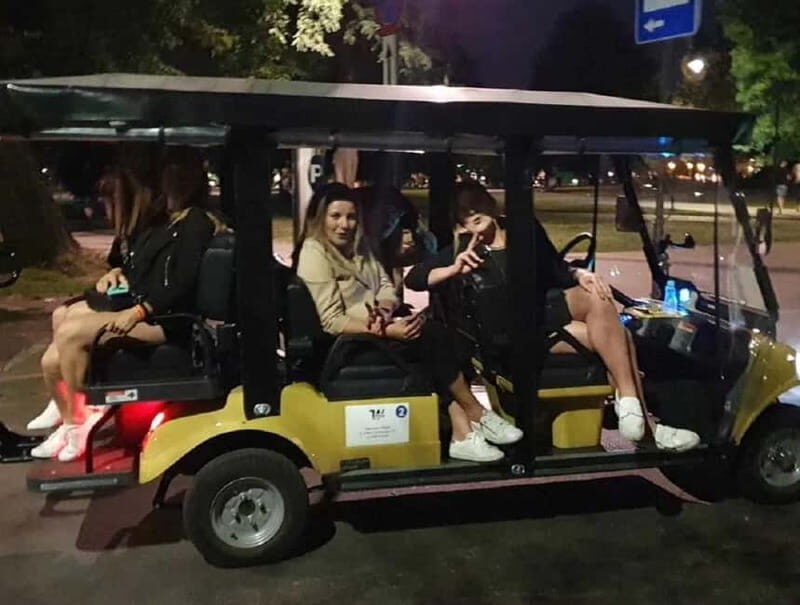
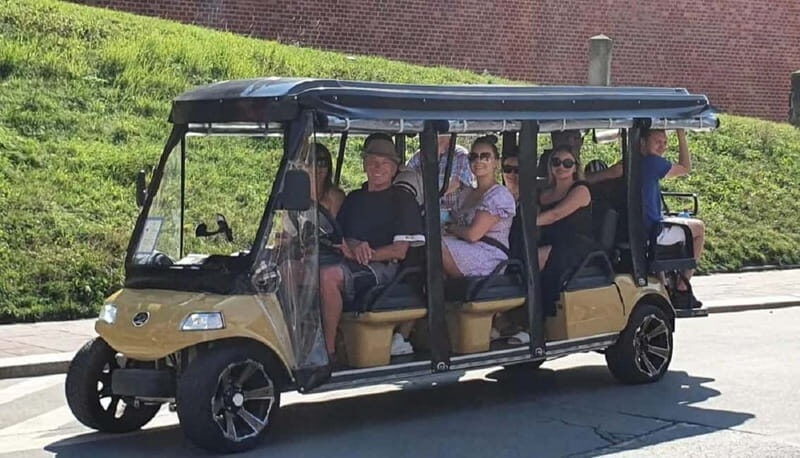
- What vehicles are used during the experience?
- What languages are available for the tour and the audio guide?
- Which Jewish district stops are included?
- Where does the tour end after the cruise?
Key highlights at a glance
- Golf cart-style cruising past the Kraków Barbican and through the Old Town gateway area
- Main Market Square orientation with time for quick photos and people-watching from Europe’s largest medieval plaza
- Kazimierz synagogue stops in the Jewish district, including Remuh, Popper, and Izaak Synagogues
- Schindler’s Factory photo and museum area via Apteka pod Orłem and the factory complex
- Father Bernatek’s Bridge details and the ghetto-memory photo points in Podgórze
- One-hour Vistula River catamaran cruise with audio in many languages
Why this golf car + river combo makes Krakow easier
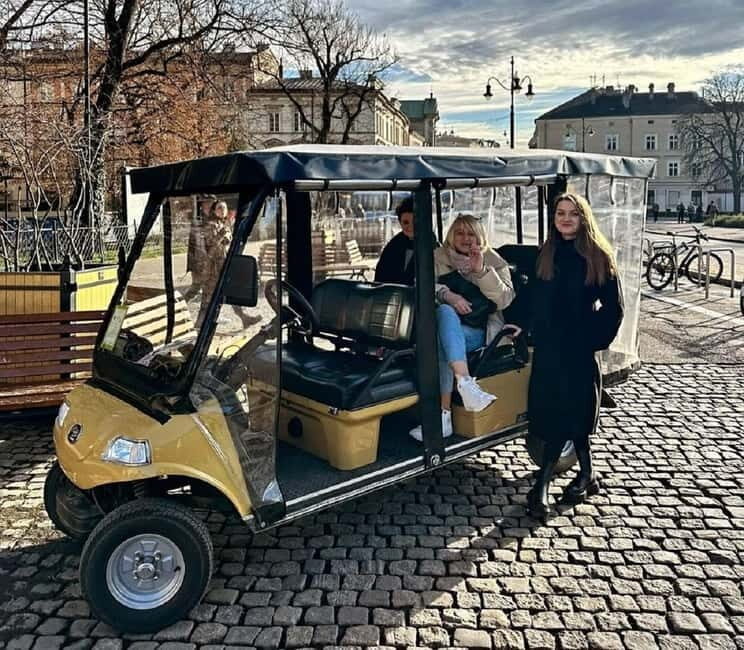
Krakow can feel spread out. The Old Town core is walkable, but once you start reaching the Jewish district (Kazimierz) and then Podgórze, you’re crossing neighborhoods that each deserve attention. That’s where the golf car helps: you get a “cover the map” day without turning it into a marathon.
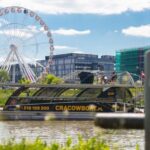
You also get two very different experiences in one ticket. First, you’re on the ground, rolling past landmarks like a local moving through the city. Then you float on the Vistula River in a modern catamaran for a full one-hour cruise—the kind of break that helps you reset your legs and your brain before the next cluster of sights.
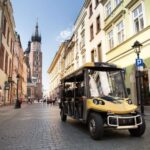
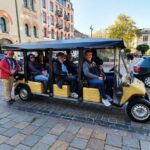
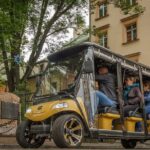
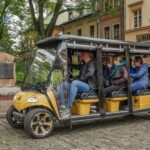
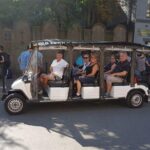
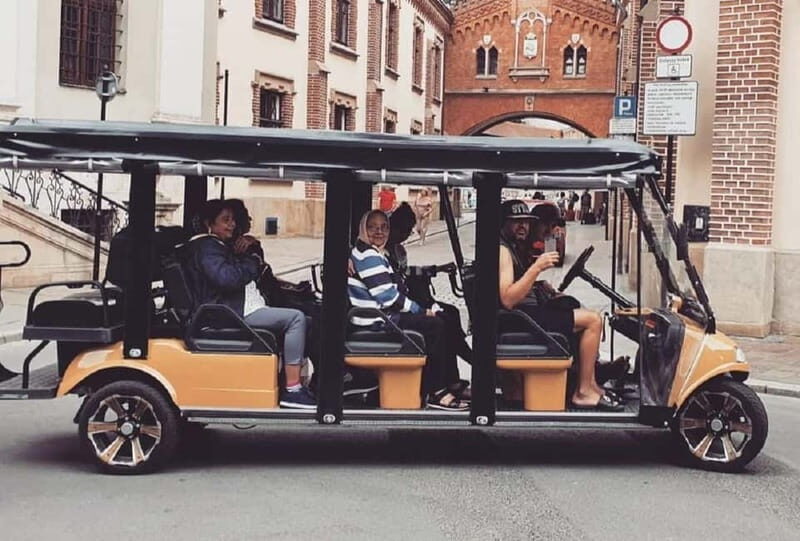
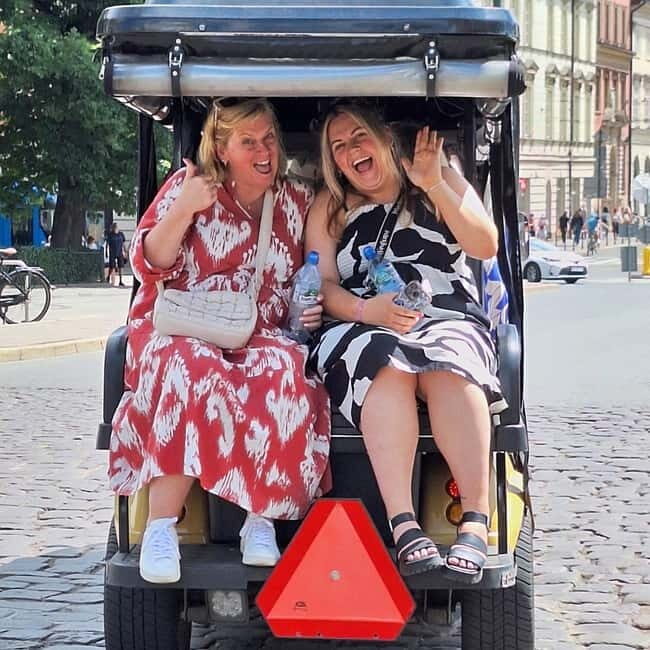
One small bonus that matters: a good golf car route creates frequent photo angles. Reviews for this operator often mention that the buggy is warm and comfortable, which is exactly what you want on a longer sightseeing loop.
You can also read our reviews of more boat tours in Krakow
Florian Gate, Barbican, and Planty Park: getting your bearings fast
The tour starts with pickup in Kraków. From there, it’s straight to classic entry points—your mental map begins here.
Florian Gate and the medieval gateway feeling
You’ll pass Florian Gate, the Gothic stone gateway that has welcomed people into Kraków since the Middle Ages. Even from the roadside, the towers and angles give you a sense of how the Old Town functioned as a fortified space. It’s the kind of stop that makes the rest of the route click, because you’re no longer guessing where everything is.
Kraków Barbican as the Old Town threshold
Next comes Kraków Barbican, the defensive structure that acts like a throat between outer city streets and the Old Town approach. You’ll see it up close and then pass onward toward the core. If you like history you can see in architecture, this is a smart early anchor because it frames what you’re about to witness in the Main Market area.
Planty Park as the reset zone
After the Old Town driving sequence, you’ll reach Planty Park. This is more than a green strip; it’s a circular transition around the old fortifications. Even if you only take quick time for photos, it helps you understand why Kraków’s layout looks the way it does: walls and gates, then a park ring where defenses once stood.
Practical tip: keep your camera ready here. Planty Park viewpoints are great for quick skyline shots without needing a long walk.
You can also read our reviews of more city tours in Krakow
Main Market Square, Town Hall, and Collegium Maius
Once you’re inside the Old Town flow, the tour does what a good orientation day should: it takes you to the center first, then fans out from there.
Main Market Square: the big medieval plaza moment
You’ll reach Main Market Square, the massive medieval plaza that functions like Kraków’s living room. Even if you don’t go inside every building, just standing in the space tells you why this city matters. Cafés, historic façades, and that open square geometry make it easy to imagine how the city worked before modern traffic.
This stop includes time for photos and quick self-guided wandering. If you want to see the square in a low-stress way, this tour format works because you’re not forced into a sprint.
Town Hall area and the Old Town skyline
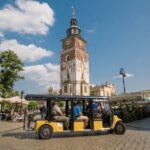
The route also passes the Town Hall Tower, which is one of the classic “look up and orient” points in the area. You’ll be seeing it as part of the drive-by flow, which is good if you want the views without committing to a separate ticketed climb.
Collegium Maius: university space with stone details
Another standout stop is the Muzeum Uniwersytetu Jagiellońskiego Collegium Maius area. You’ll have self-guided time around this historic university building, including the courtyard and cloisters (the architecture is the story here). Even if you only spend a short window, it’s a useful contrast: Kraków isn’t only royal and religious; it’s also academic.
Church of St. Francis, Bishop’s Palace, and Wawel Hill views
The middle-to-late part of the Old Town loop leans into the “religion and power” axis of Kraków, while also giving you classic skyline perspectives.
St. Francis of Assisi area and the human-scale details
You’ll visit or pass by Church of St. Francis of Assisi. This is one of those Kraków landmark buildings where the style and setting make you slow down without being obvious about it. The tour gives you self-guided time, which means you can go at your own pace—quick look if you want, longer pause if something catches your eye.
Bishop’s Palace and a royal-city feel
The route includes Bishop’s Palace as well. This is part of the broader feel of Kraków as a city shaped by institutions—church power and civic life built right into the streets you’re driving past.
Wawel Hill: the castle-on-a-bluff perspective
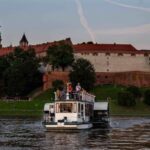
Then you get to Wawel Hill, with views of the castle area sitting on that limestone bluff. The tour doesn’t push you into a deep castle visit, but it does give you the key advantage of a big overlook: you can see the geography that made this site so strategic.
If you’re the type who likes to understand why places are where they are, Wawel Hill is a “now I get it” moment.
Kazimierz and the Jewish quarter: synagogues plus walking history
This is the section many people remember most, because Kazimierz changes the mood of the day. The tour’s route gives you both major synagogue photo/seeing points and the surrounding context spaces.
Old Synagogue and the synagogue cluster
You’ll see the Old Synagogue area and then continue toward Remuh Synagogue, Popper Synagogue, and Izaak Synagogue. Even if you only have time for quick viewing and short self-guided pauses, the value is in grouping them together in one loop. You start to notice how the district’s layout and street rhythm differ from the Old Town center.
A good way to approach these stops: treat them as “markers.” Look, get a sense of place, and then connect what you’re seeing to the broader story the tour points toward.
Plac Nowy and the daily-life vibe
You’ll pass plac Nowy and Dom Heleny Rubinstein. These aren’t only about monuments; they add everyday neighborhood texture to the day. It helps keep the Jewish quarter from feeling like a checklist of formal buildings only.
Corpus Christi Basilica: dates that ground the architecture
There’s a stop at Corpus Christi Basilica, a Gothic church established in 1335 by King Casimir III the Great. When a tour gives you a specific date like that, it helps your brain store the place in a timeline, not just a photo.
Wolnica Square and the old salt trading corridor
The tour also passes Wolnica Square, tied to a former salt trading route connecting from Wieliczka and Bochnia. It’s a great example of how Kraków’s history isn’t only about wars or rulers. Trade routes shaped neighborhoods, and the tour uses that idea to connect the built environment to real movement of goods.
Podgórze, the ghetto memorial spots, and Oscar Schindler’s factory area
After Kazimierz, you head toward Podgórze, where the story shifts toward the memory of the Kraków ghetto and World War II.
Father Bernatek’s Bridge: sculptures and a strong photo angle
You’ll take photos at Father Bernatek’s Bridge, known for sculptures by artist Jerzy Kędziora. This is a stop that feels modern in form but memorial in meaning. It also gives you a good view direction before you move deeper into the Podgórze sites.
Plac Bohaterów Getta and the ghetto connection
There’s a photo stop at Plac Bohaterów Getta, which was part of the ghetto. This is one of those short stops that matters because the tour keeps you oriented to the geography of the area.
Apteka pod Orłem and the Schindler’s Factory complex
You’ll visit Apteka pod Orłem and then reach Oscar Schindler’s Factory, which is now the location of two museums. Even if you only take in the exterior and the area, you’re in the correct place for that Kraków story—industrial space tied to human choices.
Fragment of ghetto wall and Église Saint-Joseph ending point
The tour includes a photo stop for a fragment of Ghetto Wall and then ends at Église Saint-Joseph in Podgórze. Ending here also helps you understand that Kraków’s WWII story isn’t confined to one museum room; it’s embedded in streets and corners you pass or photograph.
The one-hour Vistula River catamaran cruise with 27-language audio
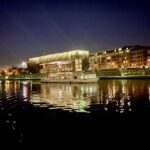
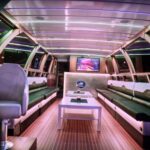
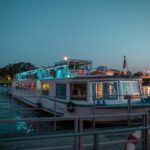
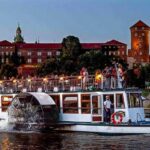
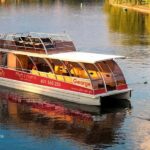
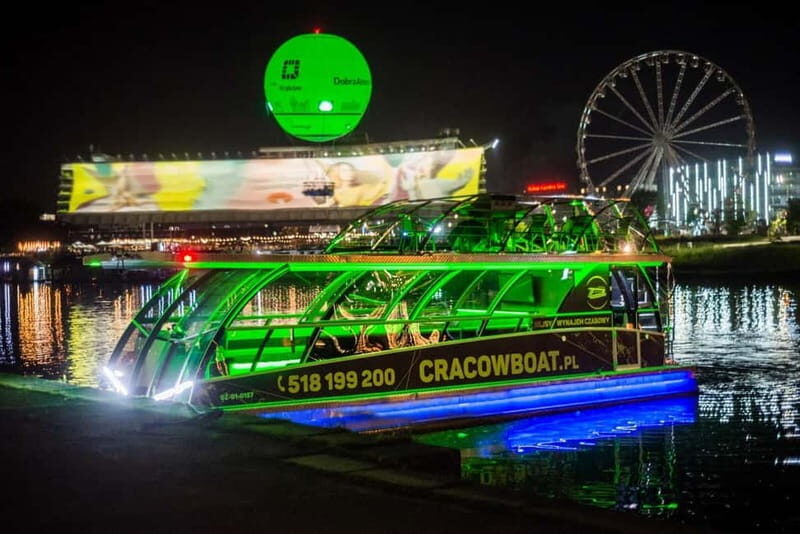
After the land portion, you transfer to a modern catamaran for a one-hour cruise on the Vistula River. This timing is a smart recovery move. Your sightseeing load shifts from “look up at façades” to “watch the city from the water.”
Audio narration in many languages
During the cruise, you’ll listen to an audio guide in your language. The tour offers a long list of languages, including English, German, French, Italian, Spanish, Russian, Japanese, Korean, Hebrew, and many more (up to 27 languages total). Even if you’re not the type to read every sign, the audio helps you connect the river views to what you saw on land.
If you want a practical strategy: put your phone/camera away for a few minutes at a time and just listen. The audio turns the river into a moving timeline.
Where you end: back near Wawel Castle
The tour ends on the boulevard close to Wawel Castle. That’s useful because it makes the day feel complete: you started near medieval gateways and you finish near the big castle silhouette.
What I think the best value is for you
This is not a tour that tries to win by adding 25 museum tickets. Its value is in the mix:
- Hotel pickup saves time and friction.
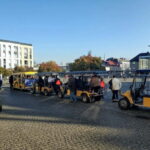
- Golf cart ride reduces fatigue while still giving frequent viewpoints.
- Audio narration during the cruise keeps you informed without forcing a constant spoken lecture.
- The route hits both the Old Town and the Jewish district, plus Podgórze, which most visitors struggle to connect in one day.
One practical consideration: because much of the experience is self-guided at stops (you’ll see several items but not stay long inside everything), you’ll get the best results if you’re comfortable moving on a schedule.
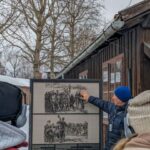
Also, check your expectations for the guide. This operator uses an English and Polish-speaking driver, and the driving tone often matters as much as the sites. In the positive feedback, a guide named Marian gets highlighted for being on time, enthusiastic, and proud of Kraków—exactly the energy that helps a long driving route feel like more than transportation.
Who should book this (and who might want another option)
This tour is a great match if you:
- Want a high-coverage day that still includes meaningful stops in Kazimierz and Podgórze
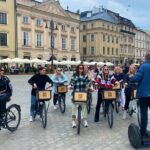
- Prefer easier movement in a golf car over nonstop walking
- Like a mix of landmarks and “place-based” context, then a relaxing river finish
- Want multi-language support without needing to hunt down information yourself
It may not be the best choice if you:
- Want slow, deep museum time at a single site
- Need an entirely step-by-step guided walk-through at every stop
- Are hoping for a fully guided narration for the entire day on foot
Before you go: simple tips that help
- Wear shoes you can stand in comfortably, since the stops include brief walking and photo breaks.
- Bring something for light weather changes; you’ll be outdoors for gateways, parks, and the synagogue-area streets.
- Use the self-guided time with intention: pick one or two questions you want each stop to answer, like what role this building played or what the setting suggests.
Should you book this Krakow golf car and Vistula cruise?
If your goal is to cover Kraków’s most important zones in about three hours, this one makes sense. The pairing of a golf car loop through Old Town highlights, then a Kazimierz + Podgórze storyline, and ending with a one-hour Vistula cruise is a smart use of time. It also helps you avoid the classic problem of Kraków trips: you see pieces of the city but don’t connect how they relate.
I’d book it if you want orientation plus the major memory sites, with enough flexibility to spend a minute longer where something grabs you. If you’re looking for a heavy, slow museum day, you might feel rushed here. But for most first-timers—and for anyone who wants Krakow’s key sights without turning the day into an endurance test—this combo is a solid choice.
FAQ
How long is the tour, and how much of it is the river cruise?
The total duration is 3 hours, including a one-hour cruise on the Vistula River.
Is hotel pickup included?
Yes. The tour includes hotel pickup in Kraków.
What vehicles are used during the experience?
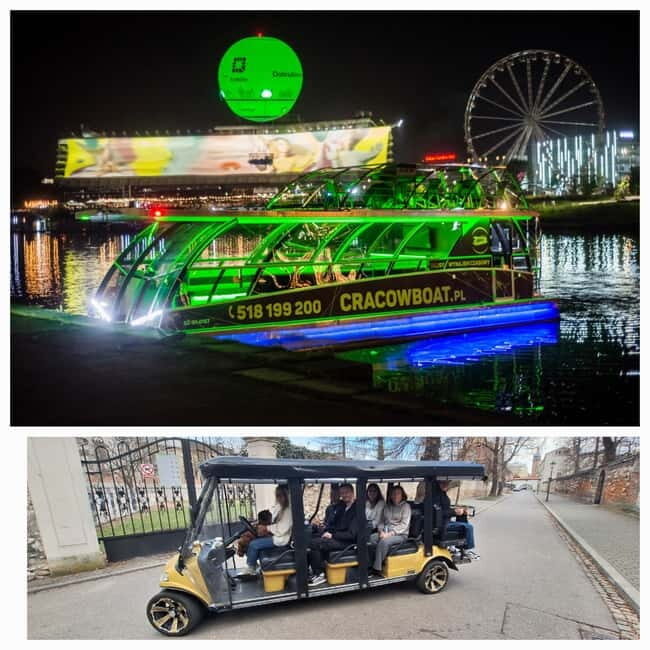
You’ll ride in a golf car for the city sightseeing portion, then transfer to a modern catamaran for the Vistula River cruise.
What languages are available for the tour and the audio guide?
The live tour is in English and Polish. The audio guide is available in 27 languages, including English and many others.
Which Jewish district stops are included?
The route includes sights in Kazimierz such as the Old Synagogue, Remuh Synagogue, Popper Synagogue, and Izaak Synagogue, along with photo points related to the ghetto such as Plac Bohaterów Getta and a fragment of Ghetto Wall.
Where does the tour end after the cruise?
The tour ends on the boulevard close to Wawel Castle.