REVIEW · WARSAW
Warsaw Old Town (UNESCO area): Facts & Legends | small groups
Book on Viator →Operated by Orange Umbrella Free Tour · Bookable on Viator
Old Town in Warsaw tells its story in stone and shortcuts. This 2-hour small-group walk mixes famous monuments with legend-friendly details, so you get a clear mental map fast. I like that it stays focused on the UNESCO Old Town core instead of spreading you across the whole city, and I also like the pacing: quick stops where you can actually look around, not just shuffle along. One thing to consider: it’s a walking tour, and the open-air nature of the Old Town means you’ll feel cold or heat more than you expect.
What I especially liked was how the guide work actually shows up in the experience. Names I heard and remember from the vibe: Martin’s interactive style, Albert’s friendly explanations, Iga’s mix of history and personality, and Gośka’s energy that makes even bad weather feel manageable. You’ll also get a practical city map along with the tour, so you can keep exploring after the walk ends.
The possible drawback is simple: you’re not going deep into museums here. You’re getting highlights and context, which is great for a first pass, but if you want long indoor time, you may feel a bit rushed at each 15-minute stop.
In This Review
- Key highlights you’ll feel right away
- A 2-hour UNESCO Old Town orientation you can actually use
- Where you meet and how the tour route stays practical
- Kolumna Zygmunta: the 20-meter anchor of royal memory
- Palacio Real de Varsovia: royal residence, best seen from the street
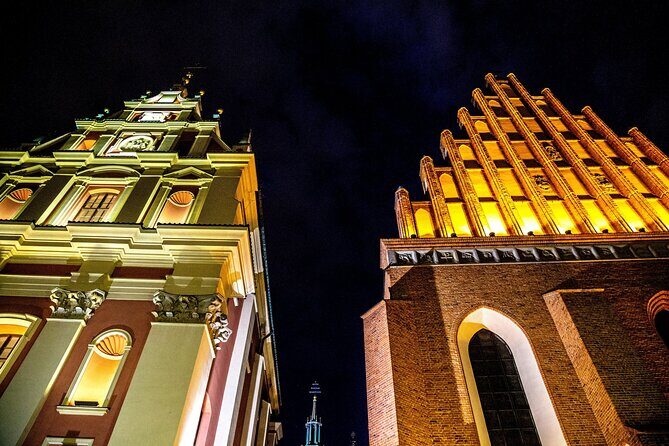
- Archcathedral Basilica of St. John the Baptist: the oldest Warsaw church stop
- Kanonia: the narrowest house in Poland and the magic bell
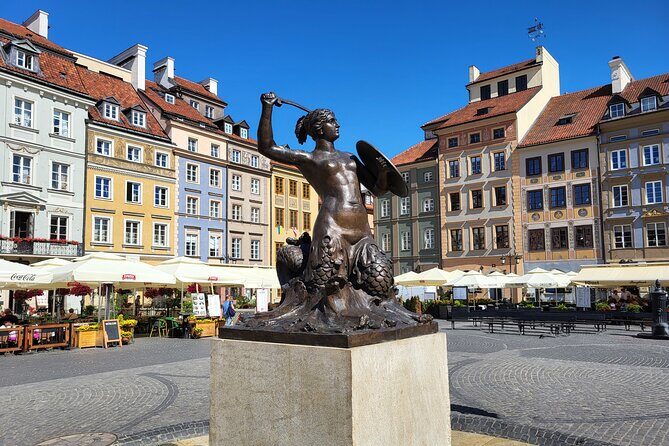
- Rynek Starego Miasta: the main square and the Mermaid Statue
- Warsaw Barbican: a rare fortified outpost you can picture
- Maria Skłodowska-Curie Museum: shifting from royal Warsaw to science Warsaw
- Price and group size: why this feels like real value
- Weather reality and what to pack for an Old Town walk
- Who this tour suits best
- Should you book this Warsaw Old Town facts-and-legends walk?
- FAQ
- How long is the Warsaw Old Town (UNESCO area) tour?
- What is the price per person?
- Is the tour offered in English?
- Where do we meet, and where does the tour end?
- Are any admission fees included for the stops?
- What’s included in the tour price?
- Is there a limit on group size?
Key highlights you’ll feel right away
- UNESCO Old Town, tightly focused: you’ll move through the key medieval sights without getting lost in side streets for too long.
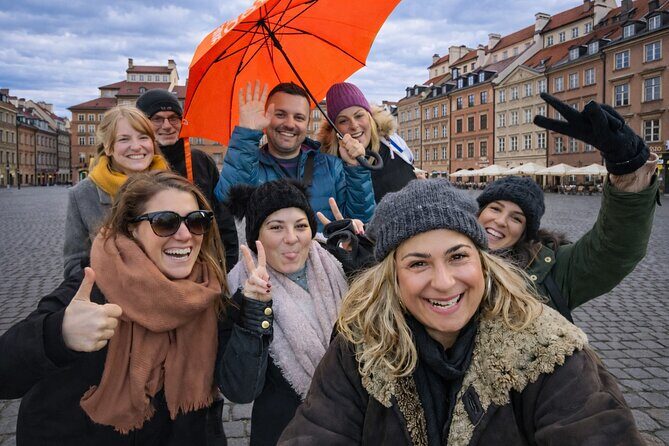
- A guide-led story thread: the tour leans on facts and legend-style storytelling so the area makes sense as you go.
- Free entry at most stops: the listed sights are admission-free on the tour schedule, including the royal castle exterior and main square.
- Real small-group energy (max 25): it’s easy to ask questions and keep the pace comfortable.
- Ends in New Town with Curie history: you shift from royal and medieval Warsaw into the Maria Skłodowska-Curie museum area.
- Weather matters: the walk is outdoors most of the time, so layers help.
A 2-hour UNESCO Old Town orientation you can actually use
This tour is built for orientation. In about two hours, you get a guided pass through Warsaw’s Old Town highlights and landmarks that people recognize on sight. You’ll walk away with the “where am I?” answers, plus enough background to understand why these places mattered.
The price, $11.35 per person, is what stands out as good value. You’re paying for a guide and a structured route. The sites along the way are mostly free to enter on the tour schedule, so you’re not stacking extra admissions on top of the cost.
And because it’s offered in English with a small group cap of 25, you’re not stuck with a huge crowd. That makes a difference when a guide is pointing out tiny details you’d otherwise miss, like which direction to face for the best views or how to spot the significance of a landmark quickly.
You can also read our reviews of more tours and experiences in Warsaw.


Where you meet and how the tour route stays practical
Meeting is at Sigismund’s Column (Kolumna Zygmunta), Plac Zamkowy, 00-001 Warszawa. The start time is 10:00 am, and the tour ends at the Maria Skłodowska-Curie Museum, Freta 16, 00-227 Warszawa.
You’ll get a mobile ticket, which keeps things simple when you arrive. Since the meeting spot is right in the Old Town area, it’s also close to public transportation, so you’re not dependent on taxis or long walks just to start.
One practical heads-up: if there’s a mass event (like a parade, protest, or concert) around the usual meeting point, the start shifts to beneath a red-brick medieval defensive wall about 100 meters north of the column. It’s the kind of thing that saves you from standing around wondering what changed.
Kolumna Zygmunta: the 20-meter anchor of royal memory
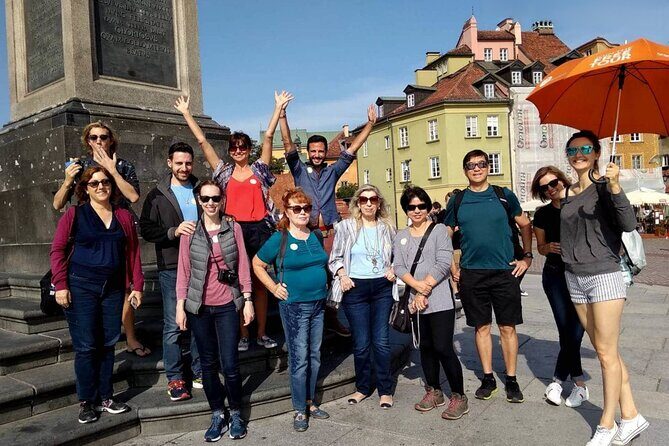
Your tour kicks off at King Sigismund’s Column (Kolumna Zygmunta). This is the oldest, tallest, and most famous Warsaw monument, with a height of about 20 meters and a history of roughly 400 years. That alone makes it a smart first stop: it’s an obvious landmark, so you quickly learn how to “read” the area.
The column commemorates Sigismund Vasa, one of Poland’s powerful kings. Even if you don’t know the story already, the guide’s job here is to connect the monument to Warsaw’s long royal timeline. In practice, this matters because later landmarks in the Old Town start to feel like chapters, not random buildings.
The time here is about 15 minutes, and because it’s an outdoor monument, it’s also a good moment to take photos before the tour turns into tighter streets and squares.
Palacio Real de Varsovia: royal residence, best seen from the street
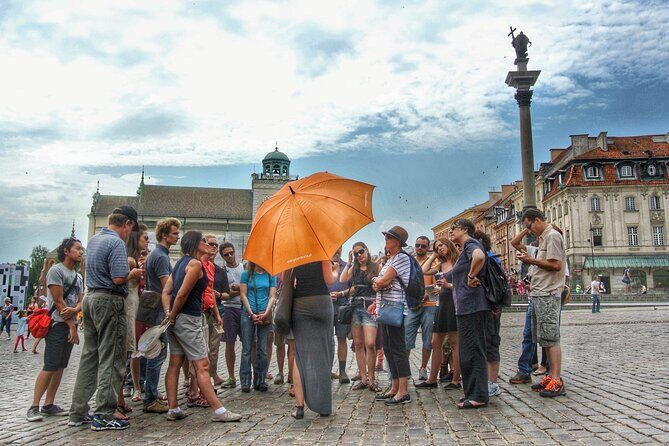
Next up is Warsaw Royal Castle (Palacio Real de Varsovia), mainly viewed from outside. The tour frames it as the residence of Polish kings in the 17th and 18th century, and the castle is one of the main landmarks of the Old Town.
Outside viewing is not a downside here. It’s actually a smart way to get context. You’ll see the scale and positioning in the space, and you’ll likely understand why the castle dominates the Old Town geography. Then you can decide later if you want to add more museum time on your own.
This stop is another 15 minutes, with admission ticket free as listed for the tour. That makes it easy to keep the tour’s rhythm without getting hung up on extra lines or ticket decisions.
Archcathedral Basilica of St. John the Baptist: the oldest Warsaw church stop
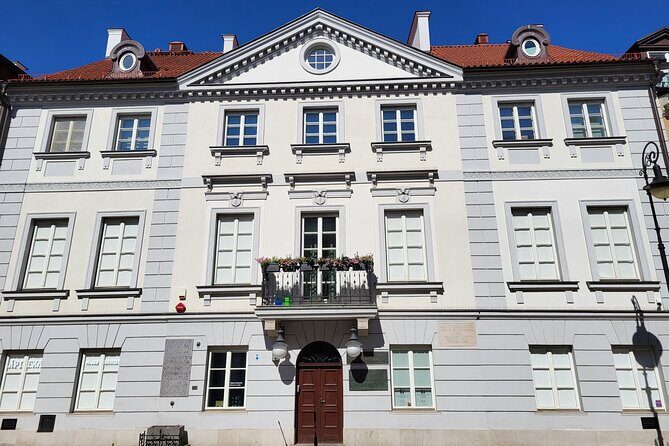
The walk continues to the Archcathedral Basilica of St. John the Baptist. This is described as the oldest Warsaw church, with a presence here going back to the city’s foundation period in the early 14th century.
There’s an important practical condition: free entrance if there is no service. So if you arrive and notice ongoing activity, you may need to treat this stop as observation from the outside or around the immediate area rather than a full interior visit.
Either way, the value of this stop is the sense of continuity. When you’re walking through an area famous for changes and rebuilding, it helps to see a site that dates back far earlier than most of the surrounding structures. The guide’s narration is what turns that age into something you can picture, not just a fact you read and forget.





Kanonia: the narrowest house in Poland and the magic bell
At Kanonia, you get the Old Town side-street experience. This is where the tour becomes more fun in a “walk and notice” way rather than just monument viewing.
Kanonia is described as a picturesque back street with the famous magic bell and the narrowest house in Poland. That combination is exactly what you want from a legends-style walk: you’re seeing a real, specific feature, and the guide can connect it to why it became a recognizable quirk in the Old Town.
This stop is also about 15 minutes, so it’s long enough to slow down, find the bell and street details, and capture photos without feeling like you’re stuck in a single spot for ages.
Rynek Starego Miasta: the main square and the Mermaid Statue
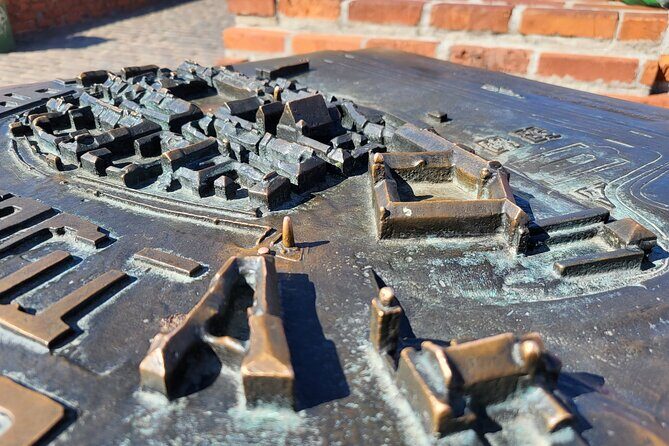
Your tour returns to the big open space at Rynek Starego Miasta, the main square of the Warsaw Old Town. The tour highlights it as the most important place in medieval Warsaw, with the Mermaid Statue placed in the middle of the square.
This is where you can breathe and do the “okay, I’ve got it” moment. Squares make orientation easier. Once you’ve seen the column, the castle area, the church stop, and then you reach the main square, the whole Old Town starts to click into place.
The listed time is 15 minutes, and admission is free here for the tour stop. You’ll likely get a quick historical framing plus practical suggestions on how to look around the square so you notice the details that make it feel medieval even when crowds show up.
Warsaw Barbican: a rare fortified outpost you can picture
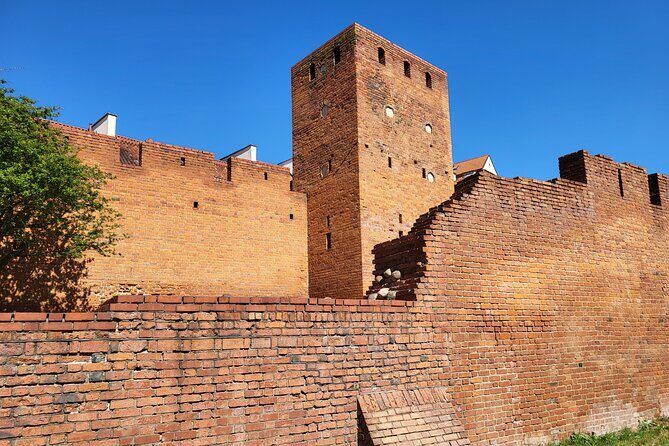
Next is the Warsaw Barbican (Barbakan Warszawski). This is described as a fortified outpost of the medieval city walls, and it’s noted as one of two such constructions in the world.
That “one of two” line matters because it changes how you look at it. You stop thinking of it as just an old wall and start thinking of it as a rare survival of a specific defensive design. In a small tour, that kind of detail helps you remember what you saw later.
It’s another 15-minute stop with admission listed as free. Plan to spend that time looking at how the structure connects to the idea of city defense. Even if you’re not a history buff, the guide’s explanation makes it understandable at street level.
Maria Skłodowska-Curie Museum: shifting from royal Warsaw to science Warsaw
The tour ends at the Maria Skłodowska-Curie Museum in Warsaw’s New Town area. The building dates to the 19th century, and it’s tied to Curie’s early life. The tour notes that it’s the birthplace of Maria Skłodowska-Curie and where she spent her childhood, and today it functions as a museum.
This last stop is a smart pivot. Old Town history can feel heavy and war-remembering, especially in places rebuilt over time. Ending with a major figure in science helps you round out your mental picture of Warsaw. It also gives you a logical next move if you want to keep sightseeing: you’re already in the New Town area rather than back at the starting point.
The tour end point is at the museum address, so you’re not left navigating the city’s geography right away.
Price and group size: why this feels like real value
At $11.35, you’re paying for a guided structure plus a city map and a mobile ticket setup. The listed stops are free for the tour schedule, which reduces the most annoying form of travel costs: surprise charges and unclear ticket rules.
The tour’s group cap of 25 travelers is also a practical value. In a bigger crowd, guides end up talking at people. With a smaller group, you’re more likely to get questions answered and explanations adjusted to the pace of the group. You also tend to get better photo timing because you’re not constantly fighting for space.
One small note from what the experience signals: it’s designed for an overview. Each stop is timed at about 15 minutes, which means you’ll get a strong sense of the route but not a long study session at any one building.
Weather reality and what to pack for an Old Town walk
This is an outdoor-first tour. Even if the route includes historically important buildings, you’re spending most of the time outside, standing around during explanations and walking between stops.
On a cold day, that matters. I’d treat this like a classic layering situation: warm coat, hat, and gloves if you run cold. A long chat with a guide can keep you warm for a bit, but the Old Town air gets you eventually.
If it’s warm, bring sunscreen and water. The route doesn’t last long enough to plan a full “break,” so staying comfortable helps you enjoy every stop.
Who this tour suits best
This is a great match if:
- You’re in Warsaw for a short stay and you want Old Town orientation without planning every stop.
- You like facts delivered with storytelling energy, not just dates and names.
- You want to see the main landmarks at a steady pace rather than hopping between places solo.
It may not be ideal if:
- You want deep museum time or long interior visits at each site.
- You prefer tours with fewer standing moments. This one is built around quick stops and walking.
It’s also described as suitable for most travelers, and service animals are allowed. If you’re relying on public transport, the meeting location being near transit is a plus.
Should you book this Warsaw Old Town facts-and-legends walk?
I’d book it if you want a fast, guided way to understand Warsaw’s Old Town UNESCO core and leave with a clean route in your head. For the price, it’s a solid deal because the guide does the “what you’re looking at and why it matters” work, while the tour schedule keeps many stops free.
I’d also book it early in your trip. Knowing where things are makes every later walk easier, and ending at the Curie museum area gives you an obvious next step.
If your travel style is museum-first or you hate cold outdoor walking, you might be happier picking one or two sights and doing longer self-guided time. But for most first-time visitors who want direction and stories, this tour hits the sweet spot.
FAQ
How long is the Warsaw Old Town (UNESCO area) tour?
It lasts about 2 hours.
What is the price per person?
The listed price is $11.35 per person.
Is the tour offered in English?
Yes, it is offered in English.
Where do we meet, and where does the tour end?
You start at Sigismund’s Column (Plac Zamkowy, 00-001 Warszawa) and end at Maria Skłodowska-Curie Museum (Freta 16, 00-227 Warszawa).
Are any admission fees included for the stops?
The tour lists free admission for all the listed stops, with the note that St. John’s Archcathedral Basilica is free if there is no service.
What’s included in the tour price?
You get a guide service and a city map. You also receive a mobile ticket.
Is there a limit on group size?
Yes, the tour has a maximum of 25 travelers and it’s typically booked about 7 days in advance.