REVIEW · WROCLAW
Famous Islands of Wroclaw – Cathedral Island and Sand Island Private Tour
Book on Viator →Operated by Meet My City · Bookable on Viator
Two islands, one focused church walk. This private guided route ties Cathedral Island and Sand Island together with stories that explain why Wrocław looks the way it does today. I also like the private pace and the way the guide connects each landmark to the city’s bigger turning points, not just the postcard view.
One thing to plan for: this is a good-weather walking tour, so rain can change the vibe (or your dates). That said, the overall route is built for most people, and it stays in the most historic, most walkable pocket of town.
You start outside Wrocław Cathedral and finish near Sand Bridge, so it is easy to orient yourself fast. The tour runs about 1 hour 40 minutes to 2 hours and is offered in English.
In This Review
- Key highlights you will actually notice
- Cathedral Island and Sand Island: why this walk works
- Meeting by Wrocław Cathedral and setting the story
- Cathedral Island loop: medieval justice and how the island changed
- St. Giles, the Leaning Tower area, and Dumpling Gate
- Archbishop’s Palace and the Solidarity-era 80 million zloty story
- The Gothic masterpiece: Holy Cross and Bartholomew (plus the Turin shroud copy)
- Finishing Cathedral Island via Tumski Bridge
- Crossing to Sand Island: Our Lady on the Sand and the old monastery
- Walking pace, group size, and time you should plan for
- Price and value: is $75 per person worth it?
- Who should book this private Cathedral Island and Sand Island tour?
- Should you book it?
- FAQ
- How long is the Cathedral Island and Sand Island private tour?
- Is this tour private?
- What language is the tour offered in?
- Where does the tour start and where does it end?
- What major sights are included?
- What is the tour price?
- Do I get a mobile ticket?
- Is the tour dependent on weather?
- Is free cancellation available?
Key highlights you will actually notice
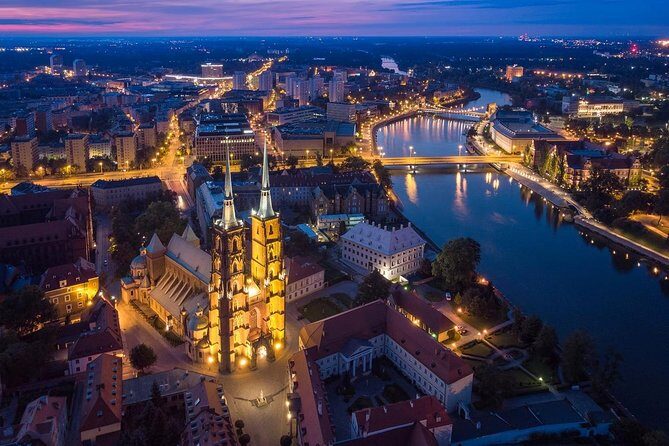
- Cathedral Island medieval escape legends with explanations of how the island changed over time
- St. Giles plus the Leaning Tower area and a nearby 19th-century Botanical Gardens entrance
- A real 1980 Solidarity story involving a cardinal and 80 million zloty hidden for the movement
- Church of the Holy Cross and Bartholomew with a copy of the Turin shroud
- The biggest Gothic church in Wrocław: Church of Our Lady on the Sand
- Tumski Bridge as a historical jurisdiction border before you cross to Sand Island
Cathedral Island and Sand Island: why this walk works
Wrocław is full of beautiful churches, sure. What makes this tour click is the way it uses those churches like signposts for history you can see, not history you have to guess.
Cathedral Island and Sand Island sit next to each other, but they feel different. Cathedral Island gives you the medieval setup: power, rules, and religious authority. Sand Island shifts toward the bold Gothic era and the religious institutions that shaped everyday life around the river.
I like that the tour stays focused. Instead of crisscrossing the whole city, you get a compact loop that helps you build a mental map in a short time.
You can also read our reviews of more private tours in Wroclaw



Meeting by Wrocław Cathedral and setting the story
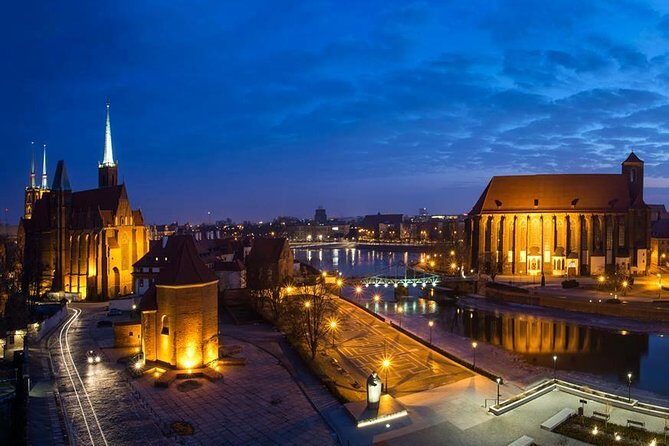
Your tour begins outside the main entrance of Wrocław Cathedral at Plac Katedralny 18. This is the kind of start that helps you settle quickly: you are right where the island story begins, not wandering around trying to find the meeting point.
From there, you walk the Cathedral Island area with a guide who frames what you are looking at. You are not just seeing buildings; you are learning why dukes and clergy chose to live here centuries ago, and how this “island” stopped being an island the way you might imagine it today.
This is a big value point for me. A lot of church visits turn into a list of dates and names. Here, the guide helps you understand the logic behind the architecture and the geography.
Cathedral Island loop: medieval justice and how the island changed
One of the most memorable parts is the walk around Cathedral Island where the guide explains the legend of wrongdoers escaping justice. It is the kind of story that sounds dramatic, but it is also a practical way to understand how medieval law and authority worked in real places.
As you move along, you also get the context for the people who lived on the island. The tour points out why dukes and clergy were drawn to this spot, and what that tells you about Wrocław’s power structure at the time.
There is also a helpful “today vs then” thread: Cathedral Island is not an island in the same way anymore, and the guide explains why that matters. If you like walking with historical context, this section pays off quickly.
Practical note: because you are outside and moving, wear shoes that handle cobblestones and uneven sidewalks. If the weather turns, you will feel it more here than on a purely indoor tour.
St. Giles, the Leaning Tower area, and Dumpling Gate
After the Cathedral Island focus, the route moves you toward other landmarks that feel like part of the same historic neighborhood.
You will see the Church of St. Giles, described as the oldest existing church in Wrocław. For many people, “oldest” is a fun fact. On this walk, it becomes more than trivia because it anchors what comes next: the idea that this city kept rebuilding and refining its religious identity over time.
The tour also includes views near the Leaning Tower of Wrocław and the Dumpling Gate. Even if you have seen these names before, the value is in how they fit into the area’s street-level layout and the surrounding church-and-gate rhythm.
If you enjoy parks and a breather between churches, this part has a nice perk: the route is near an entrance to the 19th-century Botanical Gardens. You are not stuck with only stone and towers. You get an easy option to step into greener space if time and energy allow.
Archbishop’s Palace and the Solidarity-era 80 million zloty story
Next comes one of the tour’s standout narrative stops: the Archbishop’s Palace. Here the guide tells an amazing story about a brave cardinal who, in 1980, hid 80 million zloty for the Solidarity movement—and what happened to the money afterward.
This is a powerful pivot from medieval Wrocław to modern history. It also shows why a guided tour matters. Without context, palace buildings and side streets can look like background. With the story, they become a chapter in Poland’s history you can place on the map.
It is also a good reminder that Wrocław’s religious institutions did not only shape art and architecture. They were involved in the city’s real-world conflicts and moral choices too.

The Gothic masterpiece: Holy Cross and Bartholomew (plus the Turin shroud copy)
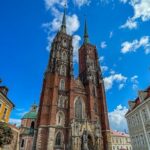
Across the street, you will see a two-tier building that the tour highlights as one of the most beautiful Gothic churches in the Silesia area: the Church of the Holy Cross and Bartholomew.
This is the part where the tour turns into pure wow-in-the-details. The guide explains that the church contains a copy of the Turin shroud. Even if you know the shroud story in a broad sense, hearing about how a copy is connected to this church makes it feel grounded in Wrocław rather than distant and abstract.
Right near here, you also get context on Orphanotropheum, a former orphanage. That inclusion adds depth. This route is not only about grand religious power; it also points to how communities lived, raised children, and handled care.
If you like churches, you will probably rate this stop as a highlight. It has strong architecture, a specific story detail, and a sense of neighborhood history packed into a small area.
Finishing Cathedral Island via Tumski Bridge
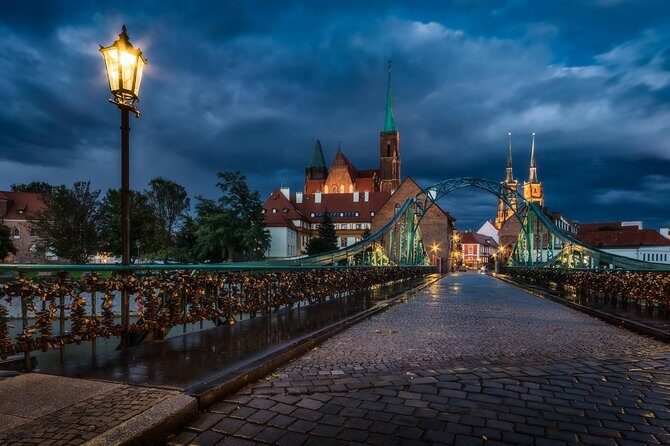
As you wrap up the Cathedral Island segment, you pass by Tumski Bridge. The guide treats it as more than a crossing: it represents the border for church jurisdiction.
I like this kind of framing because it helps you connect the dots. Bridges in old cities often feel like just infrastructure, but here it signals a legal and religious boundary. When you later reach Sand Island, you will understand why that shift matters.
This also helps you appreciate what the tour is doing overall: it moves you through a chain of meaning, not just a chain of stops.
Crossing to Sand Island: Our Lady on the Sand and the old monastery
You then continue toward Sand Island, where you will see the monumental Church of Our Lady on the Sand. The tour presents it as the biggest Gothic church in Wrocław, and it is easy to see why.
What makes it more satisfying than a quick exterior photo is the lead-up. By the time you reach this church, you have already heard how the area’s religious authorities shaped life, law, and community. So when you finally stand in front of one of the city’s most important Gothic structures, it lands with weight.
The route also includes the former Augustinians monastery nearby. You get a sense that this was not just a church building; it was part of a wider institution with daily routines and influence.
On Sand Island, you can also expect a look at charming tenement houses—described as the only remains of older residential buildings on the island. That detail matters. It reminds you that church areas were never only about clergy and stone. People lived here too, and over time the survival of those homes shapes what you can still imagine today.
The tour ends at the Sand Bridge (most maps place you near the bridge area), giving you a clean finish point that is easy to find.
Walking pace, group size, and time you should plan for
This is a private tour, meaning it is only your group. That alone can change how good the experience feels, because you can move at a human pace and ask follow-up questions without competing with a crowd.
Timing is listed as about 1 hour 40 minutes to 2 hours. That window is long enough to make history stick, yet short enough to stay comfortable for most people.
You will be outside during the walk, so the weather is not just a line item. Bring layers in shoulder seasons, and plan around the fact that the experience requires good weather. If it does not cooperate, the provider can offer a different date or a full refund.
Price and value: is $75 per person worth it?
At $75 per person for a private tour, you are paying for three things: a guided interpretation, a focused route, and time efficiency.
If you are the type who sees churches and thinks, Okay, but what does it mean, then a guided walk like this is usually money well spent. You are getting specific story content at multiple stops: medieval justice legends, the 1980 Solidarity money hiding story, and the Turin shroud copy in the Holy Cross and Bartholomew church.
Also, because the tour stays compact, you are not burning time figuring out directions or trying to read everything off plaques. That helps you get real value out of your limited hours in Wrocław.
The tour also lists group discounts, which can make the price feel friendlier if you are traveling with friends or family. And it runs in English, which is a practical detail if you want history you can follow without slowing down.
Who should book this private Cathedral Island and Sand Island tour?
Book it if you want:
- A focused Wrocław walk built around churches and the stories behind them
- A guided pace that feels calm and personal
- A mix of medieval history and modern Polish history in the same route
- A route that helps you orient yourself fast in the Cathedral Island/Sand Island area
Skip it if:
- You want a broad city highlights tour with lots of variety beyond churches
- You are avoiding walking outside in uneven historic streets
If you are coming to Wrocław for the architecture and you like learning the why behind what you see, this tour fits well.
Should you book it?
Yes, I would book this if your goal is to understand Cathedral Island and Sand Island in a short time. The route is compact, the stories are specific, and the mix of sacred architecture plus the 1980 Solidarity money tale makes it more memorable than a standard church crawl.
If weather is iffy, keep an eye on the forecast and plan to be flexible. Otherwise, this private guided walk is a strong way to get the most out of Wrocław’s most historic riverfront church zone.
FAQ
How long is the Cathedral Island and Sand Island private tour?
The tour lasts about 1 hour 40 minutes to 2 hours.
Is this tour private?
Yes. It is a private tour/activity, and only your group participates.
What language is the tour offered in?
The tour is offered in English.
Where does the tour start and where does it end?
It starts outside the main entrance of Wrocław Cathedral at Plac Katedralny 18 and ends at Sand Bridge (most specifically described as Sand Bridge area).
What major sights are included?
You will see Wrocław Cathedral area highlights, the Church of St. Giles, the Leaning Tower of Wrocław area, Dumpling Gate, the Archbishop’s Palace, the Church of the Holy Cross and Bartholomew (with a copy of the Turin shroud), Orphanotropheum, Tumski Bridge, and the Church of Our Lady on the Sand, plus the former Augustinians monastery area.
What is the tour price?
The price is $75.00 per person.
Do I get a mobile ticket?
Yes, it includes a mobile ticket.
Is the tour dependent on weather?
Yes. The experience requires good weather, and if it is canceled due to poor weather you will be offered a different date or a full refund.
Is free cancellation available?
Yes. You can cancel up to 24 hours in advance for a full refund. If you cancel less than 24 hours before the start time, the amount paid is not refunded.