REVIEW · LUBLIN
Lublin: Old Town Highlights Private Walking Tour
Book on Viator →Operated by Rosotravel - things to do in Lublin · Bookable on Viator
Lublin’s Old Town is small, but it packs a punch. This private walk focuses on the city’s Old Town highlights with a licensed guide who connects the dots between gates, towers, squares, and castles. You also get pickup from your accommodation in the Old Town, so you can spend less time hunting meeting points and more time seeing.
I especially like the straightforward, high-impact route: you hit major landmarks like Lublin Castle and the Metropolitan Cathedral of St. John the Baptist without wasting time on weak stops. I also love the practical extras, like restaurant and pub recommendations that help you plan your next meal. The main drawback to plan around is that the Trinity Tower top viewpoint costs extra, and on Sunday mornings church services can limit what you can view from inside.
In This Review
- Key highlights to look forward to
- Why this private Old Town walk in Lublin works
- Getting started: Bramowa 2 and pickup within Lublin Old Town
- Stop 1: Lublin Old Town center—built to matter
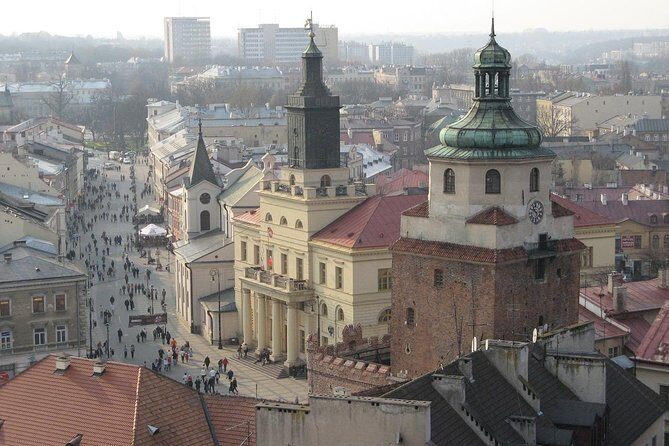
- Trinity Tower: the highest viewpoint for old-city photos
- Lublin Castle: Romanesque on a hill with a defensive past
- Lithuanian Square and the leaf-shaped multimedia fountain
- St. John the Baptist Cathedral: Jesuit Baroque, plus a rare bell tower
- Plac Po Farze: a square shaped by what was removed
- Plac Litewski monument: Poland–Lithuania union memory from 1826
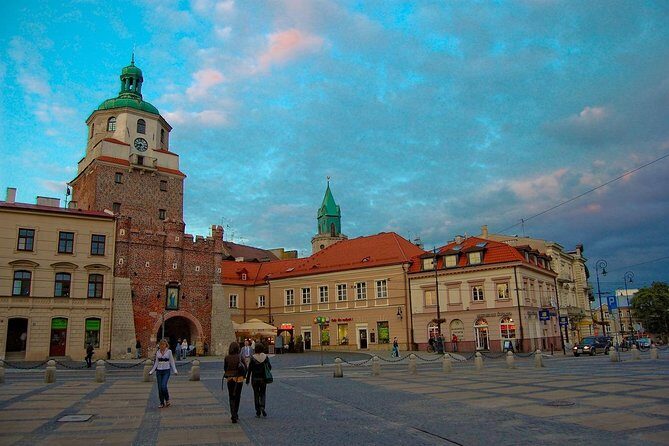
- Brama Krakowska: the 14th-century gate that still defines an edge
- Kościół pw. Sw. Stanislawa Biskupa Meczennnika: medieval stone with a Union of Lublin link
- Price and value: what $106.51 buys you in real terms
- How long it really takes—and how to plan your day
- Practical tips to get the most from the guide
- Who should book this tour
- Should you book the Lublin Old Town Highlights private walking tour?
- FAQ
- Is this tour private?
- How long is the Lublin Old Town Highlights walking tour?
- What sights are included with no admission fee?
- Is Trinity Tower included?
- Where does the tour start and end?
- Does the tour include pickup from hotels?
- What should I expect on Sunday mornings in churches?
Key highlights to look forward to
- Trinity Tower viewpoint for the highest old-city perspective, with an optional top ticket you can skip
- Romanesque Lublin Castle on a hill, including a castle tower tied to the 1200s
- Lithuanian Square leaf-shaped multimedia fountain with water, light, sound, images, and lasers
- Jesuit-era Metropolitan Cathedral in Baroque style, plus a lone bell tower that’s unusual for this region
- Medieval gates and union-era monuments that explain why Lublin matters to both Poland and Lithuania
Why this private Old Town walk in Lublin works
Lublin is the kind of city where you learn fastest by walking. The streets are tight enough that you feel history up close, but the route is still manageable in a 2 to 3 hour window. This tour is designed to keep momentum. You’re not stuck in a long lecture hall with a view of cobblestones. You’re outside, moving, and you get context at each stop.
What makes it more than a checklist is the guide’s job: connect the landmark you’re standing next to with the story behind it. You’ll hear how the city shaped itself over centuries, why certain buildings were built where they are, and what changed politically along the way. That matters because Lublin’s highlights aren’t random. They were placed to control routes, defend approaches, and prove power—then later they became identity.
The “private” part is also real value here. Your group sets the pace. The guide can adapt the program to your preferences, which is helpful if you want more time at the cathedral interior or you’d rather spend extra minutes on views from the tower.
You can also read our reviews of more walking tours in Lublin
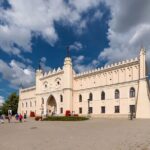
Getting started: Bramowa 2 and pickup within Lublin Old Town
The tour starts at Bramowa 2 (Lublin) and returns there. If your accommodation is located in Lublin Old Town, you can get pickup. That single detail can save you stress. In older cities, finding the exact meeting spot can feel like a tiny scavenger hunt. Pickup removes a lot of friction.
The meeting point being near public transportation also helps if you’re arriving from elsewhere in Lublin. And because the tour uses a mobile ticket, you won’t need to scramble for paper paperwork while you’re already standing in the street with a coffee.
Tip: if you’re doing this on a day when you plan to bounce to museums or dinner right after, remember the tour ends back at the same starting point area. Plan your next stop nearby if you can.
Stop 1: Lublin Old Town center—built to matter
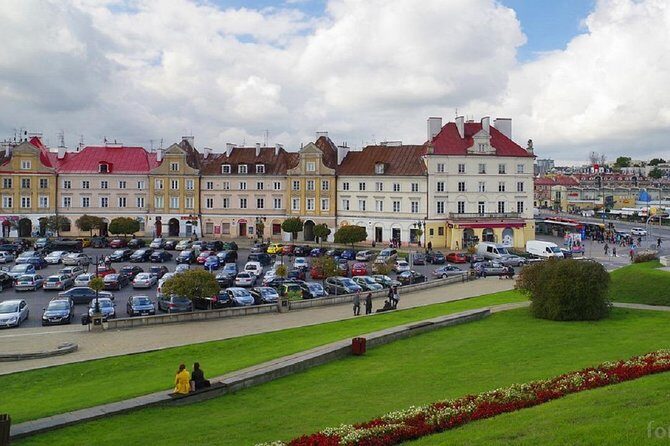
The walk begins in the Old Town, which is known for being one of Poland’s best-preserved historic complexes. That’s not marketing talk. The payoff is how quickly you can sense the city’s former role as an administrative, trade, and military center in the Polish kingdom.
This opening stretch is where I think the tour earns its keep. You get a framework for what you’re about to see. Without it, you’d notice cool buildings. With it, you notice why they’re positioned and what they signaled to the people who walked here before you.
The practical angle: since this area is central, it’s a good time to orient yourself. After a short intro, the rest of the route tends to “click” fast.
Trinity Tower: the highest viewpoint for old-city photos
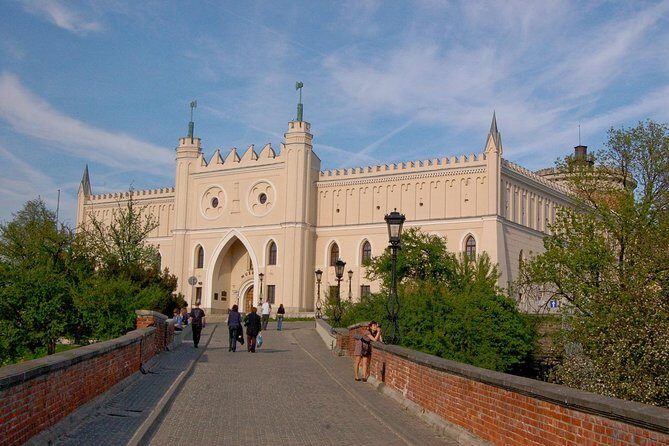
Next up is Trinity Tower, described as the highest historical viewpoint in Lublin. If you want city photos that feel more informative than just pretty, this is the stop.
One important note: access to the top is optional and costs 2 EUR. That means you can decide based on your energy and your photo goals. If you’re short on time or the extra ticket doesn’t fit your budget, you can still enjoy the tower as part of the skyline without paying for the top.
Consideration: because the viewpoint is an added option, decide early whether you want to prioritize it. If you do, you’ll want to plan your camera and timing so you don’t feel rushed.
Lublin Castle: Romanesque on a hill with a defensive past
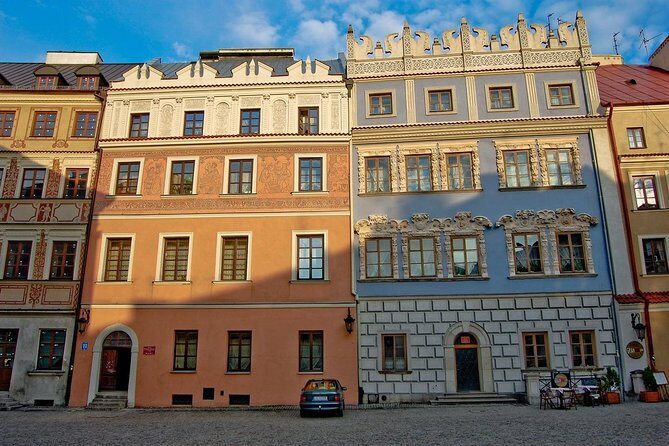
Then the tour swings toward Lublin Castle, sitting on a hill. It’s a Romanesque-style castle built in the 14th century, and it’s tied to one of the oldest building stories in the region. You’ll also hear how the castle tower goes back to the 13th century, first as a defensive and residential building.
What I like here is that the stop isn’t only about admiration. It helps you picture how cities worked: power needed verticality, control needed elevation, and walls were practical tech. Even if you don’t go deep into architecture details, the guide’s explanation makes the place feel less like a backdrop and more like a functioning “system” from centuries ago.
The castle tower admission is noted as free for this part of the visit. That’s a nice value feature—one of those moments where you get a strong landmark without paying another ticket.
Lithuanian Square and the leaf-shaped multimedia fountain
From the castle zone, you’ll move toward Lithuanian Square, where you can see a fountain designed with a leaf shape. This one is built for performances using a whole mix of effects: water, light, sound, images, and lasers.
This is a good stop for two reasons. First, it breaks the tour pattern. After gates, towers, and religious buildings, you get something more modern and playful. Second, it gives you a sense of how the city uses public space today, not only centuries ago.
Possible drawback: the “performance” aspect can be time-dependent. The tour data confirms what the fountain does, but it doesn’t promise a specific show time during your walk. If your schedule is flexible, you might check nearby timing on your own when you arrive in Lublin. If a show isn’t happening, you can still enjoy the design and setting.
St. John the Baptist Cathedral: Jesuit Baroque, plus a rare bell tower
The next major stop is the Metropolitan Cathedral of St. John the Baptist and John the Evangelist. It was built in Baroque style during the 17th century for the Jesuits.
This is where I think the tour balances “big landmark” with “why it’s unusual.” The cathedral has a charming interior, and it also features a lone standing bell tower that’s rare for northern and eastern Europe. That’s the kind of specific detail that makes you look twice, and it’s exactly the sort of thing you’d miss if you walked in without guidance.
Inclusion note: visiting is free here. The tour specifically includes the visit to this cathedral with no admission ticket.
Sunday consideration: on Sunday mornings, Catholic churches may have Masses. Sightseeing can be limited or only possible from outside out of respect for prayers. If you’re traveling on Sunday, plan for a shorter inside viewing window.
Plac Po Farze: a square shaped by what was removed
After the cathedral, you’ll reach Plac Po Farze, a square created after St. Michael the Archangel Church was dismantled. This is the kind of stop that sounds minor until you understand how much cities change.
This square isn’t only “a nice open space.” It’s a reminder that Lublin’s history includes loss, restructuring, and reusing land. The guide’s explanation helps you see how everyday places often carry deeper layers underneath.
Practical benefit: squares like this are also breathing room. You get a pause from constant looking upward at towers and gates, and you can reset before the tour continues toward the medieval boundary.
Plac Litewski monument: Poland–Lithuania union memory from 1826
You’ll also pass by an impressive monument marking a union between Poland and Lithuania, unveiled on Plac Litewski in 1826.
This stop matters because Lublin isn’t just local pride. The city sits inside broader stories across the region, and this monument gives you a concrete anchor for that idea. It turns what could be a quick photo moment into a “now I get it” moment.
Even if monuments aren’t your thing, I’d still take a minute here. It’s one of those details that helps you understand why Lublin shows up in regional history lessons.
Brama Krakowska: the 14th-century gate that still defines an edge
Next comes Brama Krakowska, a 14th-century gate guarding access to the Old Town. It’s described as a historical symbol of the city, and that’s exactly how it feels when you’re there: not just old stone, but a boundary you can imagine enforcing.
Gates like this explain travel patterns. They were about controlling movement. They also acted like proof of a city’s identity: this is where you enter, this is what rules apply, and this is what you’re up against.
The tour notes this stop as free to view. That makes it a high value photo moment—strong visual impact with no extra ticket.
Kościół pw. Sw. Stanislawa Biskupa Meczennnika: medieval stone with a Union of Lublin link
The final stop in the sequence is the Kościół pw. Sw. Stanislawa Biskupa Meczennnika, a stone church and monastery built in 1342. Here’s where the story gets specific and politically important.
After the Union of Lublin was created, a solemn ceremony was held in this church in 1569, attended by King Sigismund II Augustus. Later, in 1967, Pope Paul VI granted the site Minor basilica status.
This is one of the most meaningful stops on the walk because it ties architecture to named people and a named historical event. If you’ve ever wished tours gave more than general “this is old” facts, this is the type of stop that delivers.
As with other sites on the route, entry is listed as free for the tour’s visit here.
Price and value: what $106.51 buys you in real terms
At $106.51 per person, this tour isn’t the cheapest way to walk Lublin’s Old Town. But it can still be good value, depending on what you want.
Here’s what you’re paying for:
- Private format with a licensed guide, so you get tailored pacing and explanations
- Coverage of several major landmarks that are mostly free to visit (castle, cathedral, gates, church)
- Pickup within Lublin Old Town, which saves time and hassle
- Guidance on local restaurants and pubs, which can save you wrong-turn evenings
The optional extra is mainly the Trinity Tower top viewpoint (2 EUR). Since everything else is free to visit as listed, the optional cost stays predictable.
Another small value signal: this tour is booked on average 31 days in advance. That usually means it’s popular for a reason—people want guided time in a compact historic area, especially when it’s private.
If your travel style is more self-directed, you might tour Old Town on your own and use an app. But if you want the connections explained while you walk, the guide-focused structure makes the price easier to justify.
How long it really takes—and how to plan your day
The tour runs about 2 to 3 hours. That’s a sweet spot. It’s long enough to cover big sights and still short enough to keep your energy.
You’ll spend brief moments at each major highlight, with a longer feel at the major indoor/exterior anchor points like the cathedral and castle area. Church service timing on Sundays can affect how much you can see inside.
If you want to squeeze in something later the same day, do it nearby to the Old Town center. Also, wear shoes that handle cobblestones. You’ll be walking consistently, not hopping between far-apart venues.
Practical tips to get the most from the guide
A good private guide isn’t just a walking map. You’ll get more out of your time if you:
- Ask for a quick recommendation of where to eat after the tour, since the tour includes food and pub tips
- Decide in advance if you want the Trinity Tower top ticket, so you don’t have to rethink during the moment
- If you’re visiting on Sunday morning, be ready for limited church access from inside
One more small thing: check your email the day before the tour to receive important information. That’s part of the experience flow, and it helps avoid last-minute confusion.
Who should book this tour
This is a strong match if you want:
- A tight highlights route that still feels thoughtful
- A licensed guide who can explain why Lublin’s landmarks matter
- Pickup convenience from within Lublin Old Town
- Practical advice for dinner and evening drinks
If you only care about Instagram-style photos and don’t want to pay for guidance, you might prefer a self-guided walk. But if you want the city to make sense as you go, this guided format is the fastest path.
Should you book the Lublin Old Town Highlights private walking tour?
I’d book it if you want a calm, efficient way to see the essentials of Lublin’s Old Town with context you won’t get from reading a sign. The route hits the big names—Lublin Castle, the Jesuit-era cathedral, and Brama Krakowska—and it adds a couple of smart “why this exists” stops like Plac Po Farze and the Poland–Lithuania monument.
I’d think twice if your budget is tight and you’d rather spend money on museums or meals. Also, if you’re traveling on Sunday morning, plan for potential inside-limits at churches due to Mass.
If your goal is to leave Lublin feeling like you understand the city—not just visited it—this is an easy yes.
FAQ
Is this tour private?
Yes. It’s a private tour/activity, meaning only your group participates.
How long is the Lublin Old Town Highlights walking tour?
It runs about 2 to 3 hours.
What sights are included with no admission fee?
The tour includes visits at Lublin Castle, the Metropolitan Cathedral of St. John the Baptist, and other listed stops like Brama Krakowska and the church on KoSciol pw. Sw. Stanislawa Biskupa Meczennnika, with admission noted as free for the tour visit. The Trinity Tower top access is not included.
Is Trinity Tower included?
You can see Trinity Tower, but the top viewpoint ticket is optional and costs 2 EUR.
Where does the tour start and end?
It starts at Bramowa 2, 20-111 Lublin, Poland and ends back at the meeting point.
Does the tour include pickup from hotels?
Pickup is available only if your accommodation is located in Lublin Old Town.
What should I expect on Sunday mornings in churches?
On Sunday morning hours, Catholic church Masses may take place. Due to respect for prayers, sightseeing can be limited or possible only from outside.