Szczecin’s best stories fit in two hours. This guided walk gives you a shortcut through the city’s most memorable sights, plus a few surprises that help you get your bearings fast. I especially like the small group size (up to 15), because you can ask questions without waiting your turn. I also like that key stops have admission listed as free, so your money goes to the guide, not ticket math. One thing to consider: it’s a fast-moving circuit, so you’ll get a feel for places more than a slow, deep stay.
You start at Kino Pionier, then move through churches, a historic castle, and the Oder River waterfront area. Along the way, the guide handles navigation, so you can focus on what you’re seeing instead of scanning for streets and symbols. The tour is in English, which keeps the stories clear and practical rather than turning into a sightseeing guessing game.
My advice: bring comfortable shoes and a camera ready, but don’t plan on linger-long museum hours. If you want to study architecture for an afternoon or go deep on exhibitions, this tour will feel like a highlight reel. If you want a well-paced orientation walk with smart context, it’s right up your alley.
In This Review
- Key Highlights to Watch For
- Szczecin in 2 Hours: What This Walk Actually Gives You
- Starting at Kino Pionier 1907: Finding the Tour Without Stress
- Stop 1: Karłowicz Philharmonic and Modern Szczecin
- Stop 2: Archcathedral Basilica of St. James the Apostle
- Stop 3: The Pomeranian Dukes’ Castle as a Story Hub
- Lastadia Łasztownia: Oder River Views and Old Maritime Working Life
- Wheel of Szczecin: The “Surprise” Finale Area
- Small-Group Guide Access: Why Questions Feel Easy
- Price and Tickets: Is $32 Good Value?
- How to Prepare: Simple Tips That Make the Walk Better
- Should You Book This Szczecin Walking Tour?
- FAQ
- How long is the Szczecin walking tour?
- What does the tour cost?
- Is the tour offered in English?
- How many people are in the group?
- Where does the tour start?
- What time does the tour start?
- Does the tour end somewhere else or back at the start?
- What’s included in the price?
- Are any admission tickets free?
- What is the cancellation policy?
Key Highlights to Watch For
- Up to 15 people for easier questions and real conversation with your guide
- Free entry stops that let you spend more on experiences you choose
- A smooth route with no map needed, because the guide takes care of the walking plan
- Architecture variety from modern philharmonic design to Gothic church details
- Lastadia Łasztownia waterfront views with restored warehouses and Oder River scenery
Szczecin in 2 Hours: What This Walk Actually Gives You
This tour works best as a first (or second) step into the city. You’re not just checking boxes. You’re getting a guided sense of what matters in Szczecin: how the city thinks, worships, builds, and trades.
At about 2 hours, the pacing is intentionally tight. That’s great for most people because you leave with orientation: you know where the main landmarks sit, how the districts connect, and what to revisit later on your own. The flipside is simple: you won’t have hours to read every plaque, browse every room, or sit in silence for a full concert-style experience.
Price-wise, it’s also pretty straightforward. It costs $32 per person, and it includes a professional guide plus admission tickets for the stops on the route. In other words, you pay for the storytelling and navigation, while the listed entrances are handled for you. If you like guided context more than “free time,” this is a good value shape.
You can also read our reviews of more walking tours in Szczecin

Starting at Kino Pionier 1907: Finding the Tour Without Stress
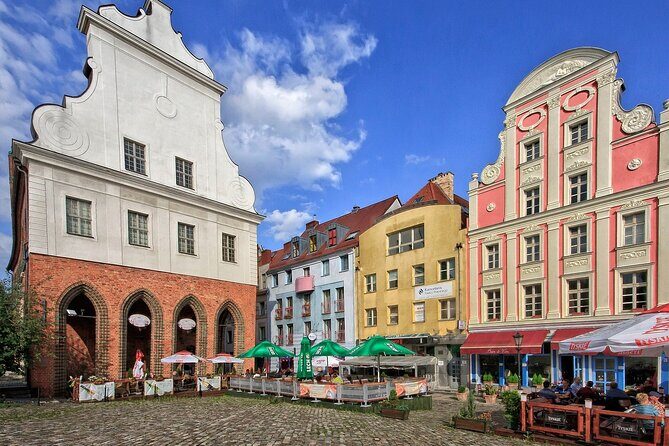
Meeting point: Kino Pionier, al. Wojska Polskiego 2, 70-471 Szczecin. The tour starts at 10:00 am and ends back at the same spot. That matters more than you might think. When a walking tour loops back, you avoid the classic travel headache: figuring out how to get home from a random endpoint.
There’s also a practical advantage to the size cap: with a maximum of 15 travelers, your guide can keep a tight rhythm and still answer questions. If you prefer a tour that moves like a conversation rather than like a lecture, this format usually fits well.
You’ll have a mobile ticket, and you’ll get confirmation at booking time. Service animals are allowed, and the meeting area is near public transportation, so you’re not forced into a long pre-walk just to start your day.
Stop 1: Karłowicz Philharmonic and Modern Szczecin
The tour begins at the Karłowicz Philharmonic, named for Mieczysław Karłowicz, a distinguished Polish composer. Even if you don’t attend a performance, this stop gives you something useful: a sense that Szczecin’s culture isn’t only old stone and old churches. It also has modern architecture with real presence.
This building is designed by architects Alberto Veiga and Fabrizio Barozzi. The point of including it early is smart. It sets a tone for the walk—planned, contemporary design next to older landmarks you’ll see shortly. When your guide points out what to notice (shape, style, and what the building signals about the city), you start looking at details instead of just faces and facades.
The visit is about 20 minutes, with admission listed as free. That’s enough time to get photographs, catch the key background, and move on before the route gets heavy. Drawback? If you’re a serious architecture person, 20 minutes can feel short. But it’s a good teaser, and the guide’s context helps you decide whether you want to return later.
Stop 2: Archcathedral Basilica of St. James the Apostle
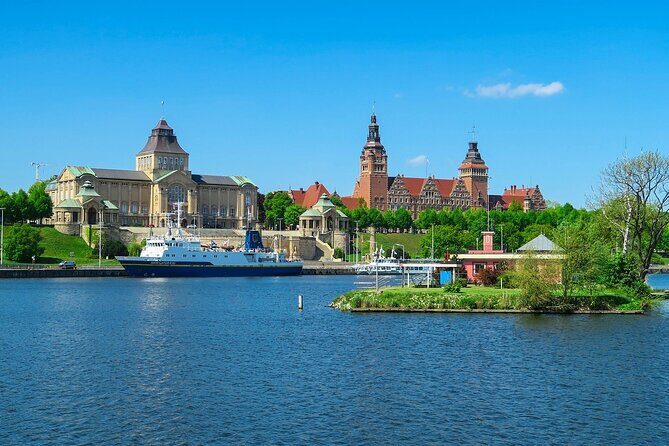
Next comes the Archcathedral Basilica of St. James the Apostle, with origins dating back to the 12th century. Gothic architecture means pointed forms and lots of visual rhythm, and this basilica is known for intricate details and stained glass windows that give color and light a role in the experience.
This stop gives you a different kind of understanding than the philharmonic. You’re seeing how faith and community are built into the city’s physical layout. Even if you’re not religious, it’s still one of the clearest ways to read a city’s priorities over centuries—where people gathered, what traditions lasted, and how aesthetics were used to inspire.
The time on this stop is again about 20 minutes, with admission listed as free. If you like quiet moments, aim to watch the stained glass area from a couple of angles while your guide explains the setting. You’ll be glad you slowed down just a bit here, because the next stops shift back into broader city scenery.
Stop 3: The Pomeranian Dukes’ Castle as a Story Hub
Then you head to The Pomeranian Dukes’ Castle, originally built in the 14th century. The castle’s main value on a walking tour is that it acts like a historical anchor. It helps you connect the earlier spiritual landmark with the later waterfront commerce you’ll see at Lastadia.
You’ll get the overview of how the castle reflects the region’s past and how it evolved over time. Today, it functions as a cultural hub, housing museums, exhibitions, and events that showcase Szczecin’s heritage. Even if you don’t go inside on this specific stop, the exterior sets the stage: you understand why this site matters and what kind of stories you’d expect to find there if you return.
The stop is about 20 minutes and admission is listed as free. Like other timed stops, the advantage is momentum. The tradeoff is that the castle is the kind of place where you could easily spend longer. If you’re the type who loves museums, you’ll probably want to come back after your walk so you can choose the exhibit that truly grabs you.



Lastadia Łasztownia: Oder River Views and Old Maritime Working Life
After the castle, the route shifts toward the Lastadia Łasztownia waterfront district. This is where the walk feels more open. You’re heading to a place shaped by the city’s practical past: cargo handling and shipbuilding, the working side of Szczecin’s relationship with the Oder River.
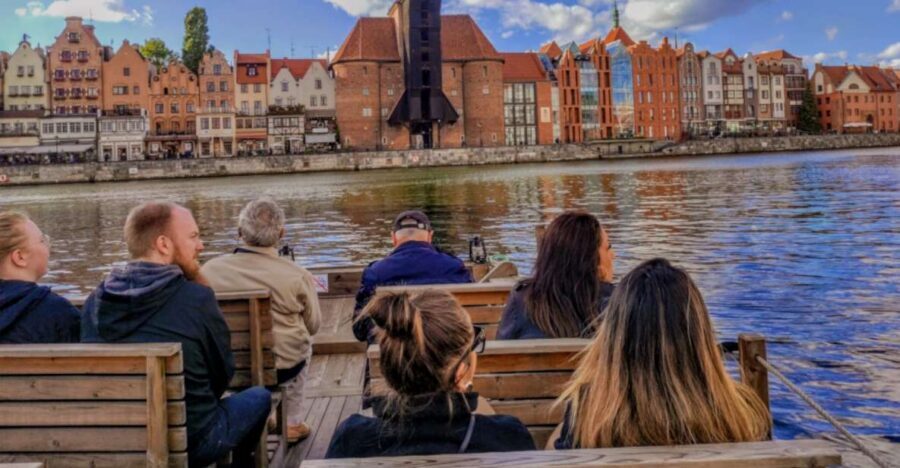
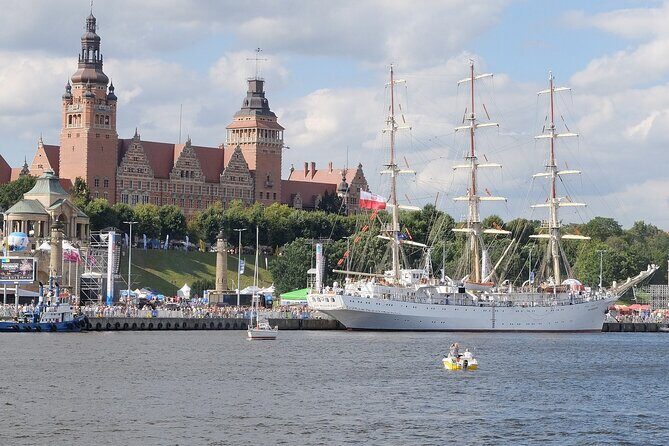
Today, Lastadia is a blend of restored historic warehouses and modern uses. Your guide points out how former maritime functions have turned into spaces for restaurants, cafes, and art galleries. The promenade setting also makes it easy to slow down for views. Expect panoramic scenery over the Oder River and a sense of the district’s maritime personality.
This stop is longer than the earlier ones: about 30 minutes, admission listed as free. That extra time makes sense, because waterfront areas are naturally good for photos and for soaking in atmosphere without rushing. One consideration: if the weather is bad, this is still mostly outdoors, so plan accordingly.
Also, Lastadia can change how you remember the city. Seeing it after churches and a castle makes the timeline feel real: belief, power, and work all occupy space in the same walk.
Wheel of Szczecin: The “Surprise” Finale Area
From here, the tour continues with a few more stops, kept as a surprise for an extra element of fun, and then you reach the Wheel of Szczecin. Even without getting too technical about it, the value of ending near the wheel is practical. It’s a recognizable landmark, and it makes for an easy mental marker: now you know where to find one of the city’s standout modern sights if you want to return.
Your time at this segment is about 30 minutes, with admission listed as free. This stretch is also a good moment to ask your guide what to do next. A good orientation tour is only half the job; the other half is knowing what’s worth your own time afterward.
Small-Group Guide Access: Why Questions Feel Easy
One of the best parts of this kind of tour isn’t what’s on paper—it’s how the guide can respond. With a maximum of 15 travelers, you’re less likely to feel like you’re attending a show where nobody can pause. The route design, with multiple major stops at short visit lengths, also creates natural question moments.
You may also run into different guide styles depending on the departure. One name that comes up is Glenn, with a fun, interactive approach and a good pace for explaining what you’re seeing. The key is that the guide doesn’t just talk at you. They help you interpret the landmarks, and they take time to answer questions when the group is small.
That’s the real payoff: you get clarity faster. Instead of leaving the city with a pile of photos and vague impressions, you leave with names, context, and a sharper sense of where Szczecin’s character comes from.
Price and Tickets: Is $32 Good Value?
At $32 per person, you’re paying for a guided walk plus admission tickets for the listed stops. Since the stops included here have admission listed as free, you’re not paying extra at each location. This matters because some cities love adding entrance fees that quietly multiply your costs.
What you really get for the money is this: a guide who handles navigation and turns landmarks into something you can remember. For a destination like Szczecin, which can be easier to read with context than by yourself, that storytelling piece is the main value.
Is it worth it if you’re comfortable wandering? It can still be worth it, especially if it’s your first time in town and you want orientation without the guesswork. If you already know your way around and don’t care much about history or architecture, you might prefer spending your time on independent exploration. But if you like getting your bearings and leaving with a plan for what to revisit, this price-to-time ratio is solid.
How to Prepare: Simple Tips That Make the Walk Better
This is a walking tour, so the comfort details are the difference between enjoying the city and counting steps. Wear comfortable shoes because you’ll be moving between multiple stops over about 2 hours.
Bring a small camera kit or phone charger because you’ll likely want photos at the philharmonic, the basilica windows, the castle exterior, the Lastadia waterfront, and the Wheel area. If you’re the kind of person who likes reading details, bring a notepad too—your guide’s explanations can give you enough leads to look things up later.
Also, since the tour includes several religious and historic sites, it’s smart to dress neatly enough for indoor areas and to keep your voice low while listening. You’re there to learn and observe, not to rush.
Finally, if you want maximum satisfaction, treat this tour as your first map. After you finish, pick one or two places you liked most and plan to return on your own time.
Should You Book This Szczecin Walking Tour?
I’d book it if you want a fast, guided orientation through Szczecin’s key landmarks and waterfront district, especially if this is your first visit. It’s built for small-group attention, with English explanations, and it bundles free-entry stops with a professional guide. The route also makes sense: you move from culture to faith, to power, to maritime life, then to a modern landmark finish.
Skip it if you need long stays at museums or you prefer to set your own pace without any structured route. With its tight timing, you’ll get context and photos, but not hours of deep exploration.
My bottom line: if you like being guided through a city so you can explore smarter afterward, this is a good way to spend $32 and two hours in Szczecin.
FAQ
How long is the Szczecin walking tour?
It runs for about 2 hours.
What does the tour cost?
The price is $32.00 per person.
Is the tour offered in English?
Yes, the tour is offered in English.
How many people are in the group?
The tour has a maximum of 15 travelers.
Where does the tour start?
The meeting point is Kino Pionier at al. Wojska Polskiego 2, 70-471 Szczecin, Poland.
What time does the tour start?
The start time is 10:00 am.
Does the tour end somewhere else or back at the start?
It ends back at the meeting point.
What’s included in the price?
It includes a professional tour guide, a 2-hour guided walking tour, and admission tickets.
Are any admission tickets free?
Admission tickets are listed as free for the stops on the route.
What is the cancellation policy?
Free cancellation is available up to 24 hours in advance for a full refund.